




Six people. Twelve bags. A flight at 6:55 AM out of Pearson. You’re standing in the hotel lobby at 4:15 AM doing math.
Two Uber XLs is the obvious answer until you check the app and see one of them showing $94 with surge, and the second car is twelve minutes out. Three regular Ubers (because each XL only fits three with luggage anyway) gets you there but splits the group across three vehicles, three drivers, three pickup times, three chances for something to go sideways. By the time everyone’s loaded and rolling, you’ve spent forty-five minutes on the curb in the cold.
There’s a better answer for groups of six to eight people heading to Toronto Pearson, and most Toronto travelers don’t know what it actually costs.
What an airport van taxi is, and why it matters at this group size
A regular sedan taxi seats four passengers and fits four small suitcases at best. An SUV ride-share fits five if you stack bags on laps. Past five travelers with real luggage, you’re splitting the group.
An airport taxi van seats six to eight passengers with luggage room designed for the trip. One vehicle, one driver, one pickup time, one drop-off at the terminal. The math changes at this group size in three ways that matter.
Cost per person drops because you split one flat fare instead of paying multiple ride-share surge prices. Coordination disappears because the whole group leaves and arrives together. Luggage works because the vehicle is specced for it, not improvised on the curb.
For groups under five people, two sedans or an SUV ride-share might still come out cheaper. Past six, the van becomes the right answer almost every time.
What it actually costs to get a group to Pearson
Honest pricing for a group taxi van from the Greater Toronto Area to Toronto Pearson (YYZ) starts around $200 for a downtown pickup, flat rate, no surge pricing.
That figure is a starting point, not a hidden floor. Compare it to the math on splitting a six-person group across ride-shares at 5:00 AM. Three regular Ubers at a typical $45 surge fare each is $135. Two Uber XLs at $80 each (limited XL availability at 5 AM often pushes price up) is $160. A van taxi at $200 flat covers all six in one vehicle, one driver.
The van is $40 to $65 more than the cheapest ride-share split. What you get for that $40 to $65: everyone leaves at the same time, the driver knows the airport, the luggage is sorted, and there’s no surge surprise. For a flight at 6:55 AM, that’s the kind of money worth spending.
The starting price climbs from $200 if your pickup is outside the GTA core (Niagara Falls, Hamilton, Kitchener, Brantford add distance) or if you need a 7 or 8 passenger configuration. Reputable operators publish flat rates on their site so you can see the cost before booking, not after.
The eight international airports inside 300 km of Pearson
Pearson is the obvious destination for most Toronto group travel, but it isn’t the only international airport in the region. Travelers who shop fares carefully sometimes find cheaper flights out of Buffalo or Hamilton, or arrive into a regional Canadian airport and need transfer to the GTA. A good airport van operator covers more than just YYZ.
Within a 300 km radius of Toronto Pearson, there are eight international airports group travelers should know about.
Toronto Pearson International (YYZ) is the main hub. About 50 million passengers a year, two terminals, the busiest airport in Canada. Most group bookings end here.
Billy Bishop Toronto City Airport (YTZ) sits on Toronto Islands, about 30 km from Pearson. Porter Airlines operates international flights to U.S. destinations from here. Some Toronto travelers prefer Billy Bishop for short-haul U.S. trips because the airport is downtown, ferry access takes five minutes, and security lines are shorter.
John C. Munro Hamilton International Airport (YHM) is about 65 km south of Pearson. It handles cargo and a growing roster of leisure carrier flights to U.S. and Caribbean destinations. Hamilton residents and Niagara-region travelers often use YHM for budget flights instead of driving to YYZ.
Region of Waterloo International Airport (YKF) is about 110 km west of Pearson, serving Kitchener-Waterloo, Cambridge, and Guelph. It runs scheduled international service and is convenient for travelers in the K-W tech corridor who want to avoid the Pearson commute.
London International Airport (YXU) is about 190 km southwest of Pearson, serving London and the surrounding region. It runs some seasonal international service plus connections through Toronto and Montreal.
Niagara Falls International Airport (IAG) sits on the New York side of the border, about 125 km from Pearson. It serves the Buffalo-Niagara region with limited scheduled service and seasonal flights. Wedding guests and tourists arriving for Niagara Falls events sometimes use IAG.
Buffalo Niagara International Airport (BUF) is about 150 km from Pearson, just across the border. Buffalo is the airport Toronto travelers cross the border for when U.S. departure fares are significantly cheaper. A Toronto-to-Buffalo round trip by van is a common booking for cost-conscious travelers chasing a $300 fare difference on a transatlantic ticket.
Greater Rochester International Airport (ROC) is about 280 km from Pearson, at the edge of the 300 km radius. Less common for Toronto travelers, but used occasionally for connections to smaller U.S. destinations.
A van operator that handles all eight of these airports gives you flexibility you don’t get from a Toronto-only ride-share. If your group is flying out of Buffalo to save money, or arriving into Hamilton because that’s where the leisure carrier flies, the same vehicle and driver can do the run.
Where the price actually changes
The base rate to YYZ from a GTA pickup starts around $200. What changes the price is mileage, vehicle size, and time of day. Here’s the rough shape of the pricing curve.
A GTA downtown pickup to YYZ runs $200 base. Niagara Falls to YYZ is closer to $300 to $400 depending on operator. Hamilton to YYZ is $200 to $260. Kitchener-Waterloo to YYZ runs $280 to $340. A cross-border pickup at Buffalo BUF to a Toronto drop-off lands at $400 to $550 depending on customs delay risk. Pre-dawn or late-night pickups don’t add surge with a flat-rate operator, which is the entire point of using one instead of ride-share.
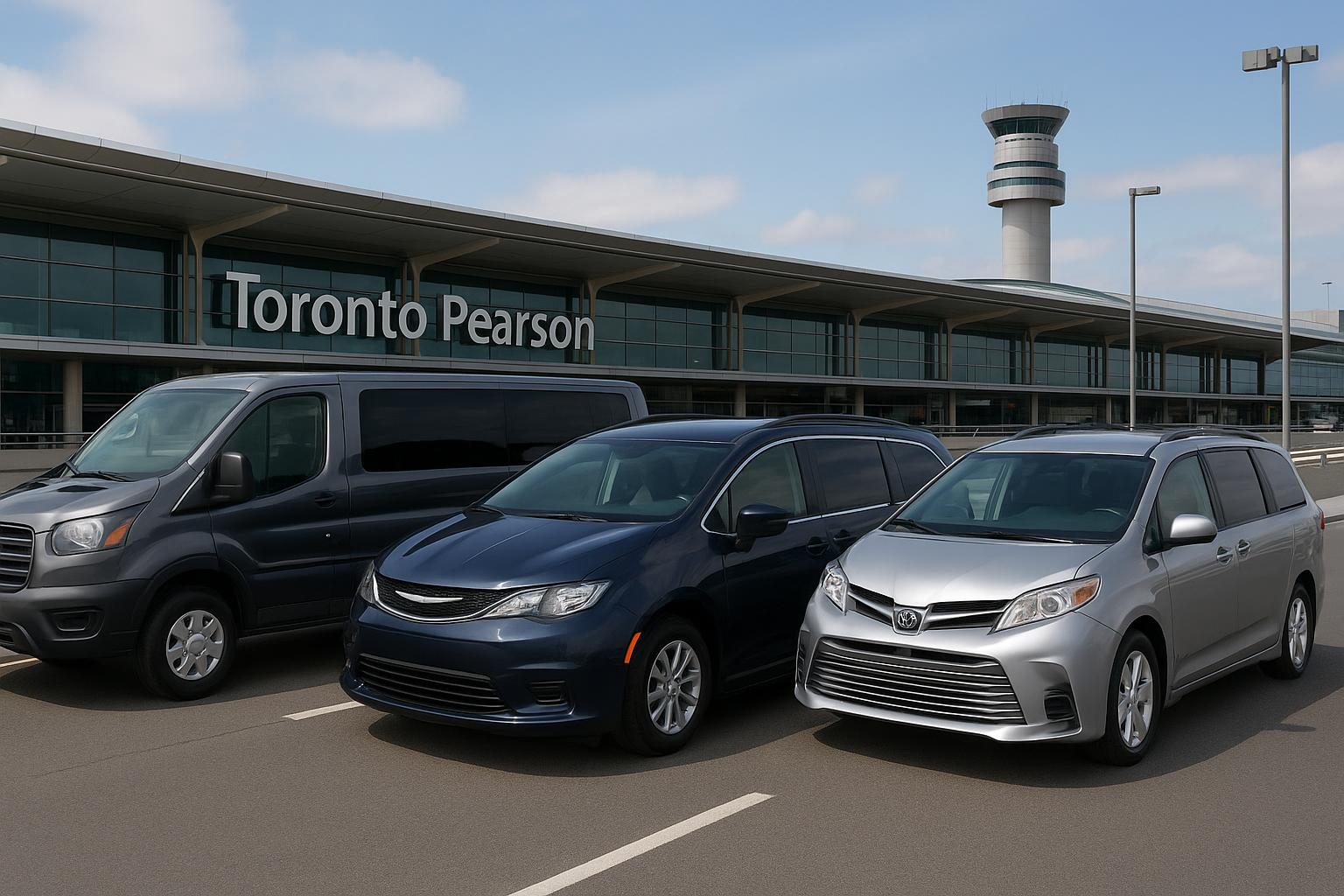
The vehicles operators use for this work are typically 7-8 passenger minivans (Toyota Sienna, Honda Odyssey, Dodge Grand Caravan) or larger sprinter-style vans for groups pushing 10 to 14 passengers with luggage. The sweet spot is six to eight passengers in a clean late-model minivan with a professional driver.
For groups in this size range, airport taxi vans to Pearson and the cross-regional airports above are typically priced as flat-rate bookings with no surge premium at off-peak hours, which is the practical difference from ride-share apps.
How corporate accounts work for recurring airport runs
Companies that move people to Pearson regularly (consulting firms doing client work in Toronto, sales teams flying in for quarterly review meetings, operations teams running site rotations) usually move past one-off van bookings and set up a corporate account with a single operator.
What a corporate account changes in practice.
Billing shifts from per-trip credit card charges to monthly invoicing against an established account. The finance team gets one HST invoice per month instead of fifteen Uber receipts to reconcile against T&E. Travel coordinators book through a designated dispatcher who knows the company’s standard pickup locations and preferred vehicle configurations.
Repeat-trip rates typically negotiate down 10 to 15% from published flat rates when monthly volume crosses a threshold (around 8 to 12 trips per month at most operators). The discount exists because the bookings are predictable and the client-acquisition cost is zero on repeat business.
Designated drivers become an option at higher volumes. Companies that run weekly Toronto-to-Pearson trips for an executive team often request the same driver across bookings, which reduces onboarding friction and improves on-time performance because the driver knows the routine.
For travel managers comparing van operators, the questions to ask are about invoicing format (does it line-item by employee for chargeback?), cancellation policy (is there flexibility for last-minute schedule changes?), and dispatcher availability (is there a single phone line for the company’s bookings, or are you in a general queue?).
Booking notes for group airport runs
A few practical things that change the experience.
The pickup time matters more than the price. A flight at 6:55 AM means you need to be at the curb by 4:45 AM for international, 5:15 AM for domestic. A van taxi quote that doesn’t include a pickup time confirmation is incomplete. Get the time in writing.
Confirmed driver and vehicle. Reputable operators send you the driver name, phone number, and vehicle model the night before. If you’re using a marketplace or app that doesn’t confirm the driver until ten minutes before pickup, you’re back to ride-share-style uncertainty.
Flight tracking. If your inbound flight is delayed by 90 minutes, the driver should know without you calling. Reputable operators track the flight number you give them and adjust the pickup time accordingly.
Cancellation policy. For flights, the standard is 24-hour cancellation for a full refund. Some operators charge a small admin fee inside 24 hours but waive cancellation if the airline cancels the flight. Read this before booking.
Pricing in writing. Flat rate means flat rate. Quotes that include “subject to surcharges” or “fuel adjustment” or “may vary based on demand” are not flat rate. The whole reason to use a van taxi over Uber is predictable pricing.
When the van isn’t the right answer
Two scenarios where ride-share or a smaller car still wins.
A group of four or fewer with carry-on luggage. A single Uber XL or two regular Ubers usually beats the van at this size, and the time difference isn’t large enough to justify the cost gap.
A solo or pair pickup with flexible departure time. A van is built for the coordination problem. If you have no coordination problem (one person, one bag, a flexible time window), ride-share solves it cheaper.
For everyone else, groups of six to eight, families with strollers, wedding parties heading to the airport together, business teams flying out for an offsite, sports teams returning from a tournament, the van is the right call. The math works at this size and the coordination headache disappears.
The takeaway for groups of six to eight
You’re not paying for the vehicle. You’re paying for the certainty that the whole group leaves on time, arrives together, and doesn’t have to think about it. For most Toronto group travel to Pearson, that’s worth $40 to $65 over the cheapest split-Uber math. For cross-regional trips (Hamilton, Niagara, Kitchener, Buffalo), it’s the only real answer because ride-share availability collapses outside the dense GTA.
Eight international airports within 300 km. One vehicle. One flat rate. The right move at this group size, almost every time.