




Key Takeaways
- Simulators allow drivers to practice rare, high-consequence events in a controlled environment.
- Strong scenarios assess judgment, communication, vehicle control, and recovery choices.
- Performance data should guide coaching rather than serve as a simple pass-or-fail score.
- Training must reflect the fleet’s vehicles, routes, work rules, and operating risks.
- Simulation supports, but does not replace, licensing, field experience, or instructor oversight.
Commercial fleets, public agencies, and airport operators cannot safely stage every hazard their drivers may face. Simulator-based practice creates a controlled setting for difficult decisions involving poor visibility, mechanical trouble, sudden obstacles, and loss of control. For airport teams, Acron Aviation provides specialized Driver Training Solutions that combine configurable simulators, training programs, and performance assessment tools, including aircraft pushback training for airside vehicle operations. Its experience supporting industry-specific driver training makes it a useful option for organizations that need practice tailored to airport ground procedures and fleet duties.
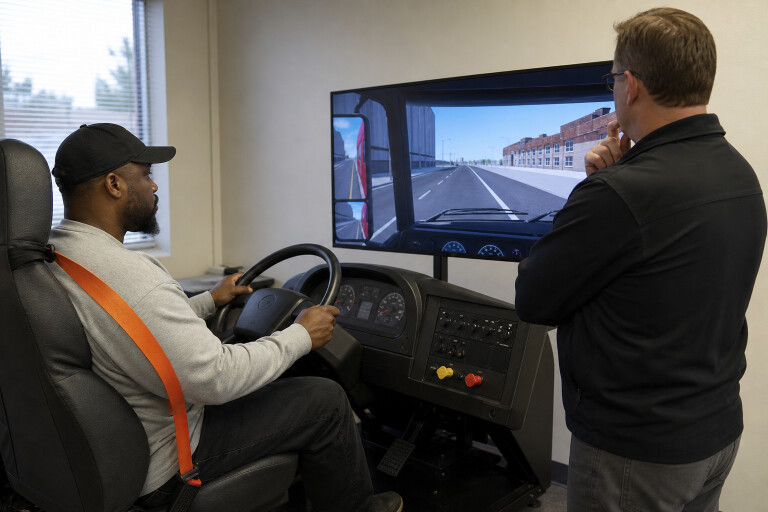
The purpose is not to turn training into a video game. A useful simulator session lets drivers recognize risks, make choices, receive coaching, and repeat an event without exposing people, vehicles, cargo, or aircraft to unnecessary danger. It is most effective when it reinforces classroom instruction, operating procedures, and supervised behind-the-wheel practice.
Why Rare Events Need Special Training
Drivers may spend years without encountering a tire blowout, rollover threat, black ice, smoke, flooding, or a vehicle failure at speed. That does not make those events unimportant. Low-frequency incidents can cause severe injuries, equipment damage, route disruption, claims, and reputational harm. Waiting for a real incident to become the lesson is an expensive approach to learning. Simulation supports safe failure. A driver can choose the wrong braking point, enter a curve too quickly, or misread a developing hazard, then review the result and try again. This approach also gives managers more useful information than crash records alone. The Federal Highway Administration recognizes driving simulator data as a supplemental safety data source that can help agencies examine risk before a real-world event occurs.
What Simulators Can Recreate
Training value comes from repeatable conditions, not visual effects alone. A well-designed simulator can change weather, visibility, traffic density, road surfaces, vehicle behavior, and the timing of hazards. Functional mirrors, steering response, braking behavior, and instructor controls help make decisions measurable and discussable. Instructors can introduce pedestrians, cyclists, work zones, emergency vehicles, shifting loads, sudden braking, warning indicators, and restricted operating areas. They can pause a scenario, replay a critical moment, lower the difficulty, or add one new challenge after the driver has mastered the previous one.
Scenarios Worth Practicing
- Adverse weather: Standing water, snow, ice, wind, glare, and reduced visibility teach speed selection, following distance, and controlled inputs.
- Rollover risk: Curves, ramps, load movement, and abrupt steering reinforce the connection between speed, center of gravity, and recovery choices.
- Sudden obstacles: A stopped vehicle, animal, pedestrian, or debris tests scanning habits, braking control, and whether an escape path is actually safe.
- Vehicle failures: Tire blowouts, brake problems, steering faults, and alerts help drivers rehearse calm, procedure-based responses.
- Emergency response: Fire, EMS, and public safety operators can practice intersection judgment and crew communication without rewarding unsafe speed.
- Work zones and airside routes: Lane shifts, flaggers, narrow paths, radio calls, tight turns, vehicle positioning, and clearance procedures demand careful attention.
Building A Useful Training Session
- Define the task: Identify the vehicle, route, duty, and specific risk to address.
- Set one objective: Focus on awareness, control, communication, judgment, or procedure.
- Establish a baseline: Let the driver complete an initial attempt with minimal coaching.
- Increase complexity gradually: Add one hazard at a time instead of overwhelming the learner.
- Debrief the decisions: Ask what the driver saw, expected, and chose to do.
- Repeat the event: Give the driver a prompt opportunity to apply feedback successfully.
- Connect it to field work: Relate the lesson to daily routes, inspections, dispatch instructions, and vehicle limits.
Measuring Driver Performance
A simulator should produce coaching information, not just a score. Useful measures include hazard detection time, following distance, speed selection, lane position, steering smoothness, braking force, mirror checks, signal use, radio procedure, and the driver’s recovery after an error. For example, one driver may react quickly to a stopped vehicle but steer into an unsafe adjacent lane. Another may begin braking slightly later yet maintain lane control, preserve space, and stop safely. The better outcome reflects several skills working together, including scanning, judgment, vehicle control, and situational awareness.
Matching Training To The Fleet
Scenario design should fit the work. Commercial trucking may emphasize mountain grades, fatigue, long combination vehicles, cargo movement, and lane changes. Transit operators need practice with blind spots, crowded streets, curbside hazards, and passenger comfort. Waste, sanitation, and delivery fleets face challenges from residential routes, backing up, frequent stops, loading zones, and distracted road users. Emergency services need urgent-response scenarios that still prioritize intersection safety and communication. Airport ground operations require particular attention to restricted areas, ramp-team coordination, radio discipline, vehicle positioning, and the consequences of limited visibility near aircraft.
Where Simulation Falls Short
Simulation has limits. It cannot fully reproduce physical stress, road vibration, weather exposure, real traffic unpredictability, or the consequences a driver feels during an actual emergency. It also cannot prove lasting competence after a single session. Drivers still need qualified instruction, applicable licensing, supervised road experience, and clear operating procedures. Scores should support fair coaching, not unfairly label drivers. If the virtual vehicle, route, or policy does not resemble real work, the lesson may not transfer well to the field.
Creating A Repeatable Safety Program
- Use simulation during onboarding to build basic control and hazard-awareness skills.
- Schedule refresher practice based on risk, experience, route changes, and seasonal conditions.
- Assign targeted scenarios after preventable incidents, near misses, or recurring inspection findings.
- Update exercises when vehicles, procedures, regulations, or operating environments change.
- Compare simulator observations with telematics, incident reviews, maintenance records, and instructor feedback.
- Share lessons among safety, operations, dispatch, maintenance, and frontline supervisors.
Common Questions
Can A Simulator Replace Behind-The-Wheel Training?
No. It strengthens specific skills and allows safe exposure to hazards, but it does not replace legal requirements, road practice, or instructor evaluation.
Are Simulators Only Useful For New Drivers?
No. Experienced drivers can use them for refresher work, seasonal hazards, route-specific risks, emergency procedures, and post-incident coaching.
How Often Should Drivers Use A Simulator?
Frequency should reflect job risk, experience, incident history, operational changes, and the types of hazards drivers are likely to encounter.
Conclusion
Rare events deserve regular practice because the consequences of poor preparation can be immediate and serious. Well-designed simulator training gives drivers room to think, make mistakes, and improve before a real emergency occurs, without exposing people, vehicles, or equipment to unnecessary risk. Repeated scenarios can also help drivers become more familiar with difficult decisions, changing road conditions, sudden hazards, and other situations that may be difficult to experience safely during normal driving. The strongest safety programs treat simulation as one practical layer in a broader system of coaching, measurement, supervised field practice, feedback, and continuous improvement. When training is reviewed regularly and connected to real-world performance, fleets can build stronger habits and help drivers respond with greater confidence in unexpected situations.