




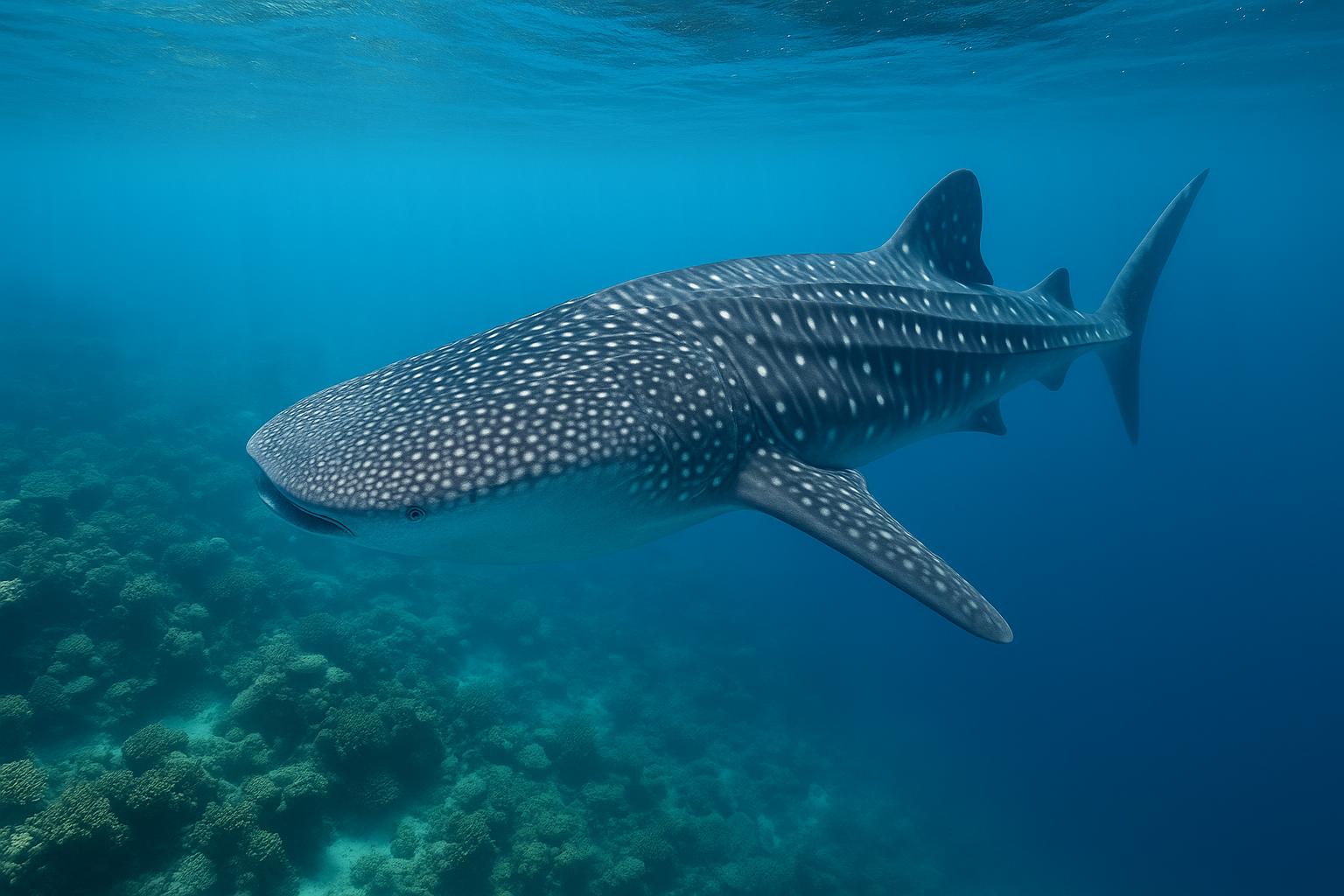
Somewhere between 300 and 500 whale sharks turn up along a single stretch of Western Australian coastline every year. It is the largest gathering of the species documented anywhere on the planet, and it happens roughly a kilometre off a beach you can drive to. That single fact explains why swimming with whale sharks has become one of the few genuinely world-class wildlife encounters left on the Australian bucket list — and why people fly halfway across the world for a day trip out of a town of a few thousand people.
Ningaloo Reef stretches around 260 kilometres down the west coast of the Exmouth peninsula, and unlike most reef systems, it sits close enough to shore that you are in open water within twenty minutes of leaving the boat ramp. The Ningaloo Coast was inscribed on the World Heritage list in 2011, partly on the strength of that whale shark aggregation.
What follows is a practical look at how the season works, what the day on the water actually involves, and the rules that keep the whole thing sustainable — the sort of detail that tends to get skipped in the highlight reels.
Why This Stretch of Coast Beats Almost Everywhere Else
Whale sharks are found across the tropics, but reliability is the problem. Plenty of destinations get sightings; far fewer get them predictably enough to build a season around.
Ningaloo does, for a few connected reasons:
- Mass coral spawning. After the autumn spawning event, the water column fills with plankton and fish eggs. Whale sharks are filter feeders, and they follow food.
- The reef sits near-shore. One of the longest fringing reefs in the world runs right alongside the coast, so boats reach the drop-off fast and spend more of the day looking rather than travelling.
- Spotter aircraft. Most vessels work with a light aircraft overhead. A shark visible from 500 feet is a shark you can be dropped in front of, rather than one you stumble across.
- Decades of accumulated knowledge. Skippers here have been reading the same water for thirty-odd years. That local knowledge is not a marketing line — it is the difference between three encounters and none.
The animals themselves are worth understanding before you get in. Whale sharks are the largest fish alive, commonly eight to ten metres at Ningaloo and occasionally larger. They have no interest in you whatsoever. They filter plankton through gill rakers, they cruise at a walking pace, and the biggest risk on the day is not the shark it is you being unfit to keep up with one.
They are also in trouble. The species was reassessed as Endangered on the IUCN Red List in 2016, with a decreasing global population. Regulated tourism is now one of the more useful things happening for them, because the boats double as a data-gathering fleet and give the animals measurable economic value alive.
Reading the Season: When to Book
The season runs from around March through to August, and in some years the sharks hang about into September or October. That is a wide window, and the experience is not identical across it.
Early season, from March into April, is the ramp-up. Numbers are building, water is warm, and the crowds have not arrived. It can be brilliant or it can be quiet you are betting on the spawning event doing its job.
The core of the season, roughly April through to July, is the safest bet. Sightings are at their most consistent, conditions are usually settled, and the operators are in full rhythm. If you only get one shot at this, book here.
Late season, August onwards, is the interesting part. Whale shark numbers begin to taper, but the humpback migration is in full swing, and Ningaloo is one of a small handful of places on earth where in-water humpback interactions are legally permitted. A late-season day can hand you both.
A few booking realities worth knowing:
- Build in a buffer. Weather cancels days. If you have one morning in Exmouth, you have one roll of the dice. Give yourself three.
- Ask about the no-sighting policy. Reputable outfits will offer a free return trip or a partial refund if the day comes up empty. Get it in writing.
- Book earlier than feels necessary. Peak-season berths on the better boats go months ahead, and the number of licensed vessels is capped.
If you want to see how a full day is structured, inclusions and all, it is worth reading through a licensed whale shark swim tour departing from Exmouth before you compare prices the cheap option and the good option are rarely the same boat, and the itinerary tells you which one you are looking at.
What Swimming With Whale Sharks Actually Involves on the Day
Boats generally leave early. You will be on the water by mid-morning, and the first part of the day is usually a shallow snorkel inside the reef partly because it is beautiful, and mostly because the crew needs to see who can actually swim.
That assessment matters more than people expect. Once the aircraft calls a shark, things move quickly, and the crew has to know who to put in which group.
Then you wait. This is the part nobody photographs: an hour or two of the vessel idling while the spotter works a grid overhead, everyone in wetsuits, watching the horizon. It is not boring, exactly, but it is not action either.
When the call comes, the sequence is tight and rehearsed:
- Your group moves to the back of the boat, fins on, mask down.
- The vessel positions ahead of the shark's line of travel, well off to the side.
- On the guide's word and only then you slide in and swim to a marker.
- The shark comes to you.
That last point is the one that surprises people. You do not chase a whale shark. You get placed in its path and wait, face down, and a fish the length of a bus materialises out of the blue and passes underneath you. Most encounters last a minute or two. Then the boat picks you up, repositions, and the next group goes in.
A good day gives you three or four of those passes. Between them you are hauling yourself up a ladder, catching your breath, and grinning at strangers.
The Rules That Keep It Working
Western Australia regulates in-water whale shark interaction tightly, and the rules are not suggestions they are licence conditions, and crews enforce them without much patience for negotiation.
The core code of conduct:
- Distance. Swimmers must stay no closer than three metres from the head or body, and four metres from the tail. That tail is powerful and the animal cannot see behind itself.
- Ten in the water. No more than ten people may be in the water with a shark at any one time, which is why boats split guests into groups.
- No touching, no riding, no blocking. You do not touch the animal, restrict its movement, or approach from behind.
- No flash, no poles, no scooters. Flash photography, extension-pole cameras and motorised propulsion aids are all out.
- Vessel zones. A 250-metre radius applies around each shark. The first boat in may work the animal for up to 90 minutes at six knots or less, staying at least 30 metres off; other vessels hold back at 250 or 400 metres depending on their position in the queue.
Only operators holding a departmental licence may run these tours commercially. If a deal looks suspiciously cheap or the boat seems to be doing whatever it likes near an animal, that is a red flag rather than a bargain.
Guides also collect identification photographs on many trips. Every whale shark carries a unique pattern of spots behind the gills, which functions like a fingerprint, and those images feed research databases tracking individual animals across years and oceans. Your holiday snap can end up as a data point.
Choosing Who to Go Out With
Every licensed boat is working to the same rulebook, so the price of swimming with whale sharks clusters fairly closely across operators. The real differences sit elsewhere. Things worth asking before you hand over a card:
- Is there a dedicated spotter aircraft, or is it shared across several boats? Shared spotting means queuing behind other vessels.
- How many guests on board? Fewer passengers means fewer groups, which means more in-water time each.
- What is the guide-to-swimmer ratio? You want someone in the water with your group, not shouting from the duckboard.
- What happens if you do not find one? See the no-sighting policy above.
- Are photographs included? You cannot hold a camera and swim properly at the same time. Onboard photography is worth more than it sounds.
- What is the food and gear situation? A long day at sea on a dry sandwich and a leaking mask is a long day.
Read recent reviews with a filter on. Anyone who saw four sharks will rave; the useful reviews are the ones from a bad-weather day, because they tell you how the crew behaves when the day goes sideways.
Getting Yourself Ready
You do not need to be an athlete, but this is not a float. Sensible preparation:
Swim fitness. You need to be able to snorkel hard for a minute or two, repeatedly, in open water with a bit of chop. If you have not swum in years, do a few laps in the weeks beforehand. It changes the day entirely.
Practise with a mask and snorkel. Learning to clear a mask while a whale shark approaches is a waste of a whale shark. Most operators will let you trial gear in the shallow snorkel use it properly.
Seasickness. Take something the night before and again in the morning, not when you start feeling ordinary. The boats hold position for long stretches, which is the worst-case motion for most people.
Sun. This is the tropics on open water in a reflective environment. Reef-safe sunscreen, a rash vest, a hat with a strap, and more water than you think you need.
Camera expectations. Whale sharks are big, water absorbs light, and phones in cheap housings produce blue mush. Either invest properly or let the onboard photographer handle it and simply look at the animal.
One more thing: leave the itinerary loose on either side. Exmouth is a long way from anywhere, the weather does what it likes, and the people who come away disappointed are almost always the ones who gave themselves a single morning.
The Part That Stays With You
The strange thing about swimming with whale sharks is that the scale does not really register while it is happening. You are busy kicking, breathing, watching the guide, keeping your distance. It lands later, usually that evening, when you realise you spent the afternoon within a few metres of the largest fish on earth and it barely acknowledged you.
That is the appeal, in the end. Not adrenaline. Something closer to perspective.
Ningaloo remains one of the most reliable and best-managed places on the planet to have that experience, and the management is the reason it is still reliable. The distance rules, the ten-swimmer cap, the licensing, the vessel queues none of it exists to spoil the day. It exists so that the aggregation still turns up in thirty years' time.
Book inside the season, give yourself more than one day, choose the boat rather than the price, and get your swimming up to scratch. The reef will handle the rest.