




How to Translate Modern English to Old English
Translating Modern English into Old English can be complex, but understanding the key differences in grammar, vocabulary, and structure makes it manageable. Old English, spoken from 450 to 1150 AD, is a highly inflected language with flexible word order, unlike Modern English, which relies on fixed word order. Here’s a quick breakdown:
- Grammar: Old English uses cases (nominative, accusative, genitive, dative, and instrumental) to define the grammatical role of words. Nouns have genders (masculine, feminine, neuter), and adjectives must agree with nouns in case, number, and gender.
- Vocabulary: Old English words are mostly Germanic, with many compound words and poetic devices like kennings (hronrad for “sea”). About 85% of Old English vocabulary has been lost in Modern English.
- Word Formation: Compounding and affixation were common, while influences from Latin and Old Norse introduced new terms.
To translate effectively:
- Analyze the sentence structure: Identify subjects, objects, and other grammatical roles.
- Find word equivalents: Use tools like the Bosworth-Toller Anglo-Saxon Dictionary for accurate Old English terms.
- Apply grammar rules: Add correct case endings and ensure agreement between words.
Modern tools like AI-powered translators can simplify the process by handling grammar and vocabulary, but manual translation offers greater precision for academic or detailed work. Always verify translations against historical texts and use reverse translation to ensure accuracy.
Old English Language Basics
Understanding Old English is key to accurate translation. Unlike Modern English, which depends on fixed word order, Old English uses inflections to signal grammatical roles. This means a word’s form can shift depending on whether it’s acting as the subject, object, or possessor in a sentence. Below, you’ll find essential grammar rules and insights into vocabulary formation to help with translation.
Old English has five grammatical cases: nominative (subject), accusative (direct object), genitive (possession), dative (indirect object), and instrumental (means or method). These cases define a word’s role in a sentence. Additionally, nouns are classified as masculine, feminine, or neuter, and these genders don’t always align with modern expectations. For instance, sēo sunne (sun) is feminine, se mōna (moon) is masculine, and þæt wīf (woman/wife) is neuter . Adjectives must match the nouns they describe in case, gender, and number, and they follow either a strong (indefinite) or weak (definite) declension pattern .
Grammar Rules in Old English
The inflectional nature of Old English allows for flexible word order, with grammatical roles indicated by case endings. Nouns, pronouns, adjectives, and determiners all change form to reflect their function in a sentence. This flexibility means you might see a Subject-Verb-Object (SVO) structure in one sentence, a Subject-Object-Verb (SOV) structure in another, or even verb–subject inversion after adverbs like þa (then) or nu (now) .
Old English verbs fall into two main groups: strong verbs and weak verbs. Strong verbs form their past tense by altering the root vowel through a process called ablaut, while weak verbs add a dental suffix, such as -de or -te . Strong verbs are further divided into seven classes based on their vowel patterns . Interestingly, Old English also includes a dual form for first- and second-person pronouns, used specifically for referring to exactly two people .
Vocabulary and Word Formation
Old English vocabulary, largely Germanic in origin, features about 34,000 recorded word forms in the Thesaurus of Old English . Most words are short – one or two syllables – with stress typically on the first syllable, a hallmark of Germanic languages . While roughly 85% of Old English words have fallen out of use, the surviving core vocabulary still includes essential terms related to family, the human body, and nature .
Word formation in Old English often relied on compounding. By combining two existing words, speakers could create more specific terms. For example, sǣ (sea) and mann (man) combine to form sǣmann (sailor) . In poetry, metaphorical compounds known as kennings were common – bānhūs (“bone-house”) referred to the body, while swanrād (“swan-road”) described the sea . Affixation also played a role, with prefixes like un- indicating negation and suffixes altering word classes. Additionally, Latin introduced words linked to Christianity and scholarship, while Old Norse contributed everyday terms, including some pronouns and modal verbs . This Norse influence helped simplify Old English’s complex inflectional system, setting the stage for the more straightforward structure of Modern English.
Manual Translation Process
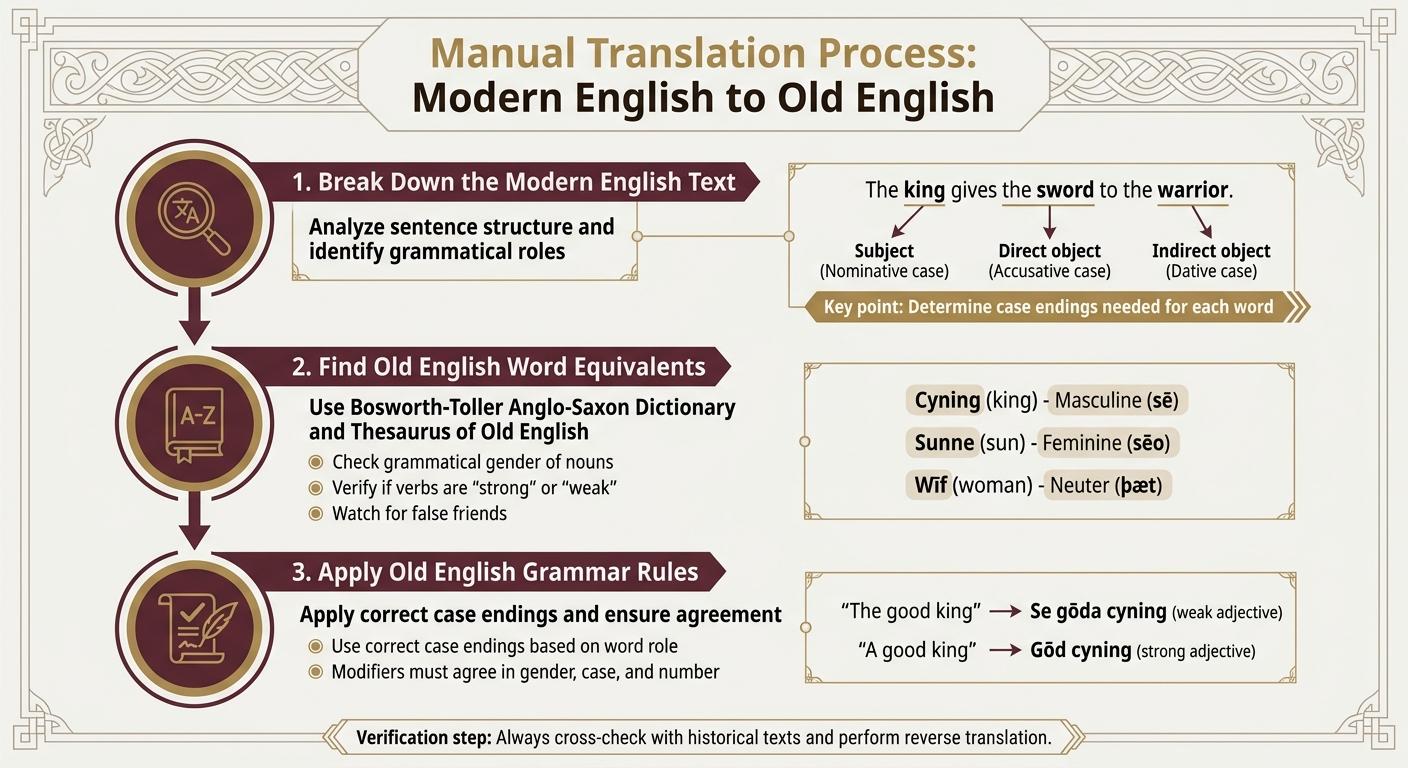
3-Step Process for Translating Modern English to Old English
This section outlines how to manually translate Modern English into Old English, building on the grammar and vocabulary basics of Old English. The process involves carefully selecting the right Old English words and applying the correct grammatical inflections. As Professor Daniel Paul O’Donnell points out:
“A Modern English translation actually has two translations built into it: a translation of the Old English words into Modern English words, and a translation of Old English inflections into Modern English word order” .
The steps below break this process into clear, actionable stages, building on the grammatical groundwork discussed earlier.
Step 1: Break Down the Modern English Text
Start by analyzing the sentence structure of the Modern English text. Identify the grammatical role of each word – whether it’s the subject, direct object, indirect object, or possessor. For example, in the sentence “The king gives the sword to the warrior”, the roles are as follows:
“King”: Subject (Nominative case)
“Sword”: Direct object (Accusative case)
“Warrior”: Indirect object (Dative case)
This analysis helps determine the case endings each word will require in Old English. Once the sentence structure is clear, you can move on to finding the Old English equivalents.
Step 2: Find Old English Word Equivalents
Use resources like the Bosworth-Toller Anglo-Saxon Dictionary to locate accurate Old English words . Another helpful tool is the Thesaurus of Old English, which includes approximately 34,000 word forms – though this is much smaller than the 80,000 words found in a typical modern dictionary . Pay close attention to the grammatical gender of nouns, as this affects related words. For example:
Cyning (king): Masculine (sē)
Sunne (sun): Feminine (sēo)
Wīf (woman): Neuter (þæt)
Additionally, watch for whether verbs are classified as “strong” or “weak”, as this dictates how their past tense forms. Be cautious of false friends – Old English words that resemble Modern English words but have different meanings. For example, bēor doesn’t refer to modern beer but a different type of alcoholic drink .
Step 3: Apply Old English Grammar Rules
Once you’ve identified the Old English words, apply the appropriate grammatical rules. Use the correct case endings based on the word’s role in the sentence (e.g., nominative for subjects, accusative for direct objects) . Modifiers must also agree with their nouns in gender, case, and number. For example:
“The good king”: Se gōda cyning (weak adjective ending -a after the determiner se)
“A good king”: Gōd cyning (strong adjective form without a determiner)
Although Old English word order can resemble Modern English, inflectional endings often make the meaning clear, allowing for more flexible word arrangements . As Professor O’Donnell explains:
“To speakers of Old English… word order was only one clue to a sentence’s grammatical sense – and even then not necessarily the most important: a speaker of Old English would pay as much or more attention to a word’s inflections” .
Using Old English Translator for Faster Results
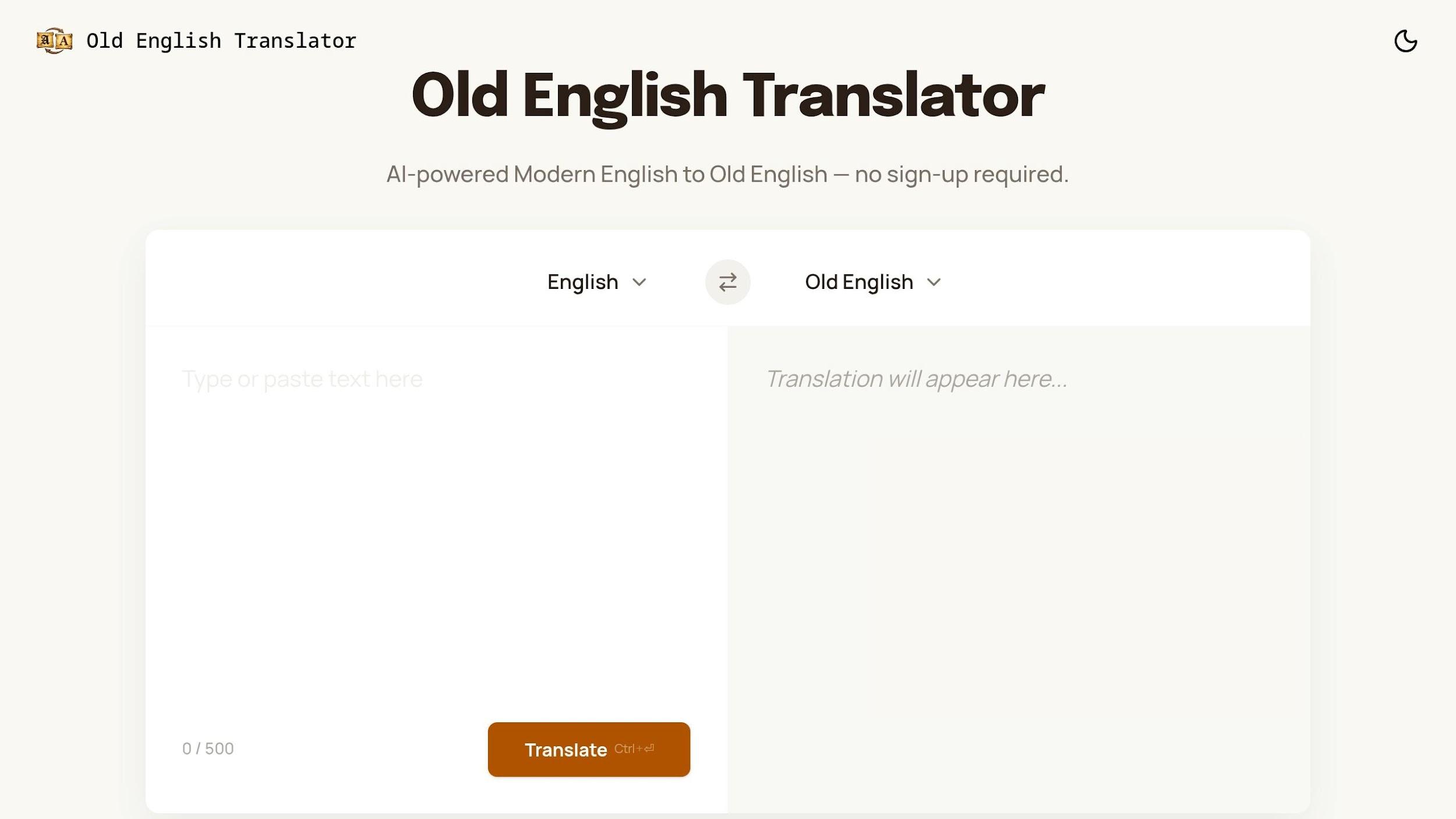
If you’re diving into Old English, whether for research or personal interest, modern AI tools can save you a ton of time while still delivering accurate results. While manual translation offers unmatched precision, it’s slow and requires extensive expertise. Enter Old English Translator, an AI-powered tool designed to make the process faster and more accessible. Instead of simply swapping words, it examines entire phrases to ensure both grammatical correctness and the authentic feel of Anglo-Saxon language.
This tool uses cutting-edge AI techniques like Low-Rank Adaptation (LoRA) and backtranslation. By pairing Old English texts with AI-generated Modern English, it creates strong parallel datasets, which significantly enhance translation quality. The results speak for themselves: BLEU scores for English-to-Old English translations have jumped from 26 to over 65 – a massive improvement.
How to Use Old English Translator
Using the tool is simple and doesn’t even require an account. Just paste or type your Modern English text into the input box (up to 5,000 characters, or roughly 1,000 words, at once). To get the best results, write clearly and avoid overly complex idioms, as these may lack direct Old English equivalents. If you’re copying text from a webpage, clean it up first by removing HTML tags and extra spaces.
For added customization, the tool offers advanced settings. You can tweak the formality level to match the historical tone you’re aiming for, whether casual or ceremonial. Want to go all-in on authenticity? Enable features like “thee/thou” pronouns and Old English verb endings like “-eth” (e.g., “hath” or “goeth”). If you’re working on a larger project, like a novel or screenplay, you can save your settings as presets to maintain a consistent style throughout your work[16]. For academic or highly specialized projects, it’s a good idea to double-check the AI’s output against historical dictionaries or consult an expert.
Dr. Rachel Kim, a linguistics specialist, shared her thoughts on the tool:
“Impressed by the accuracy and contextual awareness. This tool shows a deep understanding of language evolution and historical linguistics.”
Manual vs. AI Translation Methods
| Feature | Manual Translation | AI-Powered Translation |
|---|---|---|
| Speed | Slow and requires extensive research | Instant results |
| Accuracy | Extremely high with expert input | High, but may need occasional review |
| Complexity | Requires deep knowledge of grammar | Handles complex grammar automatically |
| Flexibility | Limited to the translator’s skillset | Offers adjustable settings and styles |
| Cost | Expensive, often requiring professionals | Free or low-cost |
Choosing between manual and AI-powered translation depends on your goals, timeline, and expertise. Here’s a quick breakdown of how each approach stacks up:
Manual translation is the gold standard for academic work, offering precise control over every detail. However, it demands both time and expertise. On the other hand, AI-powered tools like Old English Translator are perfect for creative projects, learning, or when speed is a priority. They handle grammar complexities with ease and deliver results in seconds, making them a great option for most users.
Checking and Improving Your Translations
Once you’ve chosen the right words and applied the necessary grammatical rules, the next step is ensuring your translation is accurate. This step is critical because Old English’s intricate system of inflections means even a minor error – like an incorrect case ending – can completely alter the sentence’s meaning. Even seasoned translators need to double-check their work against historical sources and assess its logical consistency.
Compare with Historical Old English Texts
One of the best ways to confirm the authenticity of your translation is to reference actual Anglo-Saxon texts. The Bosworth-Toller Anglo-Saxon Dictionary is an invaluable resource, offering examples of how words were used in their original context, not just their definitions .
For a deeper dive, explore digitized manuscripts like the Beowulf manuscript (Cotton Vitellius A.xv) housed at the British Library or the Anglo-Saxon Chronicle available at the Parker Library. These historical texts provide insight into authentic spelling, syntax, and sentence structure. For instance, in Old English, verbs in subordinate clauses are usually placed at the end. If you’re working on poetry, make sure to incorporate stylistic elements like kennings (e.g., hronrad for “sea”) and alliterative verse patterns, which are hallmarks of works such as The Wanderer or The Seafarer.
This comparative step sets the stage for the next crucial technique: reverse translation.
Test Reverse Translation Accuracy
A highly effective way to check your translation is through reverse translation – converting your Old English text back into Modern English. As Professor Daniel Paul O’Donnell explains:
“A Modern English translation actually has two translations built into it: a translation of the Old English words into Modern English words, and a translation of Old English inflections into Modern English word order.”
When performing a reverse translation, start by translating each word individually. Then, confirm that the inflections correctly establish grammatical relationships. For example, an accusative marker in Old English clarifies the intended object, which can significantly affect the sentence’s meaning regardless of word order .
Be mindful to avoid modern terms like “very” or “just”, as they didn’t exist in Old English. Also, ensure that adjectives and articles match the gender of the noun they modify. For instance, the word for “woman” (wīf) is grammatically neuter, not feminine . If your reverse translation results in swapped subjects and objects or changes the intended meaning, revisit your case endings to address any errors immediately.
Conclusion
Translating Modern English into Old English requires a deep understanding of its unique structure and grammar. This article has explored practical methods – from manually dissecting sentence structures to using advanced AI tools – that can help achieve accurate translations. Old English, as a fully inflected Germanic language, relies heavily on morphology, where word endings convey meaning regardless of word order.
Using a manual approach provides full control over every nuance, making it ideal for academic research or maintaining historical accuracy. However, this method demands time, effort, and expertise. Tools like Old English Translator offer a quicker solution, delivering translations that handle complex inflections while allowing adjustments for specific historical contexts, making this ancient language more accessible to a wider audience.
Regardless of the method, verification is key. Cross-check translations with trusted resources like the Bosworth-Toller Anglo-Saxon Dictionary or historical texts such as Beowulf and the Anglo-Saxon Chronicle. Performing a reverse translation – transforming Old English back into Modern English – can further ensure your work’s accuracy.
With only about 400 surviving manuscripts and roughly 3.5 million recorded words , translating Old English is more than just a linguistic exercise; it’s a way to reclaim a piece of history. Whether you’re delving into creative writing, academic studies, or exploring personal heritage, blending grammatical precision with modern tools and thorough validation will help you create translations that respect and preserve the essence of this ancient language.
FAQs
Which Old English dialect should I use?
The Anglo-Saxon dialect, spoken between the 8th and 11th centuries, is considered the most fitting form of Old English for use. This version, heavily influenced by Germanic roots, is featured prominently in classic works such as Beowulf and the Anglo-Saxon Chronicles. If you’re aiming for historical accuracy in translations – whether for academic research, creative endeavors, or personal projects – this dialect provides the closest connection to the authentic Old English language.
How do I choose the correct case ending for a noun?
To pick the right case ending in Old English, start by identifying the noun’s role in the sentence: is it the subject (nominative), the direct object (accusative), showing possession (genitive), or the indirect object (dative)? Once you know the function, consider the noun’s gender (masculine, feminine, or neuter) and whether it’s singular or plural. Then, use the appropriate declension pattern to find the correct ending.
Context matters, too. Demonstratives (like “se” or “þæt”) can help clarify the case, especially when endings overlap or look similar. Because Old English relies heavily on inflection, paying close attention to these details is key to understanding and using the language properly.
How can I tell if an AI translation is historically accurate?
To determine if an AI translation aligns with a specific historical period, pay attention to its use of vocabulary, grammar, and syntax from that era. Cross-check the translation against trusted historical dictionaries or original texts from the time. Although AI tools are trained on authentic materials, manual verification remains crucial to catch any modern language elements that might slip through and conflict with the historical context.