




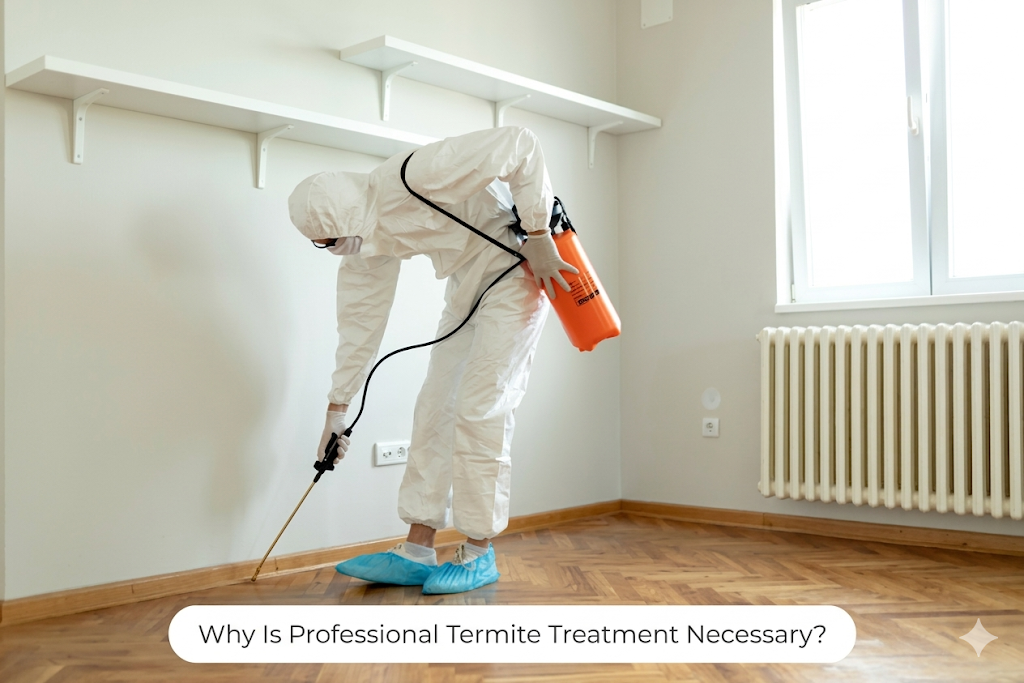
One morning, you wake up to discover small heaps of what appears to be sawdust around your walls. You do not pay attention at first. But a couple of days after that, the frame of your door is conspicuously empty, and all of a sudden, that innocent dust does not appear so innocent anymore.
Here’s the fact: termites do not simply pay a visit to your house; they quietly eat its core. And by the time you notice the damage, it is often serious.
This is something you cannot afford to ignore as a homeowner, property manager, or even a renter. And in this article, you will learn why professional termite treatment is not only useful but a must, how it helps safeguard your home, and what might otherwise occur when you use DIY solutions instead.
Let’s dive in.
1. Termites Are Silent Destroyers You Can’t Easily Detect
Termites might already be inside your home, but you don’t see them. That’s because they are hidden behind the scenes, in the walls, under the floors, and in wooden furniture.
Homeowners in regions such as San Diego often face a higher risk of hidden termite infestations, as the consistently warm climate creates ideal conditions for these pests to thrive throughout the year.
Unlike other pests, termites do not leave any visible signs at first. Hollowness of wood, tubes of mud, and cracks in the buildings can be months or even years old when you finally discover them.
With this in mind, many property owners in the area don’t take chances once they suspect a problem. They understand that dealing with termites requires more than surface-level solutions; it demands local expertise and a deeper understanding of how these pests behave in San Diego environments.
As a result, many homeowners rely on professional exterminators in San Diego who are familiar with termite activity, nesting patterns, and the region’s subtle warning signs.
Here is the key: timely diagnosis is everything. Experts use high-tech devices such as moisture meters, infrared cameras, and trained inspection methods to detect termites before they cause colossal damage.

2. DIY Treatments Only Scratch the Surface
DIY termite remedies may sound tempting. They are less expensive initially, readily available, and fast to produce.
The problem is that most store-bought treatments have a catch: they kill only the visible termites. They don’t eliminate the colony.
And that is a large issue.
Termite nests may harbor thousands, perhaps millions of insects, and these may be deep in the ground or concealed in the walls of your house. Destroying several termites at the surface would not help in stopping the queen and the rest of the colony from proceeding with their destruction.
Professional treatments, on the other hand, aim at the origin. Specialists employ special techniques such as:
- Entrapment systems to kill whole colonies
- Soil treatments to form protective barriers
- Direct long-term protection of wood treatments
The professionals are also aware of the most effective method to use for each type of infestation. Such accuracy is far beyond the reach of DIY.
3. Termite Damage Can Be Extremely Expensive
Want to know something shocking? Termites cause billions of dollars in property damage worldwide every year.
And the worst part? Most insurance policies don’t cover termite damage.
That is, when termites damage your flooring, walls, or foundation, you are not compensated; you are paying out of pocket.
Imagine this: a small, insignificant infestation is increasing. What could have been a simple treatment becomes a thousand-dollar structural repair.
Professionally administered termite treatment can save you from that nightmare.
Investing in professional services at the start-up level is a safeguard for your home’s value. It’s not just about removing pests; it’s about preventing costly damage before it happens.
Think of it this way: a small investment today can pay off in the future to a great extent.
4. Professionals Provide Long-Term Protection
Professional termite treatment is a long-term solution rather than a one-time solution.
Professionals not only eliminate existing termites but also install barriers to prevent future infestations. This may include:
- Regular inspections
- Preventative treatments
- Monitoring systems
And guess what? Many companies offer warranties or aftercare services that provide you with some assurance even after treatment is complete.
DIY solutions lack such security. Once the product is used, you’re on your own. But with professionals, you are creating a long-term defense mechanism for your home.
5. Safety Matters More Than You Think
Let’s talk about something people often overlook: safety.
Termite treatments contain chemicals that, when misused, may be detrimental to you and your family and even your pets.
Handling them yourself can cause:
- Overexposure
- Incorrect application
- Environmental contamination
The professionals are trained to administer these treatments safely and effectively. They also adhere to strict rules to ensure your home is safe during termite removal.
Here’s the point: home protection should not come at the expense of your health.
6. Every Home Needs a Customized Treatment Plan
No termite treatment is the same.
Some homes might contain underground termites, and others might contain drywood termites. Management of the two types is totally different.
This is why a universal solution is not applicable.
Professional exterminators evaluate your case and develop a special plan based on:
- The type of termites
- The extent of infestation
- Your home’s structure
- Environmental factors
This individualized method ensures maximum effectiveness. DIY methods? They depend on guesswork, and with termites, there should be no guesswork.
Final Thoughts: Protect Your Home Before It’s Too Late
Termites don’t wait until you take some action. They toil silently and steadily and inexorably. The more time you take, the more property they damage.
Professional termite treatment is not only a service but also an intelligent investment in the security, property value, and durability of your home.
If you’ve noticed signs of termites or even if you just want to be proactive, now is the time to act. Waiting until minor damage becomes a major disaster is not a good idea.
Because when it comes to termites, the question isn’t if they’ll cause damage, but how much.