




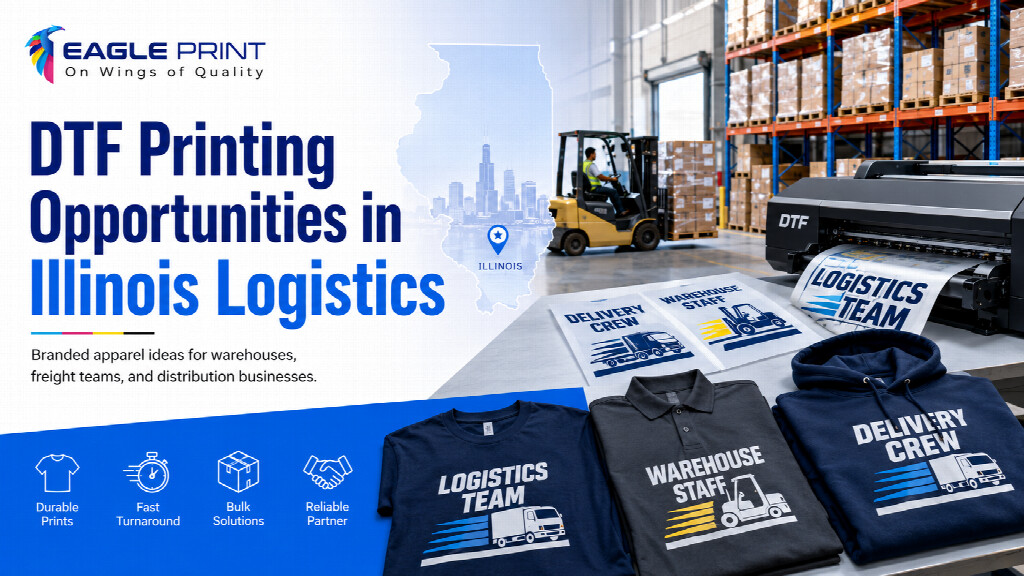
Illinois is built for movement. Warehouses, freight companies, distributors, delivery operations, third-party logistics providers, manufacturers, and transportation businesses form a large part of the state’s commercial landscape.
For apparel sellers and print businesses, that creates a market that is easy to overlook.
Logistics companies do not only move products. They hire people, open facilities, attend recruiting events, recognize employees, launch safety campaigns, meet customers, sponsor community programs, and represent their brands across multiple locations.
Each of those moments can create a reason for printed apparel.
That makes the logistics sector an interesting B2B opportunity for businesses working with DTF printing in Illinois.
The key is not to sell “DTF transfers” as a technical product. It is to understand what a logistics company is trying to accomplish and build the apparel offer around that need.
Why Illinois Logistics Stands Out
Illinois has one of the strongest transportation and distribution ecosystems in the country, supported by interstate highways, rail connections, airports, warehouses, freight operations, and a central geographic position. State economic planning documents identify transportation, distribution, and logistics as a major Illinois growth industry.
For an apparel seller, that means the potential customer base goes far beyond trucking companies.
Potential buyers can include:
- warehouses and fulfillment centers;
- freight and transportation companies;
- third-party logistics providers;
- distribution centers;
- local delivery businesses;
- manufacturing operations with shipping teams;
- recruiting and staffing firms serving logistics employers.
These businesses may have very different apparel requirements, which is exactly why a flexible decoration model can be useful.
Sell the Business Need
A common mistake in B2B apparel sales is leading with the printing technology.
A warehouse manager usually does not wake up thinking, “I need DTF.”
The real need may be:
“We have a recruiting event next month.”
“We are opening another location.”
“We need shirts for an employee recognition program.”
“Our customer-facing team needs branded apparel.”
“We are sponsoring a community event.”
Those are buying triggers.
The print method comes later.
Instead of advertising only transfer sizes, colors, or production capabilities, an apparel business can package its offer around situations the customer already understands.
That shifts the conversation from printing a shirt to solving a business requirement.
Find Repeatable Apparel Moments
Logistics operations create several predictable moments where apparel can play a role.
A new facility opening may require branded apparel for launch activities. Hiring campaigns may use shirts during recruitment events. Company anniversaries can support commemorative merchandise. Driver or employee recognition programs may create periodic apparel projects.
Customer meetings, community sponsorships, trade events, and corporate gatherings can create additional demand.
The opportunity is not necessarily one enormous order.
The stronger opportunity is becoming the business that understands these different moments and can help the customer prepare artwork before the need becomes urgent.
That makes the relationship more useful than simply waiting for someone to request “100 shirts.”
Build an Artwork System
B2B customers often need consistency more than endless creative variation.
A logistics company may have a primary logo, department identifiers, location names, campaign graphics, anniversary artwork, and recruiting messages.
Those files should not become one disorganized collection of slightly different designs.
A cleaner system separates them by purpose.
| Artwork Type | Typical Use |
|---|---|
| Core company logo | General branded apparel |
| Location version | Facility-specific apparel |
| Recruiting design | Hiring events and campaigns |
| Recognition graphic | Employee programs |
| Event design | Temporary company activities |
The benefit is operational clarity.
When the next apparel need appears, the seller already knows whether existing artwork can be reused or whether a new design actually needs to be created.
Think Beyond One Garment
Another mistake is treating every B2B customer as a T-shirt customer.
A company may want different apparel for different occasions. Lightweight shirts may make sense for one campaign, while hoodies or other compatible garments may make sense for another.
The seller should therefore separate two decisions:
What message needs to appear?
What garment makes sense for this specific use?
That approach keeps the artwork strategy stable while allowing the apparel selection to change.
It also makes conversations with customers easier because they are choosing products according to a business purpose rather than browsing an unlimited catalog.
Choose a Production Partner
Once an apparel seller begins targeting business accounts, production reliability matters more.
The seller needs to know where artwork will come from, how transfers will fit the planned garments, what application instructions apply, and how production deadlines connect to the customer’s actual event or campaign.
Working with an Illinois DTF company can become one part of that production system.
The important point is to establish the workflow before the first urgent business order arrives.
A simple process can be:
Customer need → approved artwork → garment choice → transfer planning → production → quality check → delivery
That is much easier to manage than rebuilding the process for every job.
Turn Industry Scale Into Opportunity
Illinois’ logistics economy is large enough that apparel businesses do not need to market to every possible customer.
A better strategy is to choose a narrow segment and learn how it buys.
One seller might focus on local warehouses. Another might work with transportation companies. Another could specialize in recruiting-event apparel for employers that hire frequently.
That specialization makes outreach more specific.
Instead of saying, “We print custom shirts,” the business can approach prospects with an offer that sounds like it was designed for their actual operation.
For Illinois apparel sellers, that may be the bigger lesson.
DTF printing is the production tool.
The real opportunity is understanding which Illinois businesses have a reason to use it.