




Digital platform engineering now operates under strict performance boundaries. Users demand immediate file access, zero visual lag, and uninterrupted real-time updates. Legacy web architectures built around standard HTTP request-response cycles can no longer support these operational demands. When traffic surges, traditional origin servers experience CPU saturation, database connection bottlenecks, and packet queuing delays.
Solving these performance bottlenecks requires a fundamental shift in infrastructure design. Modern digital asset delivery platforms must combine edge computing, persistent bidirectional transport protocols, and granular state synchronization. By replacing monolithic processing paths with event-driven microservices, technology teams achieve deterministic performance even during extreme concurrency bursts. Building a resilient, low-latency infrastructure requires aligned optimization across transport, caching, and state management layers.
Section 1: Low-Latency Architecture and Real-Time Synchronized State
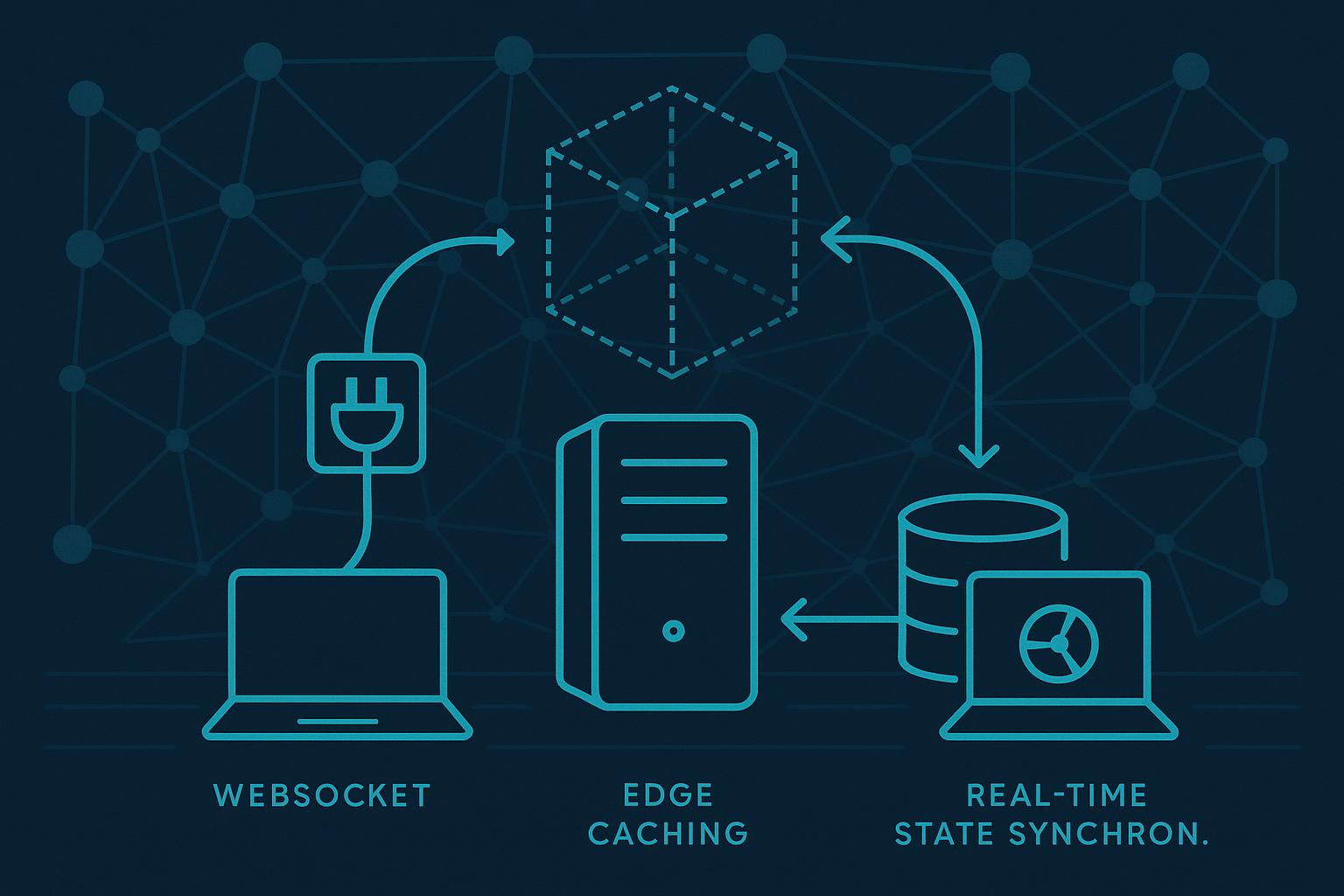
Reducing network transmission times requires moving beyond standard polling methods. HTTP short polling generates massive header overhead and exhausts server socket pools. Long polling reduces request counts but still suffers from connection establishment latencies. High-throughput digital networks rely on persistent WebSocket connections or HTTP/3 transport layers to establish full-duplex communication channels over a single TCP or QUIC connection.
Persistent connections allow servers to push binary data payloads and state changes to client interfaces instantaneously. In-memory data structures, such as Redis or Dragonfly instances, act as real-time broker layers between the database and the connection gateways. Rather than querying disk-backed stores for every user action, the system maintains application state entirely within RAM. The application backend calculates state changes and broadcasts compressed state deltas to connected endpoints, drastically cutting bandwidth usage and network serialization time.
To understand high-concurrency state synchronization in practice, platform engineers often analyze high-frequency micro-applications that calculate and stream live state updates to thousands of simultaneous connections. A prime example of this operational architecture can be seen on this website, which hosts an instant game engine built around real-time multiplier curve generation and sub-50-millisecond client state updates. The platform utilizes lightweight client-side Canvas rendering alongside persistent WebSocket event loops to ensure that every participant observes identical mathematical data points at exact millisecond increments. In this deployment model, server nodes compute state trajectories continuously and broadcast compressed state deltas to edge endpoints. This design minimizes network overhead, eliminates buffering lag, and preserves deterministic execution across globally distributed client devices.
Managing real-time connection pools requires robust backpressure controls and heartbeat algorithms. When network congestion occurs on client devices, frames queue up in memory. Efficient systems monitor socket buffer levels and implement adaptive message dropping for non-critical visual frames while guaranteeing the delivery of transactional state packets. Connection gateway nodes must also maintain lightweight reconnect handshakes to restore state seamlessly if a mobile client switches network interfaces.
Section 2: Edge Distribution, Micro-Caching, and Scalable Infrastructure
Distributing large media files, software packages, or digital assets requires a optimized Content Delivery Network (CDN) topology. Relying solely on a central origin server introduces geographic network latency and single-point-of-failure risks. Modern edge distribution relies on Anycast routing to direct user requests to the nearest Point of Presence (PoP). Edge compute scripts running directly on CDN nodes execute authentication, header manipulation, and payload transformations before traffic reaches core infrastructure.
Static digital assets benefit from long-term edge caching paired with immutable content-addressable storage identifiers. Dynamic real-time data, however, requires micro-caching techniques. Micro-caching stores dynamic API responses or state snapshot payloads at the edge node for fractions of a second, typically between 100 and 500 milliseconds. This brief retention window satisfies hundreds of identical simultaneous requests during traffic spikes while ensuring users receive fresh data. Database query loads drop dramatically, protecting core database clusters from cascading failures.
Horizontal scalability requires intelligent traffic shaping at the ingress tier. Load balancers must utilize least-connection or IP-hash routing algorithms tailored to the protocol in use. For HTTP/3 and WebSocket traffic, sticky sessions must be managed through distributed session registries rather than hard binding clients to individual server instances. This isolation ensures individual node failures do not corrupt active user sessions. When scaling out, connection draining protocols allow nodes to offload active connections gracefully during maintenance windows without causing client-side timeouts.
Client-side execution efficiency is equally critical for perceived speed. High-frequency network packets can quickly overwhelm main UI threads if client-side parsing is unoptimized. Offloading data processing, JSON parsing, and state computations to Web Workers prevents main-thread blocking. Client applications can process incoming data streams in background threads and render visual updates efficiently using non-blocking browser animation frameworks.
Conclusion: Engineering for Next-Generation Platform Reliability
Achieving sub-second performance across global user bases requires precise architectural discipline. Infrastructure leaders must move away from heavy request-driven patterns toward lean, event-driven transport systems. Combining persistent WebSocket channels, edge compute nodes, and micro-caching strategies creates an infrastructure capable of handling high-concurrency loads with high stability.
Optimizing system performance is an ongoing process of measurement and refinement. Technology teams must establish strict latency budgets, monitor real-time tail latencies (p99 metrics), and test network degradation scenarios regularly. By prioritizing low-overhead data transport and distributed processing, digital platforms maintain seamless operation, preserve user trust, and scale efficiently against growing traffic demands.