




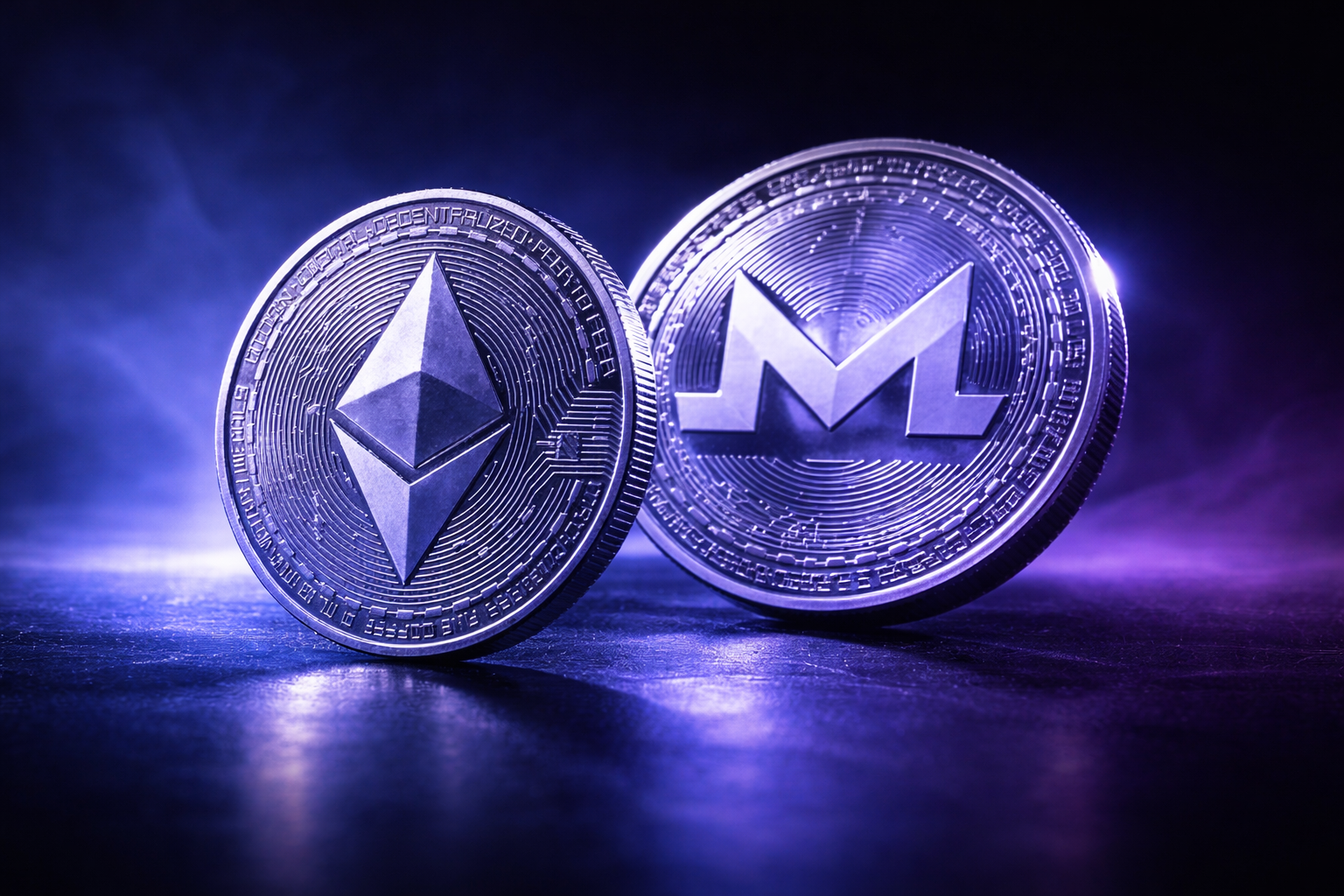
Ethereum and Monero support different profit models rather than competing in the same role. Ethereum’s returns are tied to staking, DeFi usage, and layer‑2 activity on a transparent, programmable stack. Monero’s profitability comes from mining‑driven issuance, a deflation‑leaning curve, and the premium markets place on privacy‑protected, fungible transfers.
How Profitability Splits Between ETH and XMR
Ethereum’s profit in 2026 comes mainly from protocol‑level activity. Staking yields stay modest, typically in the low‑single‑digit annual range, while DeFi‑driven strategies can push effective returns higher at the cost of added risk from impermanent loss and smart‑contract exposure.
Monero’s measurable profit remains tied to mining. Since 2022, the network emits about 0.6 XMR per block, creating a predictable, low‑inflation base. For small miners, daily returns depend on CPU hashrate, electricity cost, and XMR price; under representative conditions, home rigs can realize on the order of a few cents to a few dollars per day.
Within this setup, an ETH to XMR swap becomes a tool to move capital from a yield‑oriented, transparent stack into a more privacy‑oriented, mining‑backed layer. It does not change the underlying mechanics of either network but shifts the operational context of the assets—from high‑visibility, fee‑heavy activity toward a more opaque, fungibility‑driven environment. For many users, this swap is less about chasing narrow spreads and more about rebalancing when regulatory pressure, tax‑reporting complexity, or the need for unlinkable transactions outweigh the benefits of open‑ledger activity.
Where Swaps Fit Into the Picture
Platforms that support this kind of cross‑asset conversion generally emphasize:
- Speed: most conversions settle from minutes to under an hour, depending on network congestion.
- Non‑custodial or light‑custody flow: address‑to‑address mechanics, minimal KYC, and clear status tracking, which aligns with the privacy‑oriented use case.
- Transparent rate preview: upfront visibility into how much Monero a given amount of Ethereum will buy, including fees and slippage.
Functional Roles in a Strategy
Ethereum tends to behave as a yield‑oriented base layer, where income mainly comes from staking and DeFi‑driven flows, while Monero functions more like a privacy‑weighted buffer, with steadier returns tied to mining economics and selective demand spikes.
ETH suits participants who:
- prioritize protocol‑driven income with relatively liquid, transparent exposure.
- accept higher on‑chain visibility in exchange for broader ecosystem access.
XMR suits participants who:
- value fungibility and operational anonymity over deep liquidity.
- tolerate slower, more cyclical price movements in exchange for potential resilience under regulatory pressure.
From this perspective, a move from ETH into XMR becomes a concrete way to shift capital allocation rather than follow speculative narratives: moving from a high‑activity, yield‑oriented stack into a more privacy‑oriented, mining‑backed rail, calibrated to how each user weighs regulation, surveillance, and long‑term capital preservation.
Market Context and Positioning
Monero and Ethereum anchor non‑overlapping parts of the ecosystem. Ethereum underpins the high‑throughput, transparent layer where most DeFi volume, liquidity, and NFT‑related activity concentrate, either on‑chain or via L2s. The same visibility that supports liquidity also exposes it to on‑chain analytics, regulatory scrutiny, and reporting‑driven friction, which raises the cost of anonymous or non‑KYC‑bound usage.
Monero, in contrast, remains anchored in the privacy‑focused niche. It does not compete on throughput or smart‑contract flexibility but relies on ring‑signatures, stealth addresses, and obfuscated amounts to reduce transaction‑level linkability. The trade‑off is lower throughput, fewer liquidity venues, and more cyclical pricing in exchange for stronger default anonymity.
Privacy vs Performance Trade‑Offs
Within this framework, Monero’s position overlaps with other privacy‑oriented and performance‑driven protocols. Comparisons such as Monero vs Solana 2026 emphasize that Monero’s design prioritizes privacy and fungibility over raw speed and throughput, while Solana‑style networks focus on low‑cost, high‑throughput settlement with a transparent ledger.
This kind of analysis clarifies how different networks trade off key properties:
- Monero
- Ethereum‑style ecosystems
For participants assessing ETH and XMR, such comparisons show how privacy‑driven assets like Monero are being evaluated against both high‑performance chains and more transparent stacks, reshaping expectations around utility and risk‑adjusted returns.
Positioning in a Strategy
From a practical standpoint, each coin fits a distinct role that does not repeat earlier descriptions of their core profit mechanics:
- Ethereum
- Monero
Many participants combine both, routing most of their capital through the transparent, high‑throughput stack while reserving Monero‑based rails for privacy‑sensitive flows. This approach reflects the way privacy‑driven chains like Monero are integrated into broader strategies not as yield competitors to Ethereum, but as a purpose‑built layer for specific risk and privacy requirements.
Scenario‑Based Profit Potential
The distinction between ETH and XMR by 2026 hinges less on “which is better” and more on which scenarios align with each coin’s return profile. Three scenarios—base, optimistic, and stress—capture the core dynamics without relying on speculative price targets.
Scenario Comparison Table
| Scenario | Context | Ethereum (ETH) | Monero (XMR) |
|---|---|---|---|
| Base case | Stable market, moderate growth | Staking and DeFi‑driven yields remain modest but stable; ETH benefits from liquidity and ecosystem depth. | Mining‑driven issuance continues at a predictable rate; XMR gains from niche privacy demand but stays more cyclical. |
| Optimistic case | Privacy‑driven rally | High‑throughput, compliant solutions expand; ETH grows with broader capital inflows into DeFi and tokenized assets. | Privacy‑driven flows pick up, pushing XMR’s price and mining‑driven returns higher; exchange‑related friction amplifies volatility. |
| Stress case | Regulatory pressure rises | Transparent‑ledger characteristics expose ETH holders to higher reporting‑related friction; some flows shift toward private rails. | Monero faces liquidity squeezes and exchange‑driven constraints, but its fungibility‑oriented design reinforces its role as a niche hedge. |
Positioning by Risk Profile
From a practical standpoint, the choice between ETH and XMR aligns with different risk and visibility preferences:
- Ethereum suits users who:
- Monero suits users who:
In this framework, a move from ETH into XMR acts as a risk‑allocation shift rather than a pure yield‑driven move: transferring exposure from a high‑visibility, yield‑oriented stack into a more privacy‑oriented, mining‑driven layer whose returns depend on mining‑related economics and the evolving regulatory environment.
Risk, Regulation, and Liquidity Constraints
Ethereum and Monero operate under divergent risk profiles shaped by their design and ecosystem role. Ethereum’s exposure centers on regulatory‑driven reporting and DeFi‑linked friction, while Monero’s is driven by liquidity‑driven constraints and privacy‑driven scrutiny.
Ethereum’s Main Risks
- On‑chain visibility makes ETH flows easier to track, which raises regulatory and reporting‑related friction.
- Most ETH‑linked returns tie into DeFi protocols and L2‑integrated structures, which can amplify contagion risk during liquidity‑driven events or protocol‑specific shocks.
- Ongoing upgrades and L2‑related changes create opportunities for higher‑yield structures but also expose participants to new smart‑contract‑based attack surfaces.
Monero’s Main Risks
- Several major venues have limited or delisted XMR, shrinking the number of regulated on‑ramps and exit routes and pushing liquidity toward more decentralized or privacy‑oriented channels.
- This structure can raise slippage and execution costs during periods of high demand, while Monero’s design attracts regulatory and political pressure on infrastructure that interacts with it.
- Mining‑related friction remains a key factor: Monero is largely ASIC‑resistant, but local mining‑driven shifts and hardware‑related costs (electricity, depreciation, hashrate changes) introduce volatility for small‑scale miners.
How Risk Influences Exposure
From a risk‑management standpoint, these profiles translate into distinct exposure patterns:
- Ethereum exposes participants more to regulatory‑driven reporting friction and DeFi‑linked contagion, while offering access to deeper liquidity and broader ecosystem‑level yield.
- Monero exposes participants more to liquidity‑squeezes, exchange‑related constraints, and privacy‑driven political friction, while offering stronger protection against certain surveillance‑driven pressures.
The choice between ETH and XMR becomes less about chasing raw upside and more about aligning exposure to the kinds of risk participants are willing to tolerate, without relying on speculative narratives or unverifiable performance claims.
Where Profitability Actually Lies
By 2026, Ethereum’s higher aggregate returns come with on‑chain visibility and DeFi‑linked risk, while Monero’s slower, more cyclical returns come with stronger privacy‑driven insulation. For those who accept transparency and regulatory friction, ETH tends to dominate; for those who prioritize fungibility and privacy over liquidity and ecosystem breadth, XMR becomes a more targeted, if narrower, tool. The choice ultimately depends on how participants balance yield, visibility, and risk rather than which coin promises the largest headline gain.
FAQ
1. Is Ethereum or Monero more profitable to hold in 2026?
Ethereum usually offers higher aggregate returns through staking and DeFi; Monero provides slower, more privacy‑oriented exposure with more cyclical price behavior.
2. What makes an ETH to XMR swap useful in practice?
It moves capital from a transparent, yield‑oriented stack into a more privacy‑oriented, mining‑backed layer, mainly for regulatory or surveillance‑driven rebalancing, not narrow arbitrage.
3. Can small miners still make meaningful income from Monero in 2026?
Small miners can earn a few cents to a few dollars per day, depending on hashrate, electricity cost, and XMR price; meaningful income requires low‑cost power and efficient, long‑running hardware.
4. Why does Ethereum still dominate in returns despite its transparency?
Ethereum’s staking yield and DeFi‑driven income scale with liquidity and ecosystem depth, outweighing its on‑chain visibility and regulatory‑driven friction for most participants.
5. How does regulation affect the profit potential of XMR vs ETH?
Ethereum faces more reporting‑related friction and DeFi‑linked risk; Monero faces liquidity‑squeezes, exchange constraints, and political pressure, but gains demand in privacy‑driven environments.
6. When does it make sense to combine ETH and XMR in a portfolio?
When you want ETH for liquidity, yield, and DeFi, and XMR for privacy‑sensitive, low‑frequency flows. The split depends on how much visibility and regulation you are willing to tolerate.
7. Is choosing between ETH and XMR mainly about chasing price vs privacy?
No: it’s about aligning exposure to yield, visibility, and risk. ETH favors those who accept transparency for higher returns; XMR favors those who prioritize fungibility and privacy over liquidity.
Disclaimer
This article is for informational purposes only and does not constitute financial or investment advice. Cryptocurrencies are highly volatile and carry significant risk, including the risk of losing your principal. Regulatory and market conditions can change at any time. Always do your own research and consult a qualified professional before making any investment decisions.