




The App Is Rarely the Real Problem
There is a moment nearly every growing business runs into. The mobile app that felt fast and dependable in its first year starts to falter. Screens hang during peak hours. Payments time out. Sync errors show up in support tickets that never existed before.
The instinct is to blame the app. Teams redesign screens, trim animations, and ship performance patches. Sometimes that helps for a week or two.
The symptoms live in the app. The cause almost always lives behind it.
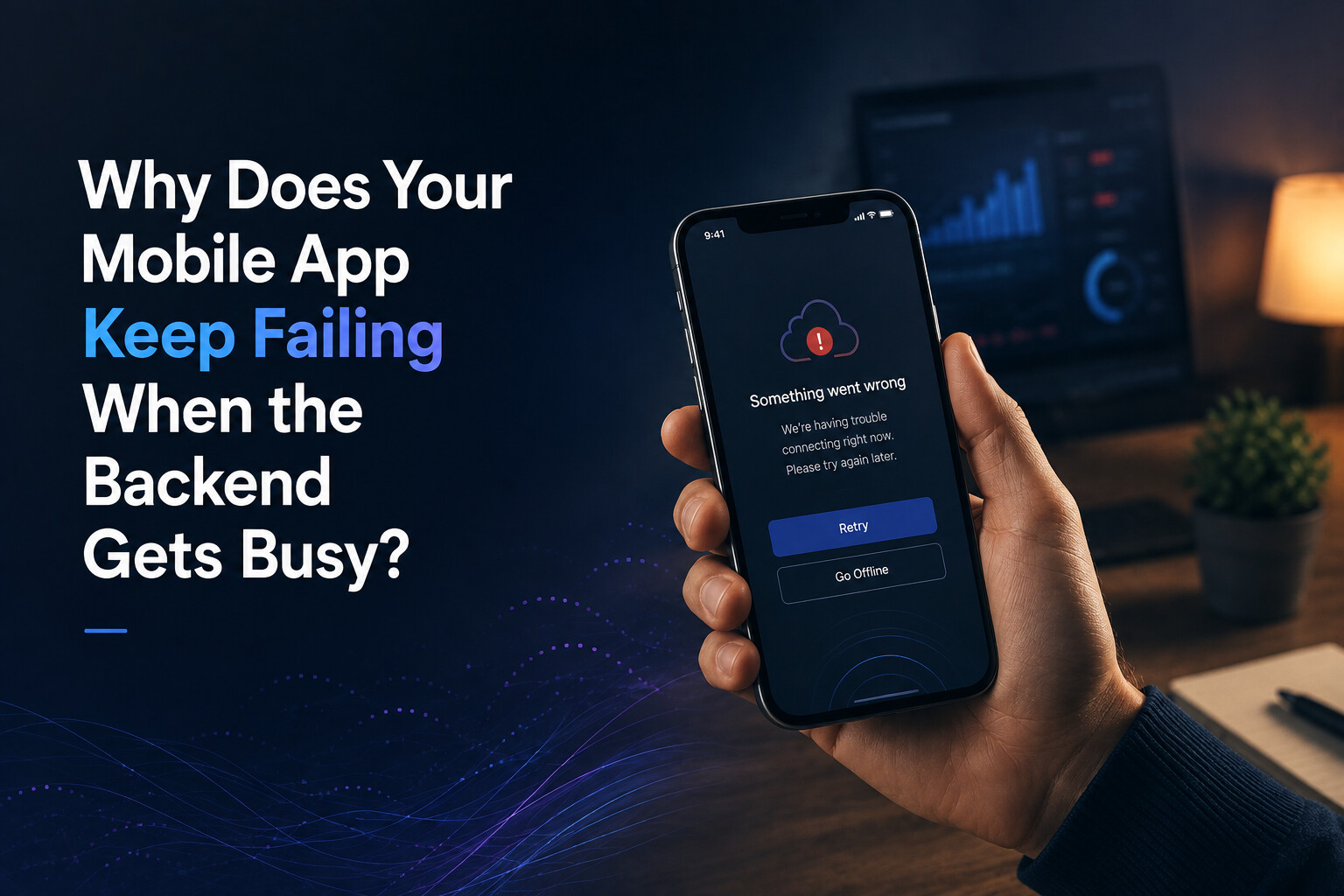
When concurrent traffic rises, the backend becomes the constraint. Database connections queue, APIs slow down, and the mobile client simply relays that delay to the user as a spinner. This is why organizations planning for scale now begin their custom mobile application development services engagements with architecture conversations rather than interface mockups.
For decision-makers, the stakes here are commercial before they are technical. A three second delay at checkout is a conversion problem. An outage during a campaign launch is a wasted marketing spend problem. A sync failure in a field service app is an operations problem measured in missed appointments.
Growth also multiplies complexity in ways that are easy to underestimate. Every integration, analytics pipeline, and intelligent feature adds load to systems that were sized for a smaller business. Companies commissioning custom AI software development services discover this quickly, because inference workloads and data processing place unusually heavy demands on infrastructure that was never designed to carry them.
The pattern is consistent. Applications do not fail because they were built badly. They fail because they were built for the business as it existed, not the business it was about to become.
What Actually Defines an Enterprise-Grade Application
The phrase “enterprise-grade” gets used loosely. In practice it describes five measurable properties.
Scalability means the system absorbs a traffic increase without a rewrite. Adding capacity should be a configuration decision, not an engineering project.
Security means access control, encryption, and audit trails are designed in from the start. Retrofitting security into a live application is expensive and frequently incomplete.
Performance means predictable response times under realistic load, not just on a developer’s machine with test data.
Reliability means the system degrades gracefully. When one component slows down, the rest of the application keeps working instead of collapsing with it.
Integration capability means new tools, payment processors, CRMs, and data platforms can be connected without disturbing what already runs.
An application missing any one of these will function well enough at low volume. All five matter the moment growth arrives.
The Pillars That Hold Up Under Load
Modular Architecture
The monolith versus microservices debate is often framed as a technical preference. It is really a question of blast radius.
In a monolithic system, a slow report generator can consume the same resources serving your login endpoint. Everything shares one fate. Modular architecture separates concerns so that heavy, unpredictable workloads run independently of the paths users touch constantly.
Microservices are not automatically the right answer. They add operational overhead that small teams struggle to carry. A well-structured modular monolith often outperforms a poorly coordinated microservices sprawl. The principle that matters is isolation of failure, not the label.
Cloud-Native Development
Hosting an application in the cloud is not the same as building for the cloud. Systems designed to scale horizontally, recover automatically, and provision capacity on demand behave very differently under stress than traditional applications simply relocated to a cloud server.
The practical benefit is elasticity. Capacity expands during your busiest hours and contracts afterward, which protects both user experience and infrastructure spend.
Data-Driven Decision Making
Teams without observability guess. Teams with proper monitoring know which query is slow, which endpoint is degrading, and which user journey is suffering.
Instrumentation should be treated as a feature, not a diagnostic tool bolted on after the first outage.
Automation and AI Readiness
AI capability depends entirely on data architecture. Clean pipelines, well-structured storage, and reliable APIs are what make intelligent features viable later. Organizations that build these foundations early can add AI functionality as an extension. Those that skip them face a significant rebuild before any AI project can begin.
Where Businesses Usually Go Wrong
Optimizing for launch instead of for year three. Speed to market is a legitimate priority, and early shortcuts are often the right call. The mistake is not documenting them. Undocumented shortcuts become permanent by default.
Deferring scalability planning until scale arrives. Rearchitecting a live application under load is one of the most costly exercises a technology team can undertake. Designing for scale before you need it costs a fraction of fixing it afterward.
Selecting a technology stack for the wrong reasons. Stacks chosen because they were trendy, cheap, or familiar to one departing developer create long-term hiring and maintenance constraints. The right stack matches the actual workload, the available talent pool, and the roadmap ahead.
Best Practices for Building Future-Ready Applications
Start with strategic planning. Before writing code, define expected concurrent users at twelve and thirty-six months, peak traffic patterns, data volume growth, and compliance obligations. These numbers determine architecture. Skipping them means designing on assumption.
Choose a development partner who asks about your business. The most useful signal during vendor evaluation is not the portfolio. It is whether the partner asks about growth projections, seasonality, and existing systems before proposing a solution. A team that quotes a fixed price without understanding your load profile is estimating a different project than the one you need.
NewAgeSysIT is a New Jersey based software development company working primarily with clients across the United States. The firm builds custom web, mobile, and AI-enabled enterprise applications, with a focus on architecture that supports growth rather than constraining it. Its NJ location gives US businesses the practical advantage of time zone aligned collaboration during architecture and planning work, where responsiveness genuinely matters.
Treat optimization as continuous. Load patterns shift as your business changes. Regular architecture reviews, capacity planning, and performance testing catch constraints while they are still inexpensive to address.
What Changes When Architecture Changes
Consider a regional retail business running a mobile ordering app. Everything worked acceptably until a holiday promotion drove a sharp spike in concurrent users. Order confirmations stalled. Inventory counts fell out of sync. The promotion produced traffic and lost revenue simultaneously.
The diagnosis was straightforward. Order processing, inventory synchronization, and notification delivery all ran through the same application layer against a single database. One slow operation blocked everything behind it.
Separating those functions into independent services with queued processing and dedicated read replicas resolved it. The next campaign handled roughly four times the traffic without incident.
The app interface did not change. What changed was what happened behind it.
Conclusion: Load Is a Business Problem First
Applications that fail under pressure are usually well-built applications that were built for a smaller company. That is not a criticism of the original team. It is a predictable outcome of designing for present conditions rather than future ones.
Scalable architecture is not an infrastructure line item. It determines whether your growth initiatives succeed or quietly undermine themselves. Every campaign that drives traffic your systems cannot absorb converts marketing investment into customer frustration.
The organizations that navigate growth well tend to make one decision differently. They ask what happens at ten times current volume while that question is still theoretical, and they design accordingly.