




The hardest part of a heavy part is the floor
A gearbox, a small engine or a mower deck is rarely difficult to hold once it is at bench height. The strain comes from getting it there, bending at the waist to grab something low, then straightening up while carrying it. As outdoor work winds down in the Canadian fall and repair jobs move indoors, a lift table takes that bending out of the day, and it does so in ways that go beyond carrying weight.
Work belongs between the knees and the chest
Ergonomics guidance for manual handling has long pointed to the same zone. Loads are handled with the least strain when they sit roughly between mid-thigh and mid-chest, close to the body. Below that the back does the work, and above it the shoulders do.
A table that rises brings the part into that zone and keeps it there while the job is done. The mechanic stands upright instead of kneeling, reaches forward a short distance instead of down, and turns the part on the padded top instead of lifting it.
Height also affects precision. Aligning bolt holes, seating a gasket or starting a thread is far easier with the part at elbow level and in clear view than with it resting on the floor, where the mechanic works half blind and at an awkward angle.
The benefit accumulates rather than arriving all at once. A single awkward lift is survivable, but a season of them, repeated every time a component comes off or goes back on, is how shop injuries build up.
How does a foot pedal lift six hundred pounds?
The pedal drives a small pump piston, and that piston pushes oil into a much larger cylinder under the platform. Pressure spreads evenly through the oil, so a modest force on a small piston becomes a large force on the big one.
The trade is distance. Each pedal stroke moves a lot of oil in the small cylinder but raises the large piston only slightly, which is why the table climbs gradually over many strokes rather than jumping up. Full, steady strokes raise it faster than short, quick jabs at the pedal. That slowness is a safety feature as much as a limitation, because it gives time to watch the load as it rises.
A lift table cart like this therefore needs nothing plugged in and no batteries charged. The operator’s leg supplies the energy, and the oil multiplies the force, which makes it equally at home in a farm shop without spare outlets or at the far end of a garage.
Coming down is controlled by a small hole
Lowering happens when a release valve opens and lets oil flow back to the reservoir through a restricted passage. The size of that passage, and how far the valve is opened, sets how quickly the platform can descend, and no pump effort is needed at all on the way down.
A heavier load pushes oil out faster, so the same valve opening lowers a full table more quickly than an empty one. Opening the release gently, especially with a heavy part aboard, keeps the descent smooth and prevents the load from shifting as the table settles.
Where the load sits on the platform
A scissor lift table is designed to carry its rated weight near the center of the platform. A heavy part placed at one corner twists the scissor arms and loads one side of the frame far more than the other.
On a mobile table the risk is tipping. The platform is often wider than the wheelbase beneath it, and a load hanging past the edge moves the center of gravity outside the wheels, particularly when the table is raised. Before rolling it anywhere, a few checks take seconds:
- Lower the platform fully before moving the table
- Center the load and keep it within the platform edges
- Secure anything that could roll or slide
- Release caster brakes only once the path is clear
Moving a loaded table across a shop floor with an engine on top is routine work, yet a lip at a doorway or a crack in the concrete can stop one caster suddenly. Pushing slowly and looking ahead is what keeps the load where it belongs.
Rated capacity assumes a load placed gently and held still. A part that drops onto the platform, or bounces as the table rolls over a floor joint, briefly loads the frame well beyond its weight, so staying comfortably under the rating leaves margin for those moments.
The rubber top does more than protect finishes
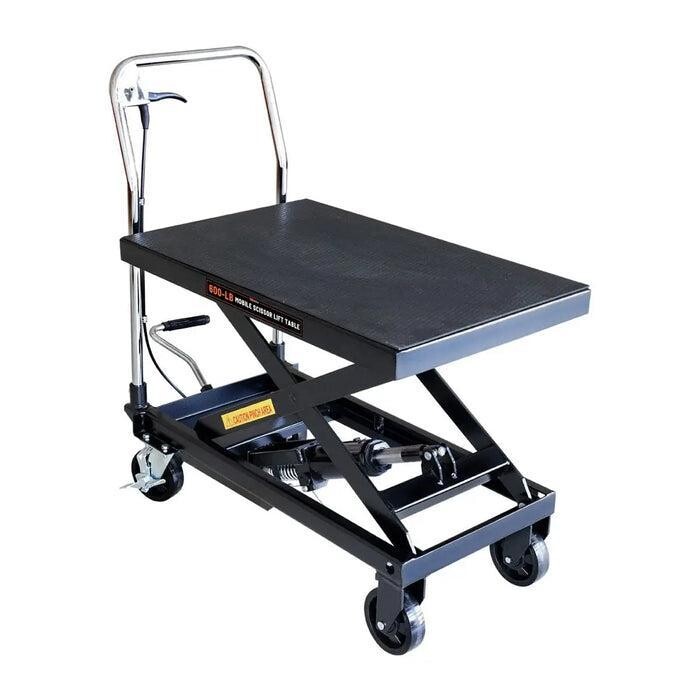
A padded platform grips the load. A steel top lets a greasy part slide as soon as the table tilts slightly or rolls over an uneven floor, while rubber holds it in place and cushions machined surfaces against scratches.
The pad also marks where the load belongs. Keeping parts within its edges is an easy visual reminder of the center-loading rule, and a worn or torn pad is worth replacing before it lets a part slip at the worst possible moment.
Signs the hydraulics need attention
A healthy system rises steadily with each pedal stroke and holds its height. A table that needs several strokes before it starts to rise usually has air in the oil, and a platform that creeps down over an hour points to a worn seal or a release valve that does not close fully.
Neither fault should be ignored. Checking the oil level, bleeding trapped air as the manufacturer describes, and replacing leaking seals keeps the table predictable, and predictability is the whole point of a machine that holds heavy parts at chest height.
Cold shops add a seasonal factor. In an unheated Canadian garage in January the oil thickens, so the table rises and lowers more slowly than it did in September. That is normal, and it is a reason to lower heavy loads patiently rather than opening the valve wider to compensate.
A hydraulic lift table is a lifting aid, not a stand
Hydraulic seals can leak slowly, which is why no one should work under a raised platform unless a mechanical safety support is engaged, and why a load should not be left raised overnight. A table positions work comfortably. Long-term support belongs on proper stands. An engine that will be apart for a week is better moved from the table onto an engine stand once it is at height, which frees the table for the next job.
TMG Industrial’s mobile unit uses a foot pedal pump, a thirty inch lifting height and a rubber padded top, the same features any hydraulic scissor lift table relies on to bring heavy work up to where people can handle it safely.