




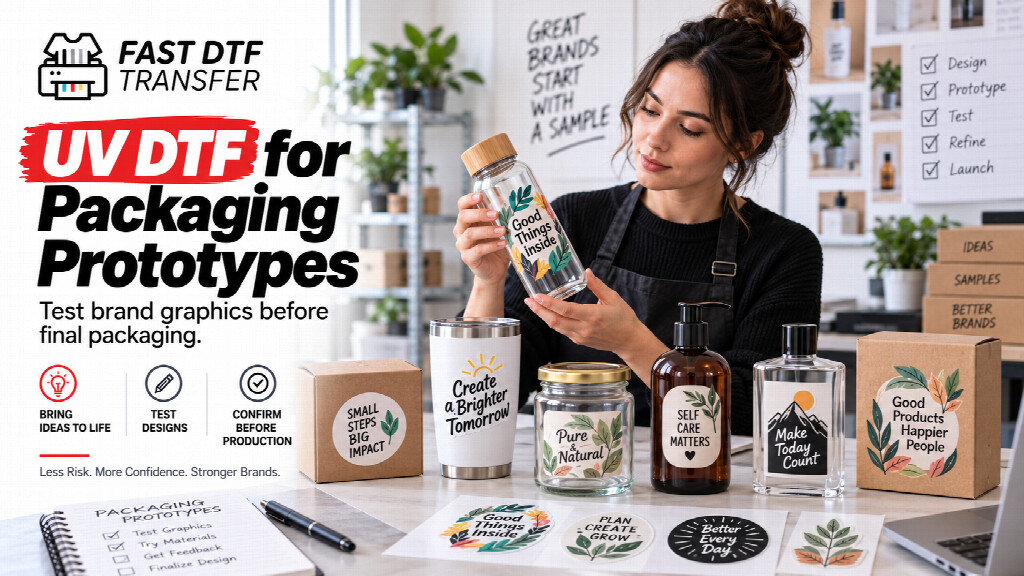
Packaging decisions often become expensive before a brand knows whether the design actually works on the physical object. A logo that looks balanced on a flat computer mockup may feel too large on a bottle. Fine text may lose impact on a curved surface. A graphic positioned perfectly on a digital jar template may sit too close to a lid, handle, seam, or product label once it is applied in the real world.
That is why physical prototypes matter. For compatible rigid items, UV DTF transfers can give small product brands, promotional teams, and designers a practical way to test visual concepts before committing to a larger packaging or merchandise decision.
A Prototype Should Answer Specific Questions
Do not create a sample simply to see whether it “looks good.” Define what the prototype needs to prove.
You may need to test logo scale, placement, contrast, readability, orientation, relationship to an existing product label, or whether the design still feels balanced when the item is held instead of viewed straight-on.
When the question is specific, the prototype becomes a decision tool rather than a decorative sample.
Test the Real Surface Whenever Possible
A digital mockup removes many of the variables that customers experience in person. Containers have edges, curves, caps, handles, seams, textures, and viewing angles.
Use the same type of object or a representative sample when testing. If the final product will be a bottle, test on that bottle style. If it will be a rigid promotional item, use an item with similar dimensions and surface behavior.
UV DTF transfers by size can be useful when a prototype program needs several controlled logo dimensions rather than one large production layout.
Build a Small Prototype Matrix
Instead of changing one variable at a time without documentation, create a simple test matrix.
Version A might use the smallest logo. Version B uses a medium logo. Version C uses the same size but moves the artwork higher. Another sample might test a reversed color treatment.
Label each prototype so the team can compare specific alternatives. “We like sample three” is useful only if everyone can identify what makes sample three different.
Evaluate Scale From Normal Viewing Distance
Designers naturally inspect prototypes from close range. Customers often do not.
Place the item on a shelf, desk, counter, or display where it would normally be seen. Step back. Is the brand still recognizable? Does small text disappear? Does the artwork dominate the object or feel appropriately proportioned?
Then pick the item up and inspect it from normal handling distance. Packaging needs to perform in both contexts.
Check Curves Before Approving a Wide Graphic
A wide logo can appear smaller once part of it begins wrapping around the side of a cylindrical object. Important text near the edges may no longer be visible from the main viewing angle.
A physical test quickly reveals whether the artwork should be narrower, moved, or divided into a different visual treatment.
This is especially important when the brand name itself must remain readable from the front.
Separate Brand Testing From Regulatory Packaging Decisions
A branding prototype is not a substitute for whatever labeling, safety, ingredient, warning, or regulatory requirements may apply to a commercial product.
Keep the visual prototype focused on the elements it is designed to test: brand graphics, decorative artwork, positioning, and presentation.
Required product information should follow the appropriate rules for the product category and market. Treating these as separate workstreams prevents a visual experiment from being mistaken for final compliant packaging.
Use the Prototype in a Real Conversation
One of the greatest advantages of a physical sample is that people can react to the same object.
Bring prototypes into a retailer meeting, internal product review, photo shoot test, or customer feedback session. Instead of debating a PDF, stakeholders can compare actual scale and placement.
Ask structured questions. Which version is easiest to recognize? Which one feels premium? Which placement leaves enough visual room for other information? Which version photographs best?
Record the reasons, not just the winner.
Test More Than One Product Size
A brand graphic approved on one container may not scale gracefully to another. A logo that works on a large bottle can overwhelm a smaller jar, while a layout created for a compact product may look weak on a larger surface.
If the product line contains multiple sizes, create at least one representative prototype from each major format.
This is where custom UV DTF transfers can support a broader testing process built around several artwork dimensions or product concepts.
Document the Final Prototype Specification
Once a version is approved, capture the information that made it successful. Record the artwork file, transfer dimensions, distance from a consistent reference point, orientation, substrate, and any application notes that matter to the finished appearance.
A photograph of the approved sample is useful, but it should not be the only specification. Measurements turn the prototype into a repeatable reference.
Know When the Prototype Has Done Its Job
Prototype testing can become endless if the team keeps making subjective variations. Decide in advance what approval means.
For example: the logo is readable from the intended viewing angle, the scale is balanced, the artwork does not interfere with other package information, and stakeholders have approved the physical appearance.
Once those questions are resolved, the prototype has served its purpose. The team can move into the next packaging or production decision with more confidence.
Physical Testing Reduces Guesswork
Digital mockups are fast and valuable, but they cannot fully reproduce the way a curved or rigid object behaves in a person’s hand.
A controlled UV DTF prototype program makes design discussions more concrete. Test a defined set of variables, use representative objects, review them at realistic viewing distances, document the approved version, and stop testing once the important questions have been answered.
The goal is not to make the most prototypes. It is to make enough physical evidence to choose the right brand presentation before a larger commitment is made.