




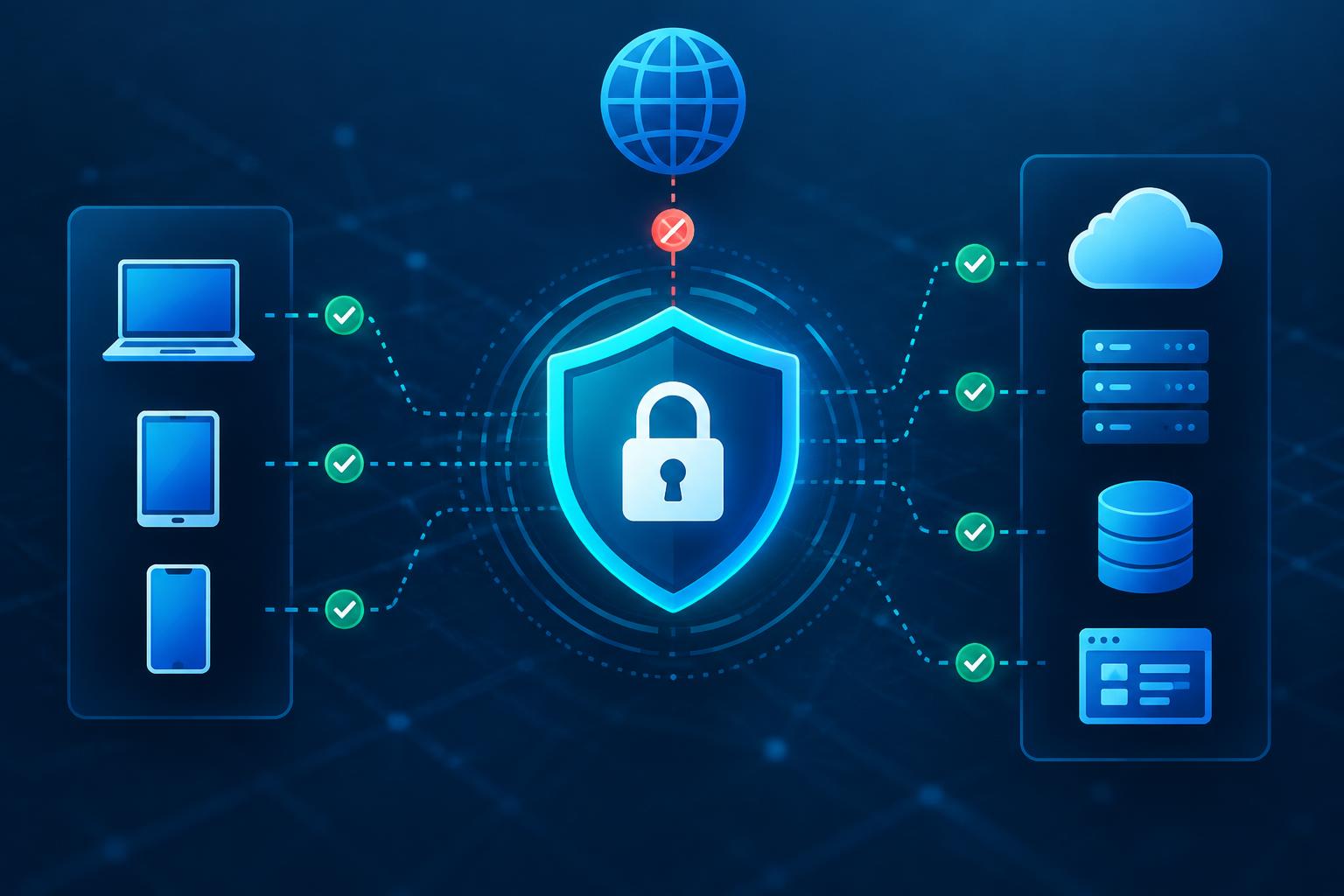
The perimeter model is broken. Modern businesses run across cloud platforms, remote workplaces, distributed networks, plus interconnected applications. The old model — a defined perimeter, trusted inside, untrusted outside — doesn’t describe that environment. Employees and applications operate from all sorts of locations, and network boundaries that once provided reliable protection have become more of a liability than a control.
Zero Trust Network Access (ZTNA) takes a different approach. Verify users and devices before granting access to specific applications — not to the network broadly. Consistent access policies, reduced network exposure, plus stronger protection against threats targeting the identity layer — these are the concrete outcomes. Knowing what ZTNA actually delivers makes it easier to decide where it belongs in a security architecture.
What Is ZTNA and Why Does It Matter?
ZTNA is a security model built around a simple premise: being on a corporate network doesn’t make a user or device trustworthy. Access to applications gets granted based on identity, device security, plus defined authorization policies — evaluated each time, not assumed from network position. Every access request gets evaluated before a connection is allowed. Honestly, that’s a fundamental shift from how most enterprise security has operated for the past two decades.
Why does it matter? Because employees receive access only to the applications their roles require — nothing more. That scope constraint limits exposure and makes permission management more tractable across environments that keep getting more distributed. Cloud applications, private systems, plus remote resources all become accessible without handing over broad network connectivity in the process. ZTNA security in cybersecurity follows the same principles as broader Zero Trust architecture — continuous verification, least-privilege access, plus ongoing security monitoring are all part of the same model.
How ZTNA Works Within a Modern Security Environment
ZTNA evaluates access requests against several security factors before any connection gets established. Five factors. What does that evaluation actually look like in practice?
- Identity verification: Confirming who’s making the request through authentication methods — multi-factor authentication being the baseline worth building on.
- Device assessment: Checking whether the device meets established security requirements before it gets access to anything.
- Access policies: Determining which applications and resources that identity is actually authorized to reach.
- Contextual evaluation: Factoring in location, device status, plus access behavior — not just who you are, but whether the request looks normal given everything else.
- Continuous monitoring: Reviewing activity to catch suspicious behavior or changed security conditions after the initial connection is established.
Access decisions reflect current security requirements — not just the initial authentication. And ZTNA works alongside identity management, endpoint protection, plus security monitoring systems — it’s not a standalone tool, it’s a layer in a coordinated strategy.
Supporting Remote Work and Cloud Security
Remote work and cloud adoption changed where and how employees reach business resources. Home networks, public locations, mobile devices, plus cloud environments all show up in the access picture now. Frankly, traditional network-based security gets harder to manage the more that picture diversifies.
ZTNA applies access controls directly to users, devices, plus applications. The perimeter that keeps moving isn’t worth chasing. Remote employees get what they need without being handed access to the entire corporate network. That’s a better outcome for both security and usability — unnecessary connectivity carries risk whether or not anyone’s exploiting it at a given moment.
Hybrid environments get the same treatment. Applications running across cloud platforms and on-premises infrastructure get consistent access policies regardless of where they’re hosted. Isn’t it worth having a single policy framework that doesn’t have to be rebuilt every time something moves to the cloud?
Improving Application Visibility and Access Management
As digital environments expand, keeping visibility across applications, user accounts, plus devices gets harder. Separate access systems running independently create inconsistent policies and make unusual activity difficult to spot.
ZTNA centralizes access management and produces detailed access records. Who reached which resources, when, plus under what conditions — that’s all visible in the access records — not scattered across disconnected logs. Security teams can investigate suspicious activity, spot policy violations, plus review permissions without piecing together half the picture first. Honestly, that’s useful independent of everything else ZTNA does.
Regular reviews matter too. Access policies that aren’t reviewed drift out of alignment. Roles change. Applications get updated. New business requirements appear. Each one is a reason to review. The NCSC’s introduction to ZTNA covers the principles and security considerations in detail — worth reading before designing access policies, not after.
Integrating ZTNA With Existing Cybersecurity Controls
ZTNA is most effective when it works alongside other security technologies. Identity management, endpoint security, cloud protection, plus security monitoring all have to connect to it — not operate separately from it. Integration is what creates consistent access policies with actual visibility across the environment.
But implementation requires planning. Compatibility problems don’t surface on their own — they get discovered mid-deployment, which is the worst time to find them. Before committing to a deployment approach, map the existing infrastructure. Understand the application dependencies, employee access requirements, plus what technical expertise is actually available internally.
A phased implementation is worth it. Test policies on a subset of applications or users, identify weaknesses, improve configurations, then expand. Attempting a full transition at once introduces risk that a staged approach avoids — and isn’t worth much if compatibility problems force a rollback halfway through.
Challenges and Considerations for ZTNA Adoption
Real advantages come with real implementation challenges. Legacy applications may need additional configuration that takes longer than anticipated. Complex access requirements can make policy management genuinely difficult, especially across organizations with large user populations plus diverse application environments.
Employees often need training. New authentication procedures and access restrictions change daily habits, and users who don’t understand why something works differently tend to find workarounds. Frankly, that’s a security problem before it’s an IT support problem.
Implementation costs, integration requirements, application performance, plus ongoing administrative overhead — all sorts of line items that don’t show up in the initial vendor quote — factor into what adoption actually costs. Recent research on modern cybersecurity and network access offers useful context for evaluating security architectures and their practical limitations — worth reviewing before finalizing an approach.
Organizations that implement ZTNA and then leave it running without review find that security controls drift out of alignment with the environment they’re protecting. Threats change. Technologies change. Business requirements change. Regular reviews are what keep the implementation effective — not just running.
Final Thoughts
ZTNA plays a real role in modern cybersecurity — controlling application access, reducing unnecessary network exposure, plus protecting distributed business environments that perimeter security was never designed to handle. Its identity-focused approach supports remote work, cloud adoption, plus more consistent security management across environments that keep getting harder to define.
But implementation matters. Careful planning, reliable authentication, appropriate policies, plus continuous monitoring are what make ZTNA effective rather than just present. Organizations that integrate it with broader security controls get the full benefit. Those that treat it as a checkbox miss the point entirely.
FAQs
What does ZTNA mean in cybersecurity?
ZTNA — Zero Trust Network Access — verifies users and devices before granting access to specific applications and resources — without handing over broad network connectivity as part of the deal. The core idea: trust nothing automatically, verify everything explicitly.
How does ZTNA improve cybersecurity?
Reduced unnecessary access, limited network exposure, plus permission management tied to identity and security requirements. When a compromised account can only reach one application rather than the whole network, the blast radius of that compromise drops significantly. Honestly, that’s the most concrete security improvement ZTNA delivers.
Is ZTNA suitable for cloud environments?
Yes. Consistent identity-based policies apply across cloud, on-premises, plus hybrid environments — which is exactly what makes it useful for organizations that have already moved beyond single-location infrastructure. Isn’t that most enterprises at this point?
Does ZTNA replace traditional VPNs?
For application access scenarios, often yes. ZTNA typically delivers better performance once the centralized VPN chokepoint is gone, plus simpler administration when access policies are identity-based. But organizations must evaluate infrastructure and business requirements before transitioning — not every legacy system maps cleanly, and finding that out mid-deployment is a bad position to be in.