




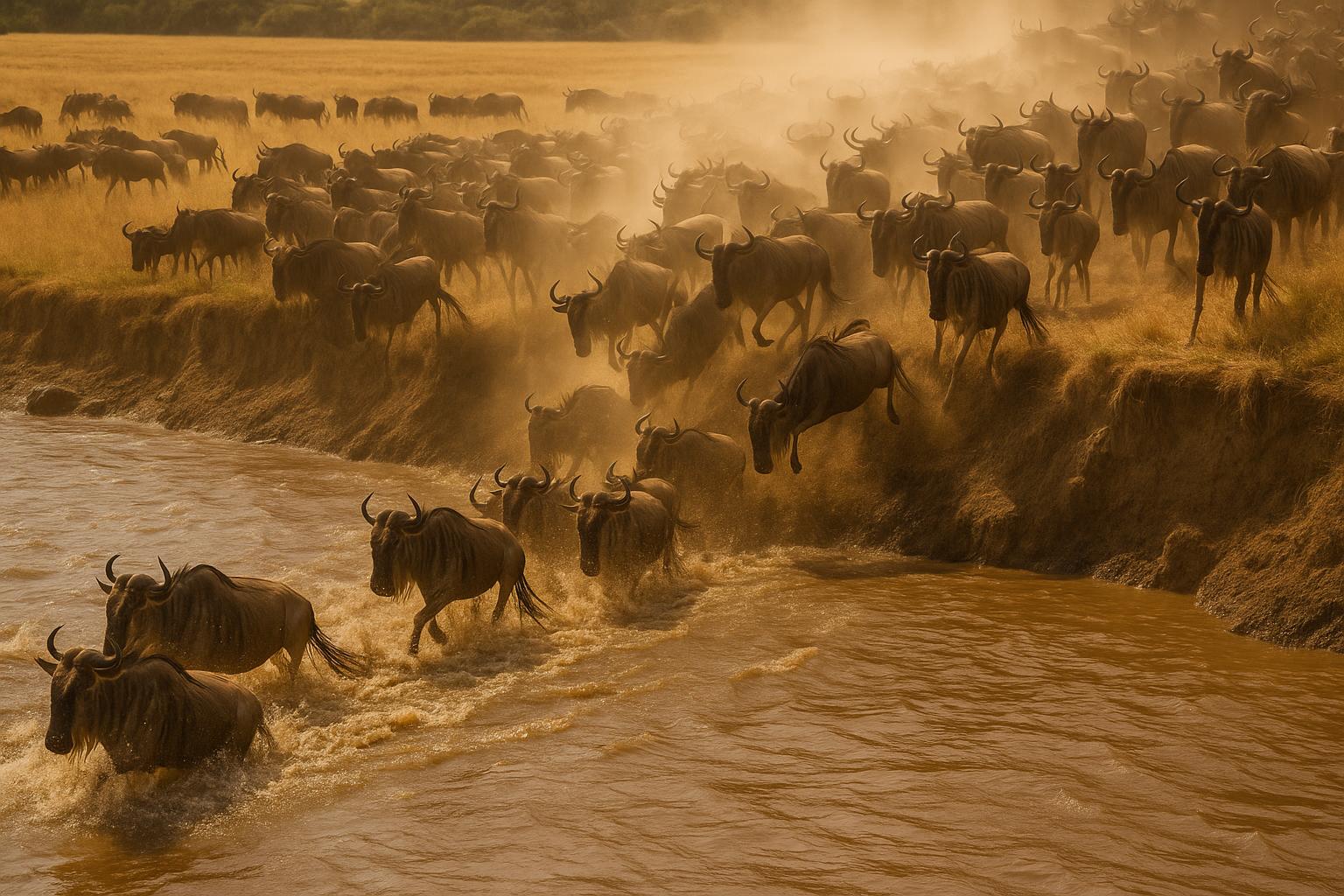
In the vast, rolling plains of East Africa, a spectacle unfolds every year that defies imagination. It is a primal, thundering display of life, death, and endurance known as the Great Migration. Often referred to as the “Eighth Wonder of the World,” this annual movement of over 1.5 million wildebeest, accompanied by hundreds of thousands of zebras and gazelles, is the largest overland migration of mammals on the planet.
For travelers, photographers, and nature enthusiasts, witnessing this event is a bucket-list priority. However, the migration is not a single event but a continuous, year-round cycle. To truly appreciate this phenomenon, one must understand the rhythm of the Serengeti-Mara ecosystem and know how to find the best wildebeest migration viewpoints depending on the season.
The Rhythm of the Plains: Understanding the Cycle
The Great Migration is driven by one thing: rain. The herds follow the green grass, moving in a clockwise circle between the Serengeti National Park in Tanzania and the Maasai Mara National Reserve in Kenya. Because the timing depends on seasonal rainfall, the herds are always on the move, and no two years are exactly alike.
The Calving Season (January – March)
The journey arguably begins in the southern Serengeti and the Ngorongoro Conservation Area. During these months, the short rains have nourished the soil, creating nutrient-rich grasses perfect for nursing mothers.
This is a time of incredible abundance. In a synchronized feat of nature, roughly 500,000 wildebeest calves are born within a two-to-three-week window. For the observer, this is a period of high drama. While the sight of thousands of wobbly-legged calves finding their feet is heartwarming, it also attracts the world’s highest concentration of predators. Lions, cheetahs, and hyenas linger on the fringes of the herds, waiting for an opportunity. The calving season offers some of the most intense predator-prey interactions found anywhere in the wild.
The Trek North (April – June)
As the southern plains dry up, the herds begin their journey northwest. This is a transitional period. By May, the massive columns of wildebeest can stretch for miles—a literal “mega-herd” moving toward the Western Corridor of the Serengeti.
In June, the herds face their first major obstacle: the Grumeti River. While not as famous as the Mara River, the Grumeti is home to massive Nile crocodiles. Watching the herds navigate these waters is a precursor to the high-stakes crossings that define the later months.
The Iconic River Crossings (July – October)
This is the peak of the migration and the period most travelers associate with the event. By July, the herds have reached the northern Serengeti and are preparing to cross the Mara River into Kenya’s Maasai Mara.
The river crossings are pure, unadulterated chaos. Driven by hunger and instinct, the wildebeest gather on the banks, sometimes for days, building up the “courage” to jump. When the first brave soul finally leaps, a frantic stampede follows. They must contend with steep, slippery banks, powerful currents, and the largest crocodiles in Africa. On the other side, lions and leopards often lie in wait. To see this in person is to witness the rawest form of survival. For many, finding a spot on the riverbank during these months represents the best wildebeest migration experience possible, offering a front-row seat to nature’s most brutal and beautiful moments.
The Return Journey (November – December)
With the arrival of the “short rains” in late October or November, the herds begin to move south again. They leave the grazed-over grass of the Maasai Mara and head back down through the eastern Serengeti. They move quickly during this time, covering vast distances to reach the lush southern plains just in time for the cycle to begin anew with the next calving season.
How to Plan Your Safari
Because the migration is a moving target, planning is essential. You cannot simply “show up” in the Serengeti and expect to see millions of animals. Here are the key factors to consider for a high-quality experience:
1. Location is Everything
The Serengeti is massive—nearly 15,000 square kilometers. If you book a lodge in the south during August, you will likely miss the herds entirely. It is crucial to choose “mobile” camps or lodges located in the specific region where the herds are expected to be during your travel dates.
2. Patience is a Virtue
If you are hoping to see a river crossing, be prepared to wait. Safari guides often spend hours sitting quietly by the river, watching the herds hesitate. The payoff is worth the wait, but it requires a mindset of “safari time”—slowing down and letting nature dictate the schedule.
3. Consider a Multi-Region Itinerary
To maximize your chances of seeing the herds in different states—grazing, moving, and crossing—consider splitting your time between two different areas of the park. For example, in July, you might spend three days in the Central Serengeti (to see the tail end of the herds) and three days in the Northern Serengeti (to catch the river crossings).
The Ecological Importance of the Migration
Beyond its value as a tourist attraction, the Great Migration is a vital heartbeat for the African continent. The movement of these animals acts as a massive “mowing” service, keeping the grasslands healthy. Their dung provides essential nutrients to the soil, and they serve as the primary food source for a vast array of predators and scavengers.
Without the wildebeest, the entire Serengeti-Mara ecosystem would collapse. It is a delicate balance of biology that has existed for thousands of years, and witnessing it serves as a powerful reminder of why conservation efforts in East Africa are so critical.
Why You Should Go
There are many wildlife experiences in the world, but few carry the emotional weight of the Great Migration. It is more than just “seeing animals”; it is about feeling the vibration of the earth under the hooves of a million creatures. It is about the silence of the savanna broken by the low, constant “gnu” grunting of the herds.
Whether you are watching a calf take its first breath in February or holding your own breath as a wildebeest plunges into the Mara River in August, the experience changes you. It provides a perspective on the persistence of life that stays with you long after you’ve left the plains of Africa.
By understanding the movement of the herds and choosing the right time and place, you ensure that you don’t just see a safari—you witness the best wildebeest migration the world has to offer. Pack your binoculars, bring plenty of memory cards for your camera, and prepare yourself for the most spectacular journey on Earth.