




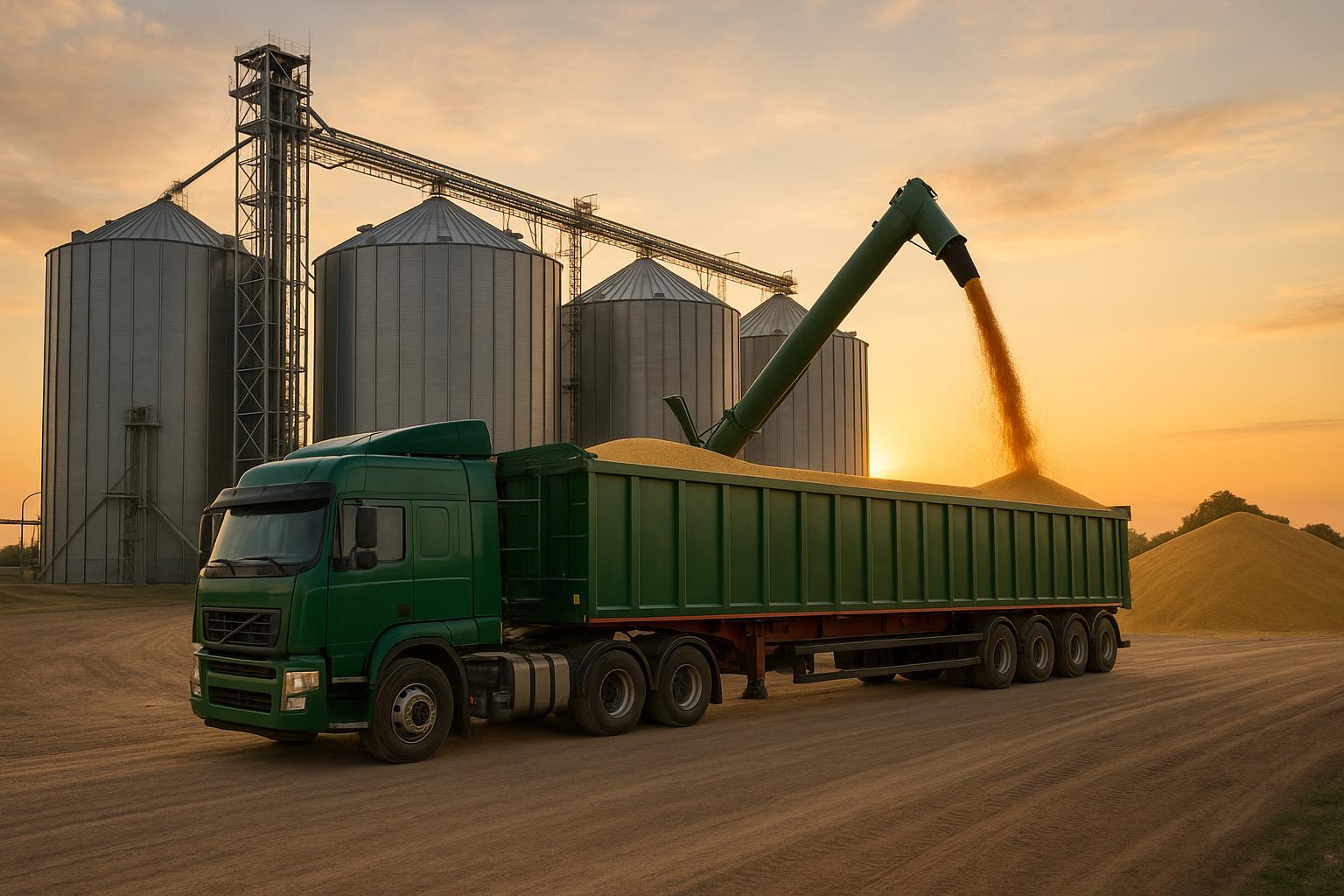
It’s not a supply chain mystery; it’s a predictable capacity wall that shippers keep hitting because they plan for freight the same way in September as they do in March.
Why Harvest Season Breaks The Freight Market
Agricultural freight is not typical freight. Throughout most of the year, grain elevators, feed mills, and processors ship manageable quantities that local and regional carriers can easily handle. Then, for a month-and-a-half, distribution centers receive three to four times the volume – and everything is concentrated in one location.
The trucks contracted for in August don’t come close to cutting it in October. Carriers that work multiple industries point their equipment in the direction of the highest rate for the week, and ag shippers that didn’t previously secure capacity battle for trucks on the spot market. Rates rise, schedules slip, and grain piles up in fields or bins.
This is a logistics problem before an agricultural problem. The product is seasonal, but the failure to plan, and learn to plan, for adequate capacity is a new disaster every year.
The Driver Shortage Hits Agriculture Harder Than Most Sectors
The trucking industry has had a driver shortage for years, and if current trends continue that gap is only expected to increase. It’s estimated that by 2030 we could be short roughly 160,000 drivers, up from about 80,000 in 2021. Those are big-picture industry numbers, but something ag haulers feel more acutely than most.
That’s because during harvest, agricultural freight is bidding against retail freight, construction freight, and everything else that’s moving that quarter for the same pool of drivers. Given a choice between a steady dry van route and a short-term grain hauling gig in a rural area, drivers more often than not will take the route that has predictable hours and better pay. Against year-round contracts, ag asks drivers to be on full volume for a few weeks and then go silent. That’s not a great pitch.
It’s not just that ag shippers don’t have enough trucks during harvest. They don’t have enough of the right drivers to cover this specific work during this specific window at this specific rate. It’s a niche problem within the larger driver shortage, and it needs a niche solution.
Equipment Matters More Than Most Shippers Realize
Not all bulk freight is transported in the same manner. Considering hopper trailers and pneumatic tankers to be equivalents is a wrong assumption that results in shippers getting stuck with rejected loads and contamination claims.
For dry grains, you need a trailer that’s clean and dry, sealed against moisture, and free of residue from the last commodity it carried. If that was a crop nutrient and the trailer wasn’t well washed afterward, there’s a good chance that some of that fertilizer will end up in your grain, at a terminal or processing plant where they’ll refuse the load or just dock you.
Finer goods like cement and flour, or certain types of crop nutrients, weren’t meant to be hauled in a hopper in the first place. Pneumatic tankers are ideal for such materials given that they help avoid settlings and bridging problems often caused by fine particulate in the hopper.
Agricultural-dedicated equipment pays for itself. If you’re dealing with a carrier that runs hopper trucking specifically for agricultural commodities, you’re not playing trailers-roulette every time one backs up to the load-out auger for the first time. You know what you’re getting. That reliability becomes all the more important in peak season, when one of your options for a rejected load is backing up the line while you try to find an alternate carrier to take it without making you eat the cost of a full load of rejected grain.
Regulations Weren’t Built For Harvest Math
The Hours of Service rules and the ELD mandate are all well and good. But they don’t really fit the reality of how agricultural freight has to work. Harvest has always required some flexibility in HOS tracking: drivers run long when they have to and short when they don’t because the work is, by definition, seasonal and varied.
The FMCSA’s agricultural exemption makes room for this. Drivers transporting agricultural commodities within 150 air-miles of the source aren’t held to standard HOS tracking. They’re on the clock but they don’t need electronic logbooks, which leaves many carriers opting for paper logs or simply pen and pad.
A 30-day exemption is also made for the planting and harvesting season during which the driver is exempt from the HOS after those drivers have completed 12 hours or been on duty for 16 hours or more.
This gray area makes a huge difference for local grain movement from field to elevator, which is somewhat above typical market for grain haulers at about 100 air-miles, especially because the FMCSA’s definition of source includes both pick up and delivery points, load assembly points and unloading facilities – and thankfully it appears combines and tractors.
Empty Miles Are Quietly Expensive
A truck returning empty from a rural elevator to a processing plant after delivering a load of grain may not seem like a big deal. The plant is on the way back to the field anyway, inbound rates are generally cheaper, and the truck has to return to its base to start the next load – why worry about a little deadhead? Because it’s not a little deadhead, even if the elevator and farm are both close to the plant. Industry studies put the all-empty haul back to the country at over half the loaded mile total on average, and depending on the location realistically over 80 percent of those miles might be uncompensated.
This is one of the most fixable problems in agricultural freight, and most shippers don’t fix it. Carriers who can count on return loads, or who get committed to multi-load contracts instead of single spot bookings, price more competitively because they’re not eating dead miles on every run. Shippers who help arrange backhauls, even informally, put themselves at the front of the line when capacity gets tight.
Elevator operators and cooperatives that coordinate with neighboring shippers to fill return trips end up with better rates and more reliable trucks than those who book everything load by load.
Digital Tools Have Changed How Capacity Gets Found
Load boards and brokerages used to be step 2 in the process. You called a list of brokers on Monday, gave them your pricing, and they got back to you on Tuesday afternoon after they’d worked through their margin. Now it’s step 1, and you can often book before a broker would be able to call you back. It’s not just the nature of the rate information, either. A lot of brokers will promise you the world on Monday, but can you get confirmation on that load Thursday afternoon at 3 p.m.?
For agricultural shippers, the ability to book a load without waiting for your broker to get on your paperwork and call you back can mean the difference between a profitable or unprofitable season. That’s especially true in the couple of weeks before harvest, at any new production facility, when the scrap haulers are lined up out to the highway but you could still get a truck every third day. The calendar says you’re two weeks away from being completely swamped, but you’re not there yet. A good tool will tell you what’s actually still available in your region versus whether the back roads are full of early arrival trucks.
Truck Versus Rail: Knowing When Each One Wins
Rail transport is still less expensive than trucking for long-distance transportation, usually over 500 to 750 miles, when transporting grain from the Midwest to export terminals or remote processing facilities. If the quantity is sufficient and time is not constrained, the cost per bushel for using rail is very competitive.
The strengths of trucking are where rail is weak. If the load is small, time is short, or delivery must be made directly to a terminal or an elevator with no handling required, trucking is likely the most efficient method. Much agricultural transport is short to medium distance already under these circumstances (farm to local elevator or local to regional processor) and suits trucking very well.
The most successful shippers understand those constraints and do not choose one mode; they compromise and make the most of both. They save rail for the heavy, predictable movement and truck for the time-critical short haul where the flexibility is valuable. Trying to make the truck/rail decision a contest cuts profits one way or the other.
Building A Freight Plan That Survives Harvest
All of this does abstractly make sense. It’s just a matter of employing the practices prior to being stressed with the time constraints.
So, essentially, reserve your spot early. The best time to book capacity is the exact opposite of when most shippers go looking for trucks: weeks before the harvest window even opens, when pretty much all carriers still have some open space.
Have dependable carriers ready. Because price isn’t gonna do you much good if it’s with a fleet that doubles the quote the moment you sound the alarm on a truck needed next day.
Pre-position equipment nearby. This may seem like a no-brainer and everyone will say it’s important but very few actually do it. Again, the key to success in sharing a combine, grain cart(s), or trucks with your neighbors is to make sure those pieces of equipment don’t get abused in transit.
Finally, understand it’s gonna rain. Or something else will cause a delay in harvest. Maybe have a plan for that.
Treat Capacity Like A Relationship, Not A Transaction
Long-term successful agricultural freight shippers no longer view capacity as a fresh purchase each season. They have created carrier relationships that perform when stress tested. A carrier that trusts a shipper to pay reasonably and communicate effectively will choose to haul that shipper’s loads when everyone is calling.
There will always be spot market freight, and it has its place in the mix. But it is not a strategy. The agricultural shippers that win each harvest are the ones that used the off-season time to build the relationships and systems that turn what many see as a “crisis” season into a “predictable” one.