




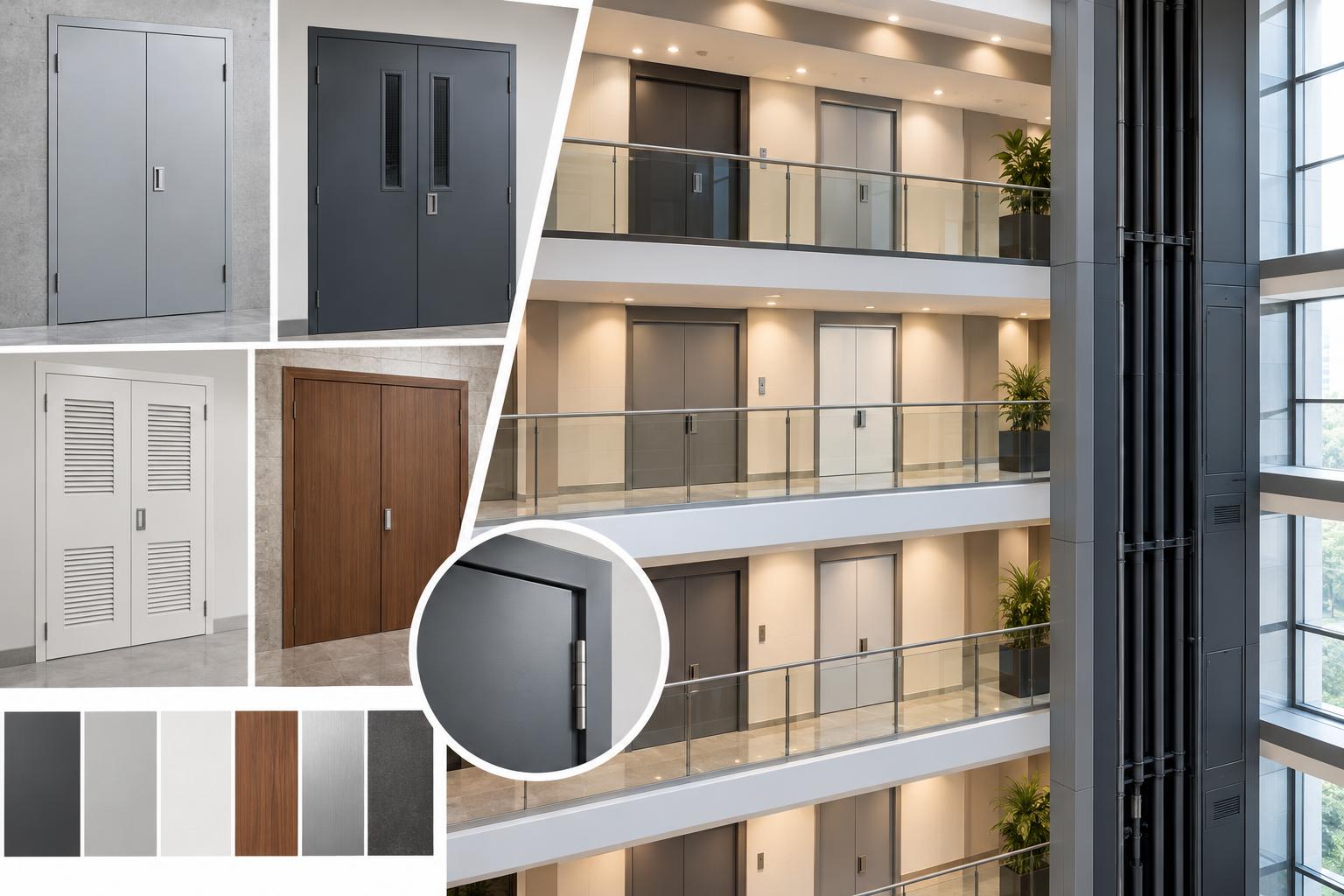
Riser doors, the access panels and access doors that close off vertical service shafts, are usually chosen late in a project. The choice is often just whatever fits the hole, and maintenance teams live with the result for decades. Installers advise starting with how the shaft will be used, not with the opening on the drawing.
Start with the maintenance task
The first question on any riser door is what has to happen behind it. A shaft that needs only visual checks asks less of a door than one housing valves or pumps that will eventually be replaced.
Manufacturers and facilities teams point to the same common failure: doors sized for a person to reach in, but not for anything to come out. If a component may need removing later, the door has to pass it. Size the clear opening rather than the structural opening. The clear opening is what remains once frame and hinges take their share.
Position matters as much as size: a door centered on the wrong stretch of shaft leaves controls at the limit of easy reach. A door that is awkward to reach through is more likely to be left propped open.
How often the door is used matters too: a riser opened weekly for meter reading needs heavier hinges than one opened yearly.
Single leaf or double leaf
Once the required opening is known, the next choice is whether to span it with one leaf or split it across a double-door set. A single leaf is simpler, with fewer hinges and less hardware to drift out of adjustment.
Double leaves suit wider openings where one door would grow too heavy to swing safely or would strain its hinges. Many maintenance teams prefer a set where one leaf handles routine access and the second opens only for bulky equipment. A double set adds coordination, since one leaf usually carries the lock while the other bolts shut until both are needed.
Weight is the constraint: large leaves are harder to hold open, and stays may be needed where engineers work alone.
Swing direction and corridor space
A riser door that opens into a corridor needs room to swing and room for someone to work. Door makers advise checking the swing path against the corridor width before the handing is fixed on the schedule.
A leaf that folds flat against the wall stays clear of traffic and leaves the engineer the full corridor. Where it cannot, the open leaf narrows the walkway and the working space at the same time.
Most riser doors open out into the corridor, which gives the engineer the shaft in front and the corridor behind. An inward-opening leaf keeps the walkway clear but only works where the shaft interior is free of obstructions.
Shafts in multi-story work tend to stack directly above one another, so a single handing decision is often copied up every floor. That can leave every door ordered with the same hand, even where a pipe run argues for the opposite, so check each floor’s door swing against the pipe layout.
Frame style and wall type
Frame choice follows the wall build-up, and two profiles cover most situations. A beaded frame is designed to be plastered up to, so the door sits flush in a finished plasterboard wall.
A picture frame does the opposite job: it shows a visible border that covers the rough edge of a structural opening. That makes it the practical choice for masonry or tiled walls, and for retrofit work with an uneven reveal.
Measure once the wall finish is known, because plaster and dry lining both change the opening size.
Both profiles are widely made to order, and the page at Access Panels Direct UK is a reference for comparing options. Ordering to the measured opening avoids the packing and making good that a poor fit requires.
Locks, hinges and hardware coordination
Riser shafts carry electrical and mechanical services. The lock is a safety decision as much as a security one. Manufacturers commonly offer a simple budget lock or a three-point lock that latches the leaf at several points along its edge.
Taller or heavier leaves benefit from the multi-point option, since a single latch can let a long door bow at its corners. Keyed-alike suites across a floor, or across the whole building, spare maintenance teams from carrying a ring of keys.
Hardware has to be coordinated with the other trades touching the door. Tiling, baseboards, signage and electronic locking all meet the frame, and clashes are cheaper to resolve on paper than on site.
Pulling it together on the opening schedule
Each decision above belongs on a single document. An opening schedule lists every riser door by location, with its measured size, leaf arrangement, handing, frame profile, lock type and finish. Since riser sizes shift as services are coordinated, the schedule works best as a living document.
Fire strategy and acoustic targets set performance requirements for certain doors, and those belong on the schedule next to the sizes.
With the schedule fixed, access panels and access doors can be ordered as one package rather than a series of one-off purchases. Ordering this way leaves less room for surprises on site and less making good around frames.
None of these decisions is complicated on its own. Problems usually show up on projects where nobody made them.