




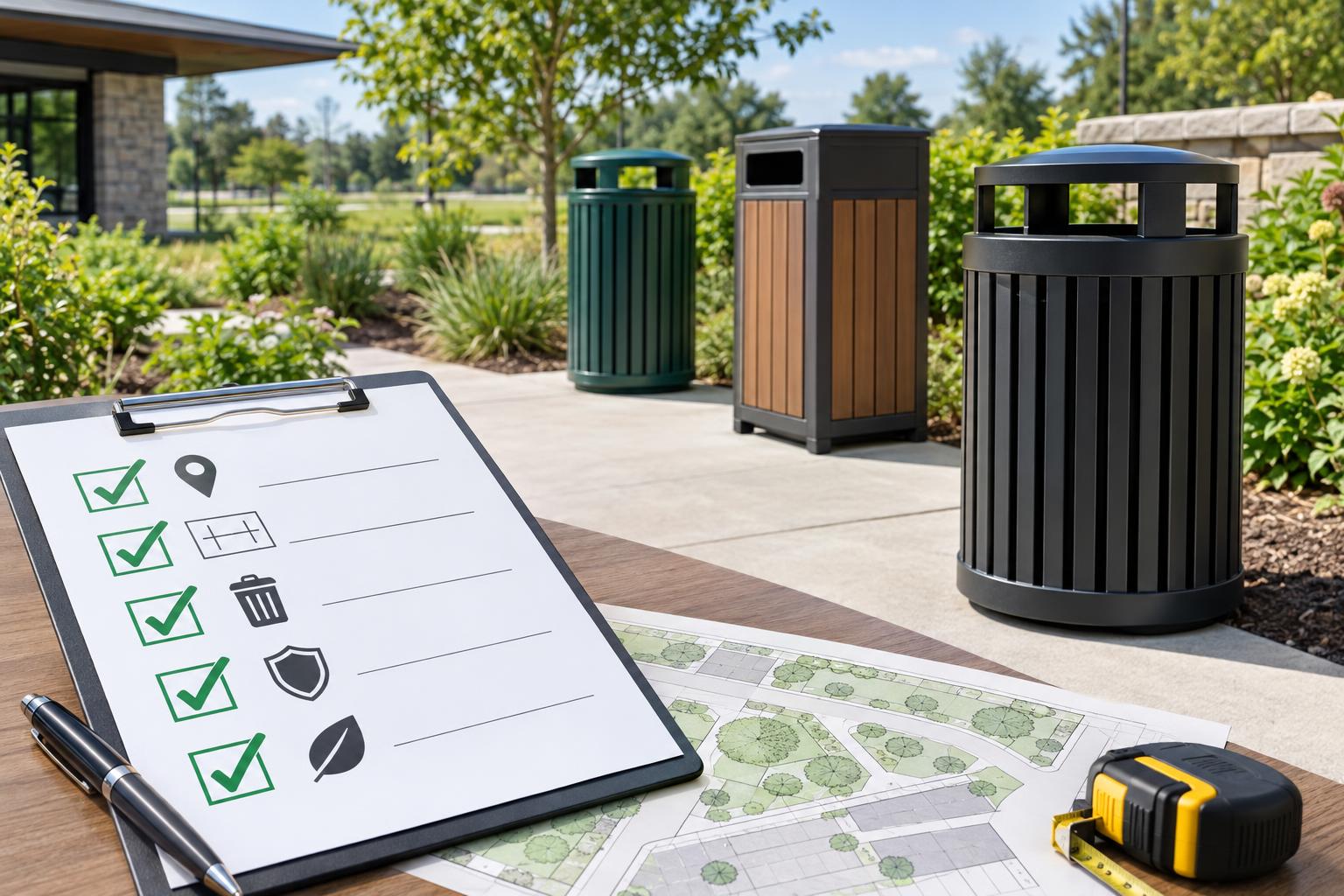
Outdoor trash receptacles are site infrastructure, and the buying decision often goes wrong before anyone compares prices. The mistake starts when the site itself hasn’t been read: where people walk, where waste collects, who empties the receptacles, and what the weather does to steel over five winters. This checklist works through the preparation questions to answer before you request a quote, so what you order fits the ground it lands on.
Audit foot traffic before you count receptacles
Walk the site at its busiest hour and again at its quietest. Note where people actually drop things and which walking routes carry the most traffic, then place receptacles along those paths. Waste concentrates in transition zones: entryways, transit stops, outdoor seating, and path intersections. If you place receptacles where the plan says people should pause and ignore where they already do, the new receptacles will sit half empty while litter collects twenty feet away. That observation gives you a placement baseline for long walkways, and it tells you when one large receptacle is a poor substitute for two smaller ones within easy reach.
Count what each zone produces between service visits, not across a full day. A lunch-hour seating area may fill a receptacle by early afternoon while an identical one near a side entrance lasts a week, and event days or tourist seasons can double those volumes overnight. Once you have the numbers, resolve two things with the provider: the capacity of each receptacle and the liner size your crew already stocks, so the purchase doesn’t force a second inventory.
Match the material to the weather it will live in
Steel and plastic fail in different ways, and the local climate decides which failure you see first. If the site sits near salt air, unprotected steel corrodes at weld points and bolt holes within a few seasons. If the site gets intense sun, dark finishes fade and ordinary plastic turns brittle. Where temperatures swing across freezing, moisture works into small coating chips and widens them every winter.
Thermoplastic and powder coatings answer most of these problems on steel frames. A thermoplastic coating bonds a thick plastic layer over the metal, resisting rust and holding up under sun exposure. Graffiti cleans off the coated surface more easily than off painted steel. Expanded metal designs add another benefit in wet climates, because the open pattern dries quickly. Where a removable liner sits behind the mesh, ask how staff can check and empty it between visits.
For the harshest exposures, high-density polyethylene (HDPE) doesn’t rust, tolerates salt spray, and, in UV-stabilized versions, holds its color in open sun. That is why it appears so often in marine environments. It also weighs less than steel, which makes units easier to move, though the shell’s weight does not change what crews lift: check how much a loaded liner weighs and how staff lift it out and empty it. Exposure also attacks the hardware below the finish, so the material choice leads into the mounting choice.
Read the ground before you choose a mount
The mounting method follows from what is already under the receptacle. A finished concrete pad takes surface-bolt anchors, and the installation stays reversible if the layout changes later. Bare soil, gravel, or turf calls for an in-ground post set in wet concrete, which is permanent and holds against tipping and theft.
Asphalt sits between those two cases. It accepts anchors, but the grip is weaker than concrete, and a heavily loaded receptacle can work loose over a season of freeze and thaw. If the site is asphalt and the spot is exposed, an in-ground mount or a heavier portable base is the safer specification.
Wind is a load case of its own. A tall, light receptacle on an open plaza or rooftop terrace will shift in a storm unless the base is anchored or weighted for it, so ask for the wind resistance of any portable model you consider. Check drainage at the same time, because a base that sits in standing water after every rain will corrode years before its coating wears through. In unsupervised areas, heavy-gauge steel construction and locking lids deter casual vandalism and liner theft.
Resolve the hardware questions before the order ships: whether anchors are included, whether the quoted base weight accounts for wind, what tools the installation needs, and what the provider recommends for your surface. When the sites you’re equipping include a public park, a school campus, a transit stop, or a city sidewalk, source commercial outdoor trash receptacles built with weather-resistant coatings, reinforced frames, and mounting configurations that match the exposure and surface you’ve mapped.
Confirm accessibility clearances at every placement
Placement on a plan is not the same as placement on the ground. Each receptacle needs firm, level clear space beside it, positioned so someone using a wheelchair or another mobility device can pull alongside and reach the opening without crossing a slope, a curb or loose gravel. Confirm that approach space at every planned location before you finalize the layout.
Check the height and position of the deposit opening on the actual model you plan to buy, and confirm that any lid or flap opens easily for people with different reach and grip strength. A product that looks right on the plan can still be awkward in daily use, so verify this before you commit.
Keep the receptacle out of the main pedestrian route. A receptacle that narrows a walkway below the accessible width creates a problem even when its own clear space is correct, so review each planned placement against the actual model’s dimensions, including the approach space a user needs in front of and beside the opening.
Plan for pests and fire hazards
The pest profile of a site is local, and the lid has to match it. Birds and small rodents call for self-closing flaps or restrictive openings. Raccoons and larger animals defeat loose domes, so sites near wooded areas or water need heavy dome lids with mechanical latches that stay shut until a person opens them. Overflow defeats all of these defenses, because a receptacle heaped above its rim is open to anything.
A rain bonnet or covered top does double duty in wet climates. It keeps water out of the liner and keeps the contents from turning into saturated weight your crew has to lift.
Fire risk is highest where people smoke. Near building entrances and designated smoking areas, spec receptacles with integrated ash urns so cigarettes get a dedicated disposal point outside the general waste stream. Self-extinguishing designs restrict oxygen inside the receptacle and add a margin in high-density areas. Keep any receptacle that receives smoking waste a sensible distance from doors and air intakes.
Design the collection workflow into the purchase
A receptacle is emptied hundreds of times over its life, and the design decides what each of those emptyings costs your crew. Traditional top-loading receptacles force a vertical lift: the liner comes up and out over the rim, sometimes from waist height, at full weight. Side-door access lets the liner slide out horizontally, removing most of that lift.
If your team has logged shoulder or back complaints tied to waste collection, that difference belongs in the specification. Ask how full liners are removed from each model, what a loaded liner weighs at the capacity you’re ordering, and whether lighter rigid liners are available. If collection runs daily on some routes and twice a week on others, capacity and access should follow the longer interval.
Recycling belongs in the same workflow decision. Co-located dual-stream receptacles sort well when the openings do the work: a restrictive slot for paper, round holes for cans and bottles, with color coding and labels that read clearly from a few steps away. If the two openings look identical, contamination is the predictable result, and the recycling stream becomes trash with extra handling.
Confirm the consumables before committing, because replacement liners and lids are the parts that wear out or disappear first. Confirm their cost and lead time now, not after the first one cracks.
Match the look to the rest of the site
Receptacles sit next to benches, planters, bike racks, and bollards, and a mismatched receptacle reads as an afterthought. Slatted steel suits most contemporary streetscapes, while wood-grain HDPE fits parks and trails where bare metal would look industrial. Matching finishes across your site furnishings costs little at order time, and it protects the visual coherence that property value partly rests on. If you manage several properties, standardizing on one or two receptacle families simplifies the visual match and the parts inventory at once.
Price comparisons only make sense across the full life of the asset. A cheaper receptacle that needs repainting within a few years can cost more over a decade than a coated steel model that simply holds its finish, once labor is counted. Build the comparison on purchase price, expected service life, maintenance hours, and replacement frequency, and the higher quote often becomes the lower cost.
Read the terms before you commit
The quote needs the same scrutiny as the site. Check the lead time and delivery turnaround first, because installation windows close with seasons and construction schedules. Check any minimum order quantity too, since a per-unit price means little if the minimum forces you to overbuy for a small site.
Then review what the warranty covers. A warranty that includes the finish alongside the structure favors you as the buyer. One limited to manufacturing defects, with freight excluded and replacement parts billed separately, favors the provider, and both versions are common in the market. None of these terms is unreasonable on its own; the point is to know which ones you’re accepting, and to get the ones that matter in writing.
A site that has been walked, measured, and read for weather produces a short specification: capacity by zone, material by exposure, mount by surface, lids by pest pressure, access by crew. Bring that specification into the quote conversation, and the receptacles that arrive will fit the ground they’re bolted to.