




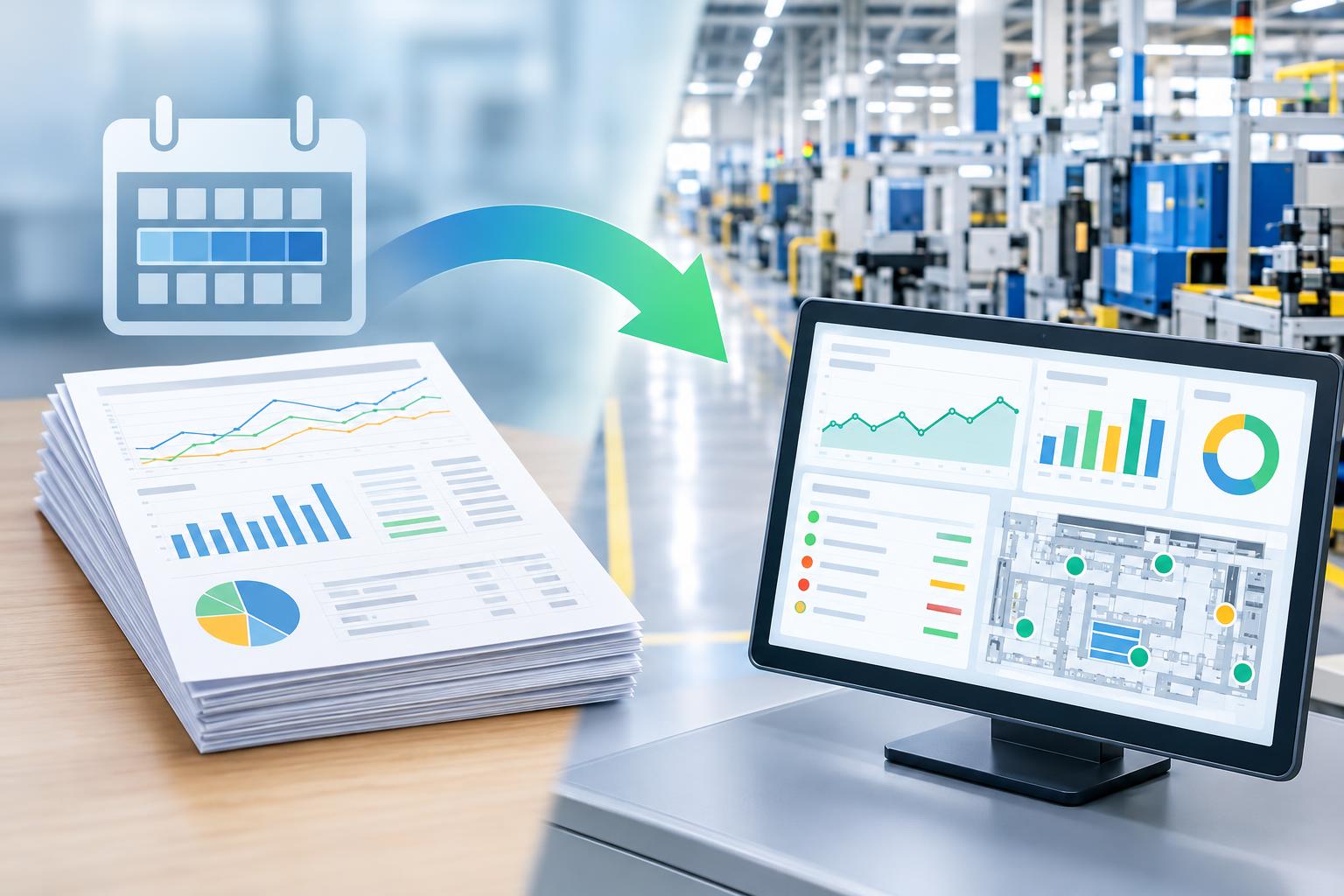
Weekly operational decks tell leadership what happened last Friday—useful for quarterly forecasting, but practically worthless for saving Tuesday’s production run. Frontline supervisors do not need another retrospective slide; they need live, reliable signals while a bottleneck is still reversible. Bridging that gap means wiring floor-level observations directly to an accountable owner, a defined countermeasure, and a verification loop that confirms the process actually recovered.
Calibrate Information Speed to Operational Decay
Every floor decision carries an expiration clock. A starved assembly cell or a backing-up shipping dock demands intervention within the hour, whereas recurring changeover drag fits neatly into a morning tiered stand-up. Capital requests for new machinery sit on an entirely different horizon, requiring months of utilization and ROI proof. Forcing all three onto a weekly reporting cadence guarantees that urgent issues expire before anyone acts on them.
To eliminate that lag, audit the true lifecycle of a floor disruption. Log four timestamps for a typical bottleneck: when the anomaly physically begins, when the system captures it, when a supervisor actually inspects it, and when corrective work gets underway. That simple time-study separates technical data delays from organizational friction such as unclear sign-offs or buried dashboards.
Avoid overhauling the entire facility at once. Target one recurring headache—such as line-side component stockouts that only surface in end-of-shift downtime logs—and establish an earlier trigger, like automated Kanban buffer thresholds, so a material handler can replenish stock before the line stalls.
Replace Vague Alarms with Diagnostic Evidence
A dashboard flashing “Line 4 efficiency low” forces a supervisor to burn twenty minutes just figuring out what broke. Actionable floor intelligence arrives packaged with diagnostic context: the exact work center, the active run or SKU, the variance against standard cycle time, and a timestamp proving the feed is current.
Single-source metrics rarely tell the whole story. Throughput dips become far clearer when cross-referenced against recent CMMS maintenance tickets, raw-material lot changes, or shift rosters. Before merging data streams, confirm that equipment IDs, shift boundaries, and system clocks align across platforms—and explicitly label missing fields so teams never mistake a working hypothesis for a confirmed root cause.
Where computer vision or facility cameras help verify floor conditions, establish strict governance before rollout: define the operational scope, restrict viewing permissions, enforce retention limits, and apply automated privacy blurring. Account for camera blind spots and lighting glare, and always validate anomalies with the operators running the line, who can explain temporary setups or mandatory quality checks that automated sensors miss.
- Asset and run specifics: Pinpoint the exact work cell, timeframe, and active product configuration.
- Variance against standard: Contrast expected throughput or cycle baseline against observed performance.
- Corroborating logs and freshness: Attach linked maintenance or inventory records with clear sync timestamps.
- Known blind spots: Flag missing telemetry, sensor lags, or unverified assumptions upfront.
- Required decision: State the specific operational call awaiting action.
Establish Single-Threaded Ownership and Clear Escalations
Shared responsibility on a plant floor usually means nobody moves. Each category of exception needs one pre-assigned owner and a clear expectation for the next step. A replenishment delay routes straight to the material-handling lead; a repeat pneumatic fault dispatches directly to reliability maintenance. Broadcasting identical alerts across multiple department channels without naming a single coordinator creates bystander paralysis.
Back up ownership with firm escalation rules. Define how quickly an alert requires acknowledgment, who covers when a lead is off-shift, and how unresolved items transfer at shift handover. Track these actions inside your existing work-order or corrective-action platform rather than spinning up standalone spreadsheets that go stale within days.
Protect frontline focus by pruning noisy alerts. If an automated rule pings a supervisor every ten minutes about an issue already under repair, floor leads will tune out the entire system. Audit alert thresholds and batching rules during weekly team reviews—while keeping immediate safety stops and EHS hazards on dedicated, unmistakable escalation paths.
Standardize Frontline Checks to Expose Systemic Friction
Consider a high-volume packaging and distribution operation where weekly KPI reviews routinely flag missed carrier cutoff times. Because mid-week reports only tally total pallets wrapped per shift, floor leads cannot see when dock staging lanes begin to choke. Introducing a structured daily check—tracking staging-lane saturation, pallet dwell time, and carrier check-in windows—changes visibility immediately.
If those daily checks reveal finished pallets backing up two hours before scheduled pickups and spilling into marked pedestrian walkways, the shift supervisor can immediately clear the aisle under site safety rules while collaborating with shipping planners to stagger line-offloading windows. Production and EHS teams then examine the exact same sequence of events rather than debating conflicting recollections.
Uniform observation standards make those insights comparable across every shift. Document precise criteria for measuring staging congestion or walkway encroachment, re-verify both metrics after adjusting the schedule, and store the initial finding, corrective action, and verification sign-off together for future compliance and continuous-improvement audits.
Measure Detection-to-Recovery Time, Not Ticket Volume
Judge any reporting upgrade by whether it shrinks the gap between a problem starting and the process recovering. Track elapsed minutes or hours from event onset to supervisor review and countermeasure launch, alongside the percentage of alerts that actually trigger a substantive intervention. Delivering bad news faster achieves very little if recipients still lack the parts, headcount, or authority to act.
Never confuse closing a software ticket with solving an operational problem. Marking an action complete only proves administrative follow-through; genuine proof comes from comparing cycle times, scrap rates, or on-time departures before and after the change under matching volume and staffing conditions.
Keep weekly leadership reviews focused on systemic, multi-shift patterns that frontline teams cannot solve alone—such as chronic equipment bottlenecks, supplier quality drift, or capital investments—while ensuring every shift handover carries open floor actions forward with a named owner and a scheduled check-in time.
Design Reporting Around the Next Concrete Intervention
Leaders evaluating operational reporting and workflows should trace how intelligence travels from raw machine or system records to root-cause review, task assignment, and verified resolution. Confirm that supervisors can inspect underlying evidence in seconds, recognize incomplete telemetry immediately, and log the physical outcome of their response without extra administrative friction.
Begin with a single operational decision that chronically arrives too late. Define the minimum evidence required, assign one accountable owner, and select one floor metric to validate improvement. Once the team demonstrates that faster, context-rich intelligence drives measurable operational recovery, scale that exact discipline across adjacent workflows.