




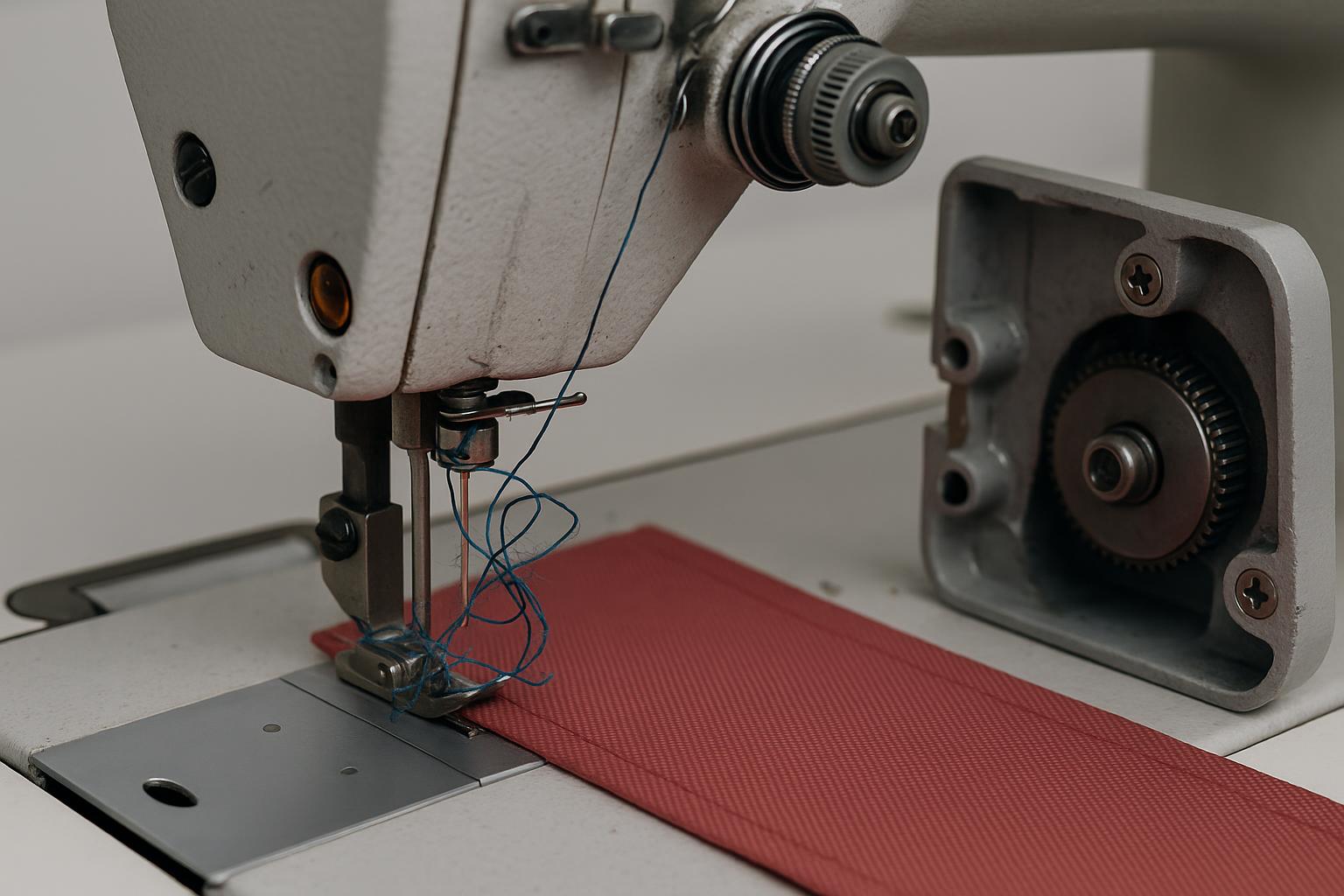
A practical guide for production managers, maintenance teams and machine operators
Introduction
Industrial sewing machines are the workhorses of garment, upholstery, automotive, footwear, medical textile and technical fabric production. Running at speeds of 3,000 to 5,500 stitches per minute for hours at a time, they are built to be tough, but they are also precision mechanisms. A needle bar that is a fraction of a millimetre out of position, a hook that has lost its polish, or a bobbin case with a hairline burr can turn a productive line into a stream of rejects.
Most industrial machine problems are not sudden. They develop gradually through wear, contamination, poor setup and skipped maintenance, and they usually announce themselves through small symptoms long before a machine stops. This article looks at the most common faults, what they cost when they cause downtime, the preventative measures that stop them occurring, and the spare sewing machine parts worth keeping on the shelf so that repairs take minutes rather than days.
The Most Common Industrial Sewing Machine Faults
1. Skipped stitches
Skipped stitches, where the needle thread fails to catch the hook or looper thread, are probably the single most reported fault. The usual causes are:
- Incorrect needle type or size for the fabric and thread. A needle that is too fine deflects on heavy materials, while one with the wrong point style can push fabric rather than penetrate it.
- A bent, blunt or incorrectly inserted needle. Even a slight bend, often caused by sewing over pins or thick seams, changes the timing of the loop formation.
- Timing issues between the needle and the hook or looper. If the hook meets the needle thread loop too early or too late, stitches are missed.
- Incorrect needle height or hook-to-needle clearance. The hook point should pass very close to the needle scarf without touching it. Too far and it misses the loop; too close and it nicks the needle.
- Flagging fabric. Stretchy or lightweight materials that lift with the needle as it rises can prevent a proper loop forming. A worn presser foot or feed dog is often a contributing factor.
Because the needle is the most frequently replaced part, a regular needle-change routine eliminates a large share of skipped stitch complaints on its own.
2. Thread breakage and fraying
Repeated thread breaks slow operators down and signal that something in the thread path is causing friction or damage. Common culprits include:
- Incorrect threading or a poorly seated thread in the tension discs.
- Burrs or rough spots on the needle eye, throat plate, hook, bobbin case or thread guides. These act like tiny saws on the thread.
- Excessive top tension or a tension assembly clogged with lint and thread finish residue.
- Poor-quality or old thread, or thread that is wrong for the speed being run. Thread that is stored in hot, dry or damp conditions loses strength.
- Needle heating. At high speeds, especially on synthetic fabrics and dense seams, the needle can reach temperatures that melt synthetic thread. Needle coolers, silicone lubricant systems or lower speeds can help.
3. Tension problems and poor stitch quality
Looping on the underside of the fabric, loose or tight seams, puckering and uneven stitches all trace back to thread tension and thread path issues. Typical causes are:
- Lint and dirt in the bobbin case and tension discs.
- Worn or weakened tension springs that no longer deliver consistent pressure.
- Damaged or incorrectly adjusted take-up levers and check springs.
- Thread of inconsistent diameter, or a mismatch between needle thread and bobbin thread.
- Operators making repeated tension adjustments to compensate for a mechanical fault, which only masks the real problem.
A useful rule of thumb is that if tension has to be adjusted dramatically to get an acceptable stitch, something else is wrong.
4. Needle breakage
Frequent needle breakage points to one or more of the following:
- Needles too fine for the material.
- Operators pulling or pushing fabric instead of letting the feed system do the work.
- A needle striking the throat plate, hook or presser foot because of misalignment or loose fittings.
- Loose needle clamp screws or needle bar damage.
- Sewing over metal items, zips with hard stops or very thick seam intersections without slowing down.
Broken needle fragments can also travel into the hook area and cause costly damage, which is why every breakage should be followed by a check to confirm all fragments have been accounted for.
5. Feeding problems
Uneven feeding, fabric slipping, mismatched plies or inconsistent stitch length indicate a problem in the feed mechanism. Causes include:
- Worn feed dogs whose teeth have been smoothed down by thousands of metres of fabric.
- Incorrect feed dog height relative to the throat plate.
- Incorrect presser foot pressure, too light to hold the fabric or too heavy to let it move.
- Worn presser feet, walking feet or roller feet, especially those with rubber or Teflon inserts.
- Wear or looseness in the feed rocker shaft, feed bar or associated linkages, which allows the feed motion to become sloppy.
6. Timing loss
Machine timing is the precise relationship between the needle bar, the hook or looper, and the feed mechanism. Timing can drift after a needle strike, a thread jam, a heavy impact or simple vibration over months of operation. Symptoms include repeated skipped stitches, noisy running, needle breakage and hook damage. Retiming requires skill and the right gauges, so it is normally a job for a trained mechanic. The key preventative step is to catch drift early, before a minor timing error damages the hook or needle bar.
7. Excessive noise, vibration and heat
Unusual sounds, knocking, grinding or a machine that is hot to touch around the arm or head almost always point to lubrication problems or worn bearings. Causes include:
- Low or contaminated oil in the reservoir.
- Blocked oil wicks and lines.
- Worn bushings and bearings in the needle bar, take-up lever or arm shaft.
- Loose belts, pulleys or motor mounts.
- Lint-packed areas causing friction.
Ignoring early noise is one of the fastest routes to a seized machine and a major repair.
8. Oil leaks and fabric staining
Oil marks on garments are a quality failure that often cannot be fixed. Overfilled reservoirs, worn oil seals, failed gaskets and incorrect oil grade can all cause leaks, as can over-lubrication of areas that are meant to be run dry (for example, hooks on some dry-head machines). Operators should be trained to know which machines are oil-lubricated, which are semi-dry or dry-head, and what each requires.
9. Electrical and servo motor faults
Modern machines rely on servo motors, control boxes, sensors and often electronic needle positioners, thread trimmers and stitch counters. Common faults include:
- Motors that fail to start, run slowly or overheat.
- Needle positioner errors where the needle does not stop in the correct position.
- Thread trimmer failures, caused by solenoid wear, loose linkages or blunt trimmer knives.
- Sensor faults caused by lint and dust.
- Damaged cables and connectors from vibration or being caught during tilting of the machine head.
- Power quality problems such as voltage drops and surges.
10. Bobbin and hook area problems
The hook and bobbin area is the most lint-prone part of any lockstitch machine. Typical issues include bobbin thread breaking, bobbin case damage, a burred or scratched hook, a worn hook gib or position bracket, and bobbin winders that wind unevenly. Regular cleaning here is the cheapest and most effective maintenance task available.
The Impact of Downtime
When a machine stops, the cost is almost never limited to the repair itself. Downtime has direct, indirect and hidden consequences.
Lost production. On a sequential production line, one stopped machine can halt every operation downstream. If a single operation is the bottleneck, the whole line is only as fast as that machine. A line of 20 operators waiting on one broken machine represents 20 paid labour hours lost for every hour of downtime.
Labour costs. Operators continue to be paid while waiting, and maintenance staff are pulled away from planned work. Overtime may be needed to recover the lost output.
Missed delivery dates and penalties. In fast-turnaround sectors such as fashion, retail supply and automotive, late delivery can mean financial penalties, air freight costs, cancelled orders or damaged customer relationships.
Quality problems. Machines that are running poorly rather than stopped cause a different kind of loss. Skipped stitches, puckered seams and oil stains lead to rework, seconds and rejects. Rework consumes labour and sometimes damages the garment further.
Emergency repair premiums. Unplanned breakdowns usually require urgent callouts, expedited freight for parts, or paying more for parts bought in a hurry.
Secondary damage. A small problem left alone often becomes a large one. A loose belt becomes a damaged motor; a bent needle becomes a damaged hook; a low oil level becomes a seized shaft.
Morale and safety. Constant breakdowns frustrate operators, reduce piece-rate earnings and increase the temptation to work around faults, which can introduce safety risks.
A simple way to illustrate the economics is to calculate the hourly cost of the line (labour, overheads and lost margin) and multiply it by the downtime hours per month. For many factories the figure is far larger than the annual cost of a proper preventative maintenance programme and a modest spare parts stock.
Preventative Measures
Preventative maintenance (PM) means doing the right small tasks at the right intervals so large failures do not occur. The most effective programmes combine daily operator care, scheduled mechanic servicing and good record keeping.
Daily operator checks
Operators are the first line of defence because they know how a machine should sound and feel. A short start-of-shift routine should include:
- Remove lint and thread debris from the hook area, feed dogs, throat plate and thread path.
- Check the needle for bends, burrs or dullness, and replace it if in doubt.
- Check oil levels where applicable, and confirm that oil is circulating (many machines have a sight window).
- Test-sew on scrap fabric to check stitch formation and tension before beginning production.
- Listen for unusual noises and report them immediately.
- Keep the work area free of pins, clips and scraps that can get into mechanisms.
Needle management
A planned needle-change policy is one of the cheapest quality improvements possible. Needles should be changed on a schedule based on hours or garment counts, not only when they fail. Use the correct needle system, size and point for each fabric, and keep a log of needle changes. A broken-needle control procedure, where the fragments are found and recorded, is essential in sectors such as medical, food-adjacent, childrenswear and automotive.
Scheduled lubrication
Use only the oil grade recommended by the manufacturer. Follow the lubrication chart for each machine, and do not over-oil. Replace oil in reservoir systems at the specified intervals, and change filters or wicks. Dry-head machines should be checked to confirm that their lubrication-free components are in good condition.
Cleaning
A weekly deep clean of the hook assembly, feed system, motor vents, cooling fins and belt covers prevents the build-up that causes overheating and wear. Compressed air should be used carefully, as it can blow lint deeper into mechanisms. A small brush and vacuum are often better in the hook area. Servo motor cooling vents and control box filters need regular cleaning too.
Scheduled mechanic servicing
A trained mechanic should carry out periodic inspections, typically every three to six months depending on use. These should include:
- Checking and adjusting timing.
- Checking needle bar height and hook clearance.
- Inspecting hook, bobbin case, feed dogs, presser feet and throat plate for wear.
- Checking belts, pulleys and motor mountings.
- Testing thread trimmer, needle positioner and sensors.
- Checking electrical cables and connectors.
- Checking the stitch length, presser foot pressure and tension mechanisms.
Training
A surprising number of faults arise from operator error. Operators need training in correct threading, bobbin winding, needle selection, fabric handling and the early recognition of problems. Operators should be encouraged to report faults without blame, and not to attempt timing adjustments they have not been trained to perform.
Quality of consumables
Cheap needles, thread and oil often cost more in the long run. Consistent-quality thread with a clean finish causes fewer breaks, less lint and fewer tension issues. Buying needles from reputable manufacturers reduces breakage and variation in point and eye quality.
Environmental control
Dust, humidity and temperature extremes affect machines and thread. Keep the sewing floor clean, store thread in controlled conditions, protect electrical equipment from moisture, and ensure power supplies are stable. Surge protection and voltage stabilisation can protect electronic controls.
Records and data
Keep a maintenance log for each machine recording servicing dates, parts replaced, faults and the time to repair. Over time, patterns emerge: a particular machine that consumes hooks, a line that breaks needles more often, a model that suffers repeated motor failures. This data allows maintenance to move from reactive to predictive, and informs decisions on replacing a machine that has become uneconomical to repair.
Planned replacement of wear parts
Rather than waiting for components to fail, replace known wear items at set intervals. A feed dog replaced during a planned service costs a few pounds and a few minutes; one that fails mid-order can cost far more in lost production.
Parts That Commonly Need Replacing
Industrial machines are modular and most parts can be replaced individually. The components below are grouped by how often they typically need attention.
Consumables and high-frequency wear parts
- Needles. The most frequently replaced item. Different systems, sizes and points are needed for different fabrics.
- Bobbins and bobbin cases. Bobbins can become bent or damaged, and bobbin cases develop burrs or tension spring wear.
- Presser feet. Wear, burrs or damaged inserts cause feeding problems and marking of fabric. Many specialist feet exist (zip, piping, walking, roller, hemmer and so on).
- Feed dogs. Teeth wear down with use, particularly on abrasive or heavy fabrics.
- Throat plates (needle plates). Needle strikes and wear around the needle hole cause thread breaks and fabric damage.
- Thread trimmer knives (fixed and moving). These blunt over time and cause failed trims or thread tails.
- Belts. Motor drive belts stretch, crack and glaze.
Medium-frequency wear parts
- Hooks and hook assemblies (rotary hooks, oscillating hooks, loopers). These suffer from needle strikes and wear, and are critical to stitch formation.
- Loopers, spreaders and needle guards on overlockers, coverstitch and chainstitch machines.
- Tension discs, tension springs and check springs. Lose consistency with age and lint contamination.
- Thread guides and take-up levers. Grooves wear into guides and cut thread.
- Needle clamp screws and needle bar bushings.
- Oil wicks, felts, filters and seals. Prevent leaks and ensure proper lubrication.
- Solenoids and trimmer linkages on automatic machines.
- Foot lifter mechanisms and knee lifters.
Lower-frequency but high-impact parts
- Servo motors and control boxes. Can fail through age, heat or power issues.
- Needle positioners and sensors.
- Timing belts and pulleys.
- Bearings and bushings in the arm shaft, hook shaft and needle bar.
- Feed rocker shafts, feed bars and connecting links.
- Hand wheels, clutches and brake assemblies.
- Foot pedals and cables.
- Gears and drive components in feed-off-the-arm, cylinder-bed and heavy-duty machines.
- Complete hook shaft or needle bar assemblies.
Which Parts to Keep on Hand
The goal of a spares strategy is to cover the parts that fail most often or that would cause the longest stoppages, without tying up cash in rarely needed stock. A sensible approach is to categorise parts by how often they fail, how critical they are, and how long they take to arrive.
Tier 1: Always keep in stock
These are used regularly and should be held in quantity.
- Needles in all sizes and types used in production (hold several boxes of each).
- Bobbins and, for lockstitch machines, a few spare bobbin cases.
- Presser feet in the types used by each machine model.
- Feed dogs for each machine type.
- Throat plates for each machine type.
- Thread trimmer knives (fixed and moving).
- Tension springs and check springs.
- Needle clamp screws, small screws and fasteners.
- Oil, lubricants and cleaning supplies in the manufacturer-recommended grades.
- Belts of the sizes used in the factory.
- Thread guides and common small guide components.
Tier 2: Hold at least one spare of each
These fail less often but their absence would stop production for a day or more.
- Complete hook assemblies for each main machine model.
- Loopers, spreaders and needle guards for overlockers and coverstitch machines.
- Solenoids and trimmer linkage parts for automatic machines.
- Take-up levers and tension assemblies.
- Needle bar bushings and oil seals.
- Foot pedals or electronic speed control units.
- Sensors and needle positioner units.
- Knee lifter and foot lifter parts.
- Spare fuses, small relays and connectors.
Tier 3: Consider holding or arranging rapid supply
These are expensive and rarely needed, so the decision depends on how critical a machine is.
- Servo motors, particularly for bottleneck machines or where many identical motors are used.
- Control boxes or circuit boards for specialist or automated machines.
- Spare complete machine heads for critical lines, or at least an identical spare machine that can be swapped in.
- Major shafts, gears and bearings for heavy-duty or specialist models.
For these items, a supply agreement with a reliable distributor with guaranteed delivery times may be more practical than holding stock.
How to decide what to hold
Several factors help refine the list:
- Maintenance history. Review the log for what has failed over the last one to two years.
- Criticality. Machines that are bottlenecks, single points of failure or used for high-value orders deserve a deeper spares cover.
- Lead time. Parts that take weeks to arrive from overseas need higher stock levels than those available next day locally.
- Standardisation. The fewer machine models and brands in a factory, the smaller the spares inventory needs to be. Standardising on a few models pays off quickly.
- Cost and shelf life. Cheap, fast-moving parts can be held generously; expensive slow-moving parts need a more careful business case.
- Compatibility. Use genuine or properly specified parts. Poor-quality copies may fit but wear quickly, damage other components or fail to hold tolerances.
Organising the spares store
A spares store is only useful if parts can be found quickly. Keep it clean, labelled by machine model and part number, and set minimum stock levels so reordering is triggered before items run out. A simple kit for each machine type, containing the most commonly needed small parts, can be placed on the floor or in a mechanic’s toolbox for immediate use. Record usage so that stock levels can be reviewed regularly.
Building a Maintenance Culture
Tools, schedules and spares only work if people use them. The most reliable factories treat maintenance as part of production rather than an interruption to it. In practice this means:
- Setting aside planned maintenance time in the production schedule instead of fitting it in when machines break.
- Giving operators ownership of their machine’s daily care.
- Rewarding early reporting of faults, not just output.
- Reviewing downtime data in regular meetings and acting on the top causes.
- Investing in mechanic training and in good tooling, such as timing gauges, feeler gauges and a proper bench for repairs.
- Replacing machines that have reached the end of their economic life, rather than continuing to pour repair costs into them.
Quick Reference: Fault Symptoms and Likely Causes
| Symptom | Likely causes | First checks |
|---|---|---|
| Skipped stitches | Wrong or bent needle, timing drift, flagging fabric | Change needle, check type and insertion, check hook clearance |
| Thread breaking | Burrs, wrong threading, high tension, poor thread | Re-thread, inspect thread path and needle eye, reduce tension |
| Loose or looping stitches | Dirty tension discs, worn springs, incorrect bobbin threading | Clean tension unit, check bobbin case and threading |
| Needle breakage | Wrong size, needle strike, operator pulling fabric | Check needle size, throat plate and hook clearance |
| Uneven feeding | Worn feed dogs, wrong presser pressure | Inspect feed dogs and foot, adjust pressure and height |
| Noise or heat | Low oil, worn bearings, lint build-up | Check oil flow, clean, inspect bearings and belts |
| Oil staining | Overfilled reservoir, failed seals | Check oil level, inspect seals and wicks |
| Trimmer not working | Blunt knives, solenoid or linkage fault | Inspect knives and linkage, test solenoid |
| Machine will not start | Power fault, motor or control fault, safety switch | Check supply, fuses, switches, motor and control box |
Conclusion
Industrial sewing machines reward care and punish neglect. The most common faults, including skipped stitches, thread breaks, tension problems, feeding issues and timing drift, almost always have simple, identifiable causes that can be prevented with disciplined daily cleaning, correct needle and thread selection, proper lubrication and regular mechanic inspections. The cost of downtime, from lost output and idle labour to missed deliveries and rework, is almost always far greater than the cost of prevention.
A well-planned spares strategy completes the picture. By holding the consumables and wear parts that fail most often, keeping a spare of each critical mid-range component, and having a plan for expensive electrical items, a factory can turn what would be a day-long stoppage into a ten-minute repair. Combined with training, record keeping and a genuine maintenance culture, these steps keep machines running, products consistent and production lines profitable.