




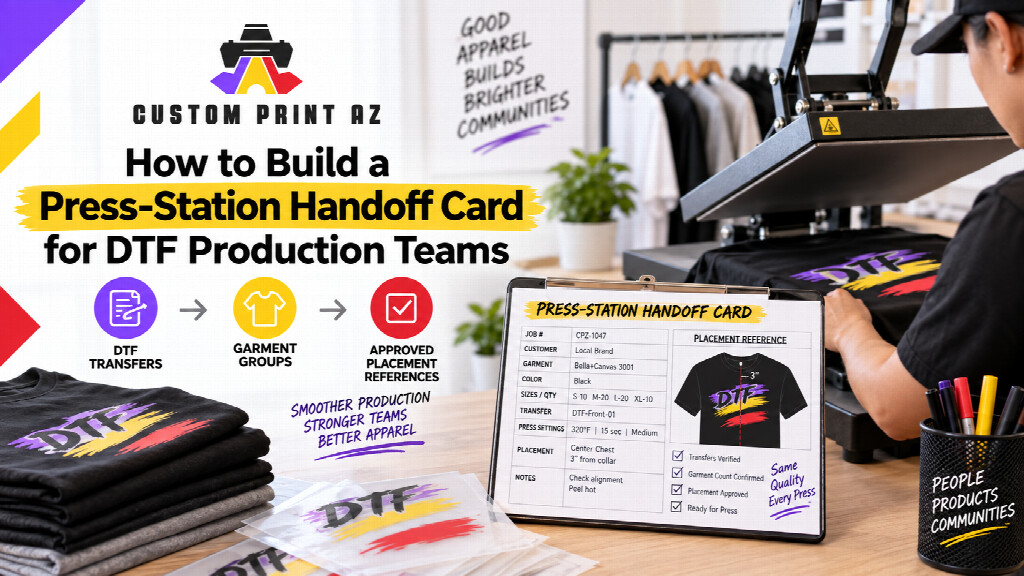
A DTF job can be perfectly organized at the ordering stage and still become confusing when it reaches the press station. That is especially true when more than one person touches the work. One employee may prepare the artwork, another may receive the transfers, and a third may press the garments. If the press operator has to reconstruct the job from emails, messages, or memory, production becomes slower and mistakes become easier to make.
A press-station handoff card is a short production document that travels with the job. It does not replace artwork approval, order records, or application instructions. Its purpose is narrower: give the person at the press enough information to identify the correct job, garment group, transfer group, sequence, and exceptions without reopening the entire order history.
Keep the Card Focused on the Press Station
The handoff card should not become a second customer order form. Information belongs on it only if the press operator may need it while working. Job identity, transfer identity, garment grouping, quantity, placement notes, and approved production instructions are the priority.
Think of the card as a bridge between planning and execution. A shop using DTF transfers for Phoenix businesses, for example, may have one person handling local ordering and another handling pressing. A clear handoff document keeps those roles connected even when they happen at different times or locations.
Start With a Job Identifier That Everyone Uses
Every card should begin with a job identifier that matches the identifier used elsewhere in the shop. That may be an order number, customer name plus date, internal job code, or another consistent system. The exact format matters less than consistency. The press operator should be able to look at the card, the transfer stack, and the garment group and see the same job reference.
List Transfer Groups by Production Role
Do not assume the artwork itself will tell the operator how each transfer is used. List the transfer groups in the language of production. Examples might include left chest, full back, sleeve, staff front, customer back, or another role that matches your approved job plan.
If two transfer groups look similar, give them distinct labels. If one design is used on two garment types, note that relationship. The goal is to prevent the operator from making a visual guess when a simple written label would remove uncertainty.
Connect Each Transfer Group to a Garment Group
A good handoff card makes the transfer-to-garment relationship obvious. List the garment style, color, size range, or internal pile label needed to identify the correct group. You do not need to repeat every purchasing detail. You need enough information to stop one transfer set from drifting into the wrong garment stack.
Many shops already stage garments in piles or bins. Give those groups names and use the same names on the handoff card. “Pile A” only works if the physical pile is also labeled “A.” Production language should match the production floor.
Record the Approved Placement Reference
The handoff card can point to the approved placement reference without attempting to rewrite it. If the shop uses a mockup, placement chart, first-piece sample, or another approved visual, note where that reference is located. Avoid creating a new measurement from memory at the press station.
This is also the right place to note when a garment group uses a different approved placement from the rest of the job. Keep the note short and specific. The operator should be able to identify the exception immediately rather than discover it halfway through the run.
Separate Standard Work From Exceptions
Most of the handoff card should describe the normal job. Exceptions deserve their own area because they are easy to miss when buried in a paragraph. If one garment is a sample, one transfer group is on hold, or a small subset uses a different artwork version, list those items under a clear “Exceptions” heading.
- Job ID: the reference used across the order.
- Transfer groups: each design or placement role.
- Garment groups: the piles, bins, or size groups used at the press.
- Approved reference: where the operator finds placement or production instructions.
- Exceptions: items that should not follow the normal sequence.
- Completion count: a place to record finished and held pieces.
Add a Completion and Exception Count
The handoff should continue through the end of the run. Give the operator a simple place to record how many pieces were completed, how many were placed on hold, and whether any garment or transfer remained unused. This creates a clean handoff to packaging, pickup, or the next production step.
A shop working with ready-to-press DTF transfers may already receive transfers in a form intended to move efficiently into pressing. A handoff card complements that workflow by keeping the internal production information attached to the physical job.
Design the Card for One-Glance Use
If the card is dense, the operator will stop using it. Keep it to one page when possible. Use short labels, simple tables, or clearly separated sections. The card should work when production is busy and the operator has a stack of garments in front of them.
A Better Handoff Protects the Work Already Done
Artwork preparation, ordering, receiving, and garment staging all create useful information. A press-station handoff card keeps that information from disappearing at the final production step. By identifying the job, connecting transfers to garment groups, pointing to approved references, separating exceptions, and recording completion counts, the card gives the press operator a clear path through the work. That makes the production floor easier to manage without turning every operator into the historian of the entire order.