





As fiber broadband becomes the dominant access technology in both residential and enterprise environments, many users encounter two key devices at the network edge: the Optical Network Terminal and the router. Although they are often installed together and sometimes confused with each other, their functions are fundamentally different. Understanding how they work and interact is essential for designing stable, efficient, and scalable networks.
This article explains the core differences between ONT and router, clarifies their roles in fiber networks, and explores how they are deployed in real-world scenarios, including solutions from VSOL.
What Is an ONT?
An Optical Network Terminal, commonly referred to as ONT, is the endpoint device of a fiber optic network. It is typically installed at the customer premises and serves as the interface between the optical fiber infrastructure and user devices.
In a Passive Optical Network architecture, the ONT connects directly to the Optical Line Terminal at the service provider side through the optical distribution network. Its primary function is to convert optical signals into electrical signals that standard network devices can process.
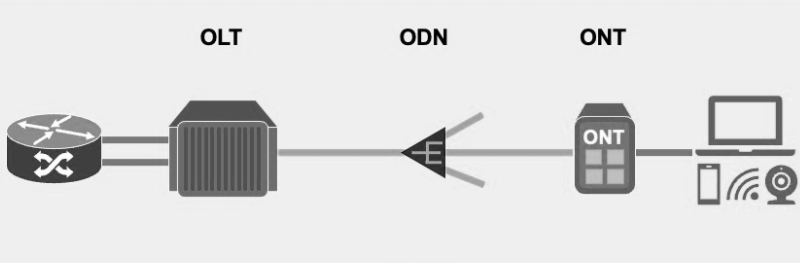
From a technical perspective, the ONT handles:
- Optical to electrical signal conversion
- GPON or XGS PON protocol termination
- Traffic encapsulation and decapsulation
- Basic service interfaces such as Ethernet ports, voice ports, or IPTV
Some modern ONTs also integrate Wi Fi functionality, but their core responsibility remains signal conversion and access termination rather than network management.
What Is a Router?
A router operates at a higher level in the network stack. It is responsible for directing traffic between different networks, typically between a local area network and the internet.
Unlike an ONT, a router does not interact with optical signals. Instead, it manages IP traffic, assigns addresses, and enforces policies that determine how data flows within and outside the local network.
Key router functions include:
- Network address translation for internet access
- DHCP server for IP address assignment
- Firewall and security policy enforcement
- Traffic routing and packet forwarding
- Wireless access point functionality in many cases
In short, the router is the intelligence layer of the network, controlling how devices communicate and how bandwidth is utilized.
Core Differences Between ONT and Router
To clearly distinguish these two devices, it is helpful to compare them across several technical dimensions.
Functional Role
The ONT serves as a physical and protocol bridge between the fiber network and the user environment. It ensures that optical signals can be interpreted by standard networking equipment.
The router, on the other hand, manages logical communication. It decides where data should go and how it should be handled within the network.
Position in Network Architecture
In a typical fiber deployment:
- The ONT is the first device after the fiber enters the premises
- The router sits behind the ONT and connects multiple user devices
This layered structure separates access technology from network control, improving flexibility and scalability.
Signal Processing
The ONT deals with optical transmission standards such as GPON or XGS PON. It converts light signals into Ethernet frames.
The router processes IP packets and operates at Layer 3 of the OSI model. It has no direct interaction with optical signals.
Configuration Complexity
ONT configuration is usually managed by the service provider through centralized systems. End users rarely need to adjust ONT settings.
Routers, however, are user facing devices. Network administrators or home users often configure Wi Fi, security rules, port forwarding, and quality of service.
How ONT and Router Work Together
Although their roles differ, ONT and router are tightly integrated in real deployments.
When a user accesses the internet:
- The ONT receives optical data from the service provider network
- It converts the signal into Ethernet frames
- The router receives the data and processes routing decisions
- The router distributes traffic to connected devices via wired or wireless connections
This division of labor allows each device to specialize, improving overall network efficiency and reliability.
Deployment Scenarios
Home Fiber Broadband
In residential environments, the ONT is often installed near the fiber entry point, while the router provides Wi Fi coverage throughout the home.
Some service providers deploy integrated devices that combine ONT and router functions. While convenient, these devices may limit flexibility in advanced configurations.
Small Business Networks
For small offices, separating ONT and router is usually preferred. The ONT handles fiber access, while a more capable router manages VPNs, security policies, and multi user traffic.
This separation allows businesses to upgrade their router without replacing the access device.
Enterprise and Campus Networks
In larger deployments such as campus networks or enterprise environments, ONTs are distributed across buildings or floors as part of a Passive Optical LAN architecture.
Routers or Layer 3 switches are deployed centrally to manage traffic aggregation, segmentation, and policy control. This architecture reduces cabling complexity and improves scalability.
Practical Considerations When Choosing Devices
When designing or upgrading a network, understanding the distinction between ONT and router helps avoid common pitfalls.
Performance Alignment
The ONT must support the bandwidth provided by the service provider, such as GPON or XGS PON speeds. The router must also be capable of handling this throughput without becoming a bottleneck.
Feature Requirements
If advanced features such as VPN, VLAN segmentation, or traffic shaping are required, the router becomes the critical component. The ONT should be selected for compatibility and stability rather than feature richness.
Integration vs Separation
Integrated ONT router devices simplify installation and reduce hardware footprint. However, separate devices provide greater flexibility, especially in professional environments.
VSOL Solutions in ONT and Routing
VSOL, as a PON and wireless CPE manufacturer, provides a range of ONT and router products designed for different deployment scenarios.
Its ONT portfolio supports GPON and XGS PON standards, offering stable optical access for residential, business, and campus applications. These devices are typically designed for high compatibility with mainstream OLT platforms and support remote management.
On the routing side, VSOL offers wireless routers and enterprise grade gateways that handle high concurrency, wide coverage, and secure traffic management. In integrated scenarios, VSOL also provides devices that combine ONT and routing capabilities, suitable for simplified home or small office deployments.
In campus or enterprise networks, VSOL solutions are often part of a broader Passive Optical LAN architecture, where ONTs act as access nodes and routers or gateways handle centralized traffic control.
Common Misconceptions
A frequent misunderstanding is that an ONT can replace a router. While some ONTs include basic routing or Wi Fi features, they are not designed to fully replace dedicated routing devices in performance or functionality.
Another misconception is that upgrading the ONT will improve Wi Fi performance. In most cases, Wi Fi quality depends on the router or access point rather than the ONT.
Conclusion
The ONT and router serve distinct but complementary roles in modern networks. The ONT enables fiber connectivity by converting optical signals into usable data, while the router manages how that data is distributed and controlled within the network.
For home users, understanding this distinction helps in troubleshooting and optimizing network performance. For businesses and network designers, it is essential for building scalable and efficient infrastructures.
A well designed network leverages both devices appropriately, ensuring that access technology and traffic management are each handled by the components best suited for the task.