




I used to treat bedtime like a negotiation I always lost. Work ran late. Screens stayed on. The alarm still rang at the same time. Mornings felt like punishment.
Last month I decided to stop guessing. I tested two free tools that claim to fix the timing problem: the Sleep Calculator at sleepcalculator and the one on Sleepopolis. Both lean on the familiar 90-minute sleep-cycle idea. Both spit out bedtimes or wake-up times in seconds. The experience, however, felt completely different.
Here is what happened when a tired human actually used them for two weeks.
Why Timing Tools Matter More Than Another Mattress Ad
Most adults need seven to nine hours. The CDC still reports that roughly one in three of us regularly fall short. That gap shows up as slower decisions, shorter tempers, and weaker focus the next day.
A good Sleep Calculator does not add hours to the clock. It simply reduces the chance you wake up in the middle of a cycle and spend the morning fighting your own brain. That is the only promise worth testing.
First Contender: sleepcalculator
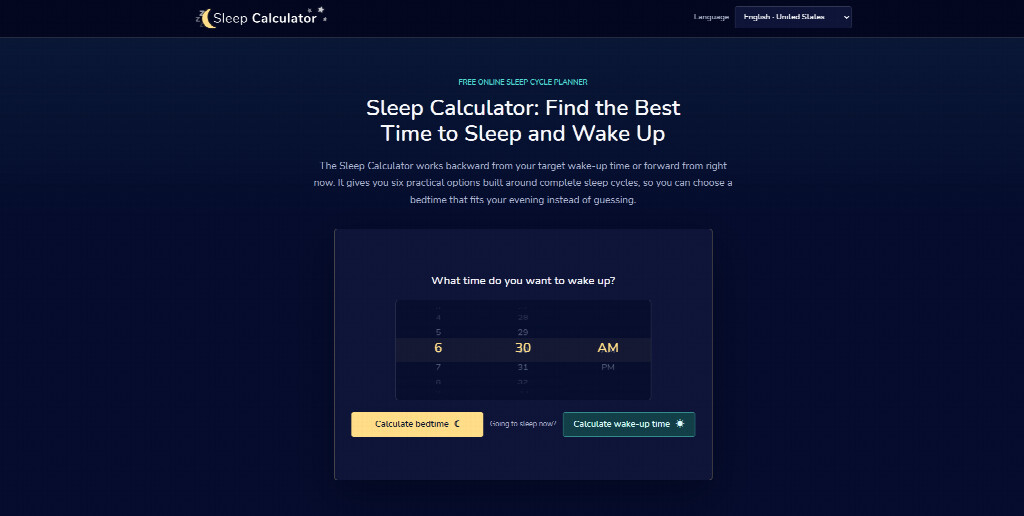
I opened the site on a Tuesday when I needed to be up at 6:15 for a call. The page loaded clean. One clear question sat in the middle: what time do you want to wake up?
I typed the hour. Six options appeared almost instantly. Each one counted complete cycles plus a short buffer for falling asleep. No age quiz. No scrolling past product banners. No “sign up for our newsletter” wall.
The whole interaction took under ten seconds. I picked the six-cycle suggestion, closed the laptop, and went to bed. The next morning felt noticeably less foggy than my usual random schedule.
What the Tool Actually Does
It works in two directions. Enter a fixed wake-up time and it counts backward. Or start from the current moment and it counts forward. Every result stays tied to full 90-minute blocks.
The design assumes you already know the basic idea of sleep cycling. It does not lecture. It just does the math and gets out of the way.
Who Gets the Most Value
Busy people who finish work at unpredictable hours like this one. Students pulling late study sessions also fit. Anyone who wants a number fast and then wants the screen to go dark will feel at home.
The main limitation is the lack of age-specific defaults. If you need pediatric or senior recommendations, you look elsewhere. For ordinary adult planning, the speed is hard to beat.
Second Contender: the Sleepopolis Calculator
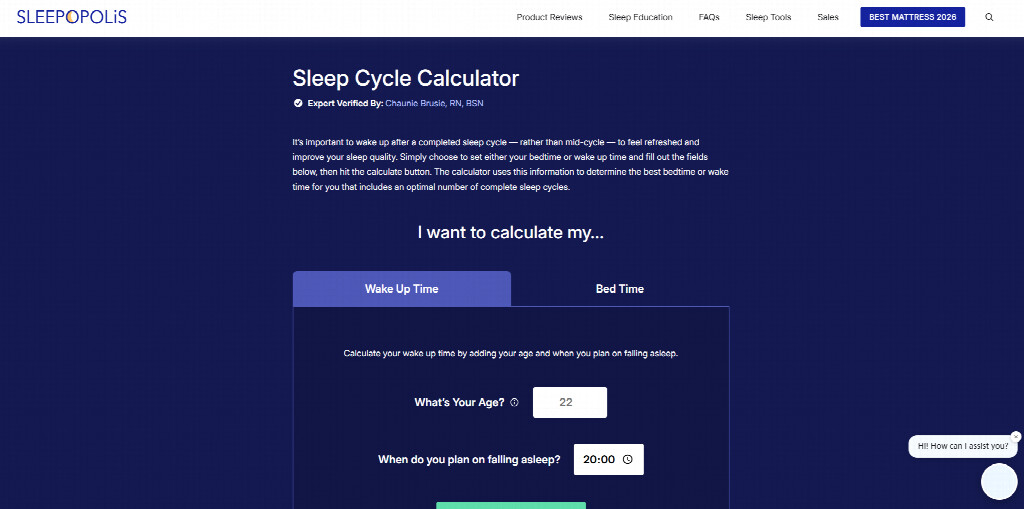
The same week I tried the Sleepopolis version. The URL promises a sleep calculator. What you meet first is a full mattress-review universe. Best mattress lists, comparison tables, and product links fill the screen before the actual tool appears.
Once you reach the calculator itself, the mechanics are familiar. You can set a wake-up time or a bedtime. The tool still uses cycle math. Results show up. The surrounding noise, however, changes the feel.
I tested it on a night when I only wanted a quick answer. I spent more time scrolling past reviews and ads than I spent looking at the numbers. The calculation worked. The environment felt like walking through a store to reach the water fountain.
Strengths That Show Up
Sleepopolis wraps the calculator in educational content. If you arrived wanting both timing advice and mattress research, the combination can feel convenient. The site clearly knows its audience: people already shopping for sleep products.
Where It Friction Shows
For pure timing questions the extra content slows everything down. Users who open the page solely to sleep time calculate often bounce before they finish. The tool itself is functional. The page around it is not optimized for speed.
Side-by-Side Reality Check
I ran both tools on the same three nights with the same target wake-up time.
sleepcalculator.io returned six clean options every time and stayed quiet. Sleepopolis returned usable numbers too, but the path included more visual clutter and more opportunities to get distracted by product recommendations.
The underlying math is nearly identical. Both treat a sleep cycle as roughly ninety minutes and add a short fall-asleep buffer. The difference lives in the first five seconds of the experience.
One site treats the calculator as the main event. The other treats it as one feature inside a larger commercial library.
Real-World Scenarios That Revealed the Gap
Night one: late client call ended at 11:40. I needed a realistic bedtime for a 7 a.m. start. The first tool gave me options in the time it took to brush my teeth. The second required extra scrolling.
Night two: weekend reset. I wanted to shift my wake-up later by ninety minutes. Both handled the forward calculation. Only the cleaner interface made me want to check it again the next night.
Night three: I deliberately arrived tired and impatient. The minimal page still felt usable. The content-heavy page felt like work.
These are small differences. They compound when the tool is meant to be used on tired evenings.
What the Data and Experience Actually Suggest
Industry surveys keep showing the same pattern. People abandon digital tools that demand extra orientation time. A Sleep calculator that delivers the answer in one clear step earns repeated use. One that asks you to navigate past other goals tends to become a one-time visit.
Neither tool replaces medical advice. Neither claims to measure your personal cycle length with laboratory precision. Both offer a practical planning layer on top of the well-known ninety-minute average.
The cleaner interface simply removes more friction between the question and the answer.
How to Decide Without Overthinking
Ask yourself one question before you open either page: do I need only the timing numbers, or do I also want mattress and product research in the same visit?
If the answer is only the numbers, the focused tool wins on speed and calm. If you are already deep in sleep-product research, the broader site keeps everything in one place.
I still open the first one most nights. The second one stays bookmarked for the days I am also comparing mattresses. Both remain free. Both remain honest about the limits of cycle math.
Yet, better sleep rarely comes from calculation alone. True rest begins with how we choose to quiet the mind before bed. Instead of spending the final hour staring at blue light, I started turning to low-pressure, creative hobbies. Lately, that has meant learning how to draw — spending just fifteen quiet minutes with a sketchbook, practicing simple lines, shapes, and shading. That focused, tactile practice gives the busy mind a gentle place to land, washing away the tension of the day.
The real upgrade was not discovering a perfect algorithm. It was stopping the nightly guesswork, pairing a simple sleep window with a mindful evening ritual, and giving the night a concrete shape. That small change turned out to be enough.