




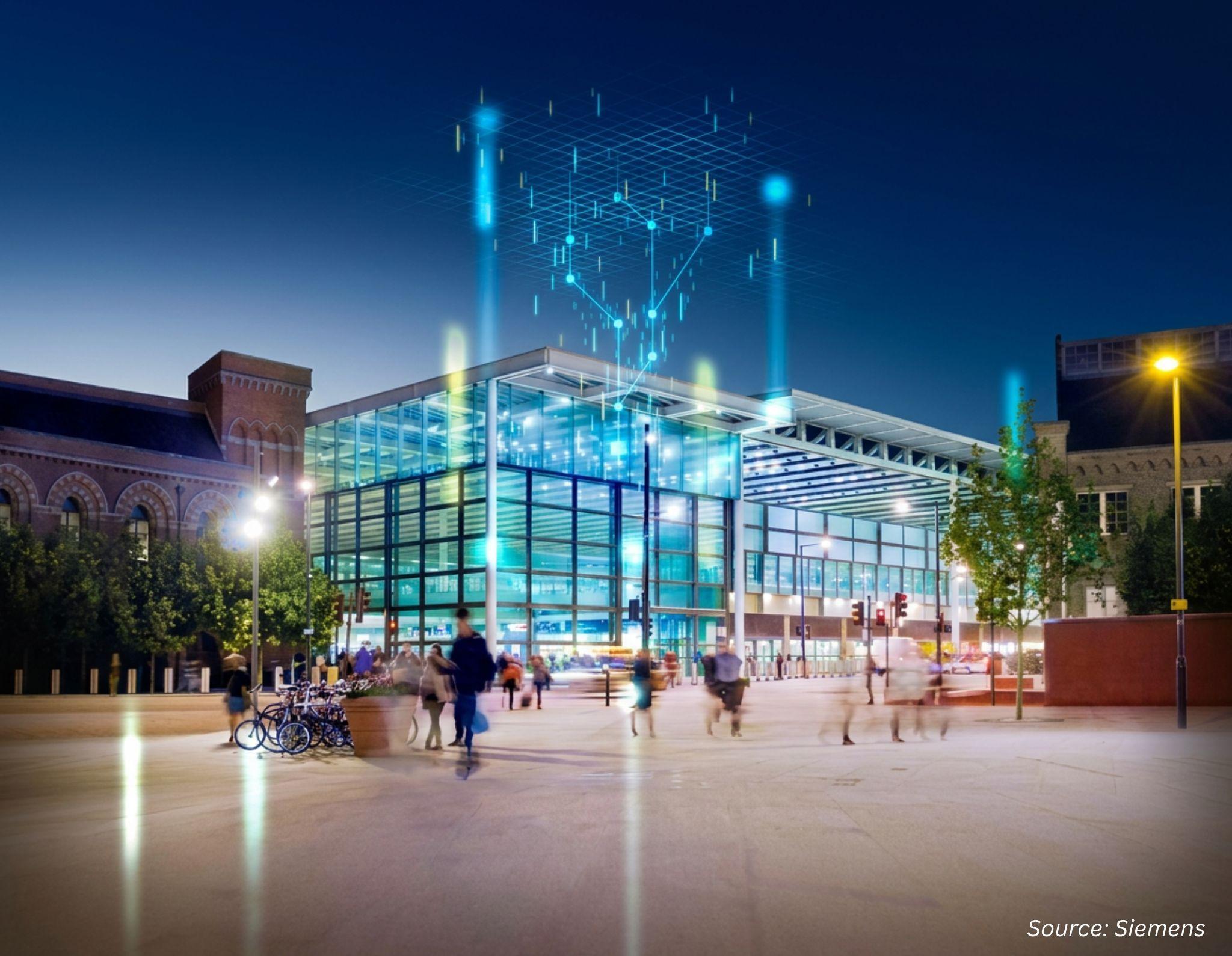
For most of the last century, a building did one thing well: it stood still. Walls held, elevators ran, and the thermostat sat on the wall waiting for someone to complain. That passive era is ending, and it isn’t ending gradually. Over the past year and a half, some of the largest technology and industrial companies on the planet have started treating the building itself as a computer—one that senses, learns, and negotiates with the people inside it.
The shift became hard to ignore in mid-2025, when Honeywell rolled out an AI-powered building management platform designed to pull previously siloed systems—security, energy, HVAC, comfort—into a single intelligent layer. Around the same window, Siemens and Microsoft announced a collaboration to connect Siemens’ Building X platform with Microsoft’s Azure IoT Operations, promising to break down the stubborn walls between building hardware and cloud software. The interoperability was slated to reach the smart spaces market in the second half of 2025.
These are not experiments. They are bets—big ones—on the idea that the next great enterprise platform won’t sit on your desk. It will be the space around you. And that reframing is exactly why investors, developers, CIOs, and governments are all suddenly paying attention to the same thing at once.
Let me walk through what’s actually happening, why it matters, and where the real opportunities and risks sit.
1. Smart Spaces Have Quietly Become Enterprise Infrastructure
There was a time when “smart building” meant a fancy lobby screen and app-controlled lighting. That definition is gone. Today the conversation is about buildings as operational infrastructure—closer to how a company treats its data center than how it treats its carpet.
The reason is simple economics. Real estate is one of the largest fixed costs a company carries, and hybrid work turned every square foot into a question mark. Executives now want to know, in real time, how their space is actually used: which floors sit empty, which meeting rooms are perpetually double-booked, how air quality tracks against occupancy.
That demand pulled building systems into the same digital transformation budgets that fund cloud migration and enterprise software. A recent Honeywell study found that 84% of commercial building decision-makers plan to increase their use of AI in the coming year to improve areas like security, energy management, and operations. That is not a technology fringe; it is a mainstream operating priority.
For facility managers and CIOs, the takeaway is uncomfortable but clarifying: the building is now part of the IT stack, whether the org chart admits it or not.
2. AI Is Redefining What “Intelligence” Means Inside a Building
The phrase “intelligent buildings” has been marketing filler for two decades. What changed is that the intelligence finally became useful, and it became useful because of three shifts happening together.
First, sensors got cheap and plentiful, so buildings finally generate enough data to be worth analyzing. Second, machine learning matured to the point where it can spot patterns humans miss—like an HVAC compressor drifting toward failure weeks before it trips an alarm. Third, edge computing moved that analysis closer to the equipment, so decisions happen in milliseconds instead of round-tripping to a distant server.
Predictive maintenance is the clearest early win. Instead of running equipment until it breaks or servicing it on a rigid calendar, AI-driven building management systems watch for the subtle signatures of wear and flag problems in advance. That trims downtime and stretches the life of expensive assets.
Occupancy analytics is the second front. AI can now read how spaces are used and adjust lighting, ventilation, and temperature to match reality rather than a static schedule. Siemens has described this trajectory bluntly: as buildings become more connected, AI is changing how they are managed and operated. The building stops guessing and starts responding.
The practical lesson for operators: the value isn’t in collecting data. It’s in acting on it automatically, without a human in the loop for every decision.
3. Sustainability Stopped Being a Preference and Became a Rule
Here is a number worth sitting with. Buildings account for roughly 30% of global final energy consumption, according to the International Energy Agency. When one sector uses that much energy, it becomes impossible to talk about climate targets without talking about the built environment.
Regulators noticed. The European Union’s recast Energy Performance of Buildings Directive now requires that all new buildings meet a zero-emission standard from 2030, with the broader goal of a decarbonized building stock by 2050. A zero-emission building, under the revised rules, has no on-site carbon emissions from fossil fuels and very high energy performance.
This is where sustainability and smart technology stop being separate stories. You cannot meaningfully cut a building’s energy use without measuring it precisely, and you cannot optimize what you cannot see. Intelligent controls, granular metering, and automated demand response are the tools that make regulatory targets achievable rather than aspirational.
The IEA has also noted that well-designed building codes can cut energy use dramatically, with buildings constructed under strong codes using up to 50% less energy. For developers, the message is that energy performance is becoming a compliance requirement and a valuation factor at the same time. A building that can’t prove its efficiency will increasingly struggle to lease or sell.
4. Connected Buildings Are Now Cybersecurity Targets
Every sensor, controller, and networked HVAC unit is a door. Add enough of them, and you’ve built a very large house with a great many doors—most of which were designed by engineers thinking about airflow, not adversaries.
That is the awkward truth of smart infrastructure. Operational technology (OT)—the systems that run physical equipment—was historically isolated. Connecting it to IT networks and the cloud unlocks enormous value, but it also exposes building systems to the same threats that plague any connected environment.
The stakes are not abstract. A compromised building management system can disable access controls, tamper with ventilation, or serve as a quiet foothold into a corporate network. NIST has published detailed guidance on securing operational technology precisely because these systems increasingly sit at the intersection of physical safety and digital risk. Frameworks like this are becoming reference points for anyone deploying connected buildings at scale.
Siemens has pointed to the core of the problem: real security in smart buildings depends on bridging the long-standing gap between IT and OT teams, who often speak different languages and answer to different bosses. For enterprises, that organizational fix may matter more than any single piece of software.
The lesson for developers and integrators: security cannot be an afterthought bolted on at commissioning. It has to be designed into the architecture from the first sensor.
5. Digital Twins Are Rewriting the Facility Management Playbook
A digital twin is a living virtual model of a physical building—fed by real sensor data, updated continuously, and detailed enough to simulate what happens before it happens in the real world.
The concept has floated around engineering circles for years, but it’s now moving into day-to-day operations. Facility teams can use a twin to test how a change to HVAC scheduling will affect comfort and energy use across an entire floor, without touching the actual equipment. They can rehearse an emergency evacuation, model the impact of adding two hundred employees, or pinpoint exactly where a maintenance issue is developing.
Academic work is pushing this further, integrating building information modeling with IoT data streams to create management tools that reflect the building as it truly operates rather than as it was drawn on paper. The gap between design intent and real-world behavior—the notorious “performance gap”—is exactly what these systems are built to close.
For operators, the appeal is predictive rather than reactive management. Instead of dispatching a technician after something fails, teams increasingly know what to fix, where, and when. That reshapes maintenance budgets, staffing models, and the entire economics of running a large portfolio.
6. Why Investors Keep Circling Smart Spaces
Follow the capital and you learn what people actually believe. Commercial real estate spent two hard years absorbing higher interest rates and shaky office demand. As sentiment cautiously improved heading into 2025, one theme kept surfacing in the outlooks: technology and sustainability are no longer optional upgrades but central to a building’s competitiveness.
Reuters, writing on commercial real estate trends for 2025, noted that technology integration—advancements in AI and smart building systems—would continue to play a transformative role in the sector. Investors are increasingly treating a building’s digital capability the way they once treated its location: as a core driver of value.
The logic is straightforward. Smart, energy-efficient buildings cost less to operate, command better tenant retention, and stand a stronger chance of meeting the regulatory bar that’s rising across major markets. A building that can document its performance—and adapt to what tenants and regulators demand—is simply a safer asset.
There’s also a supply-side pull. The same infrastructure that powers smart spaces—sensors, edge processors, connectivity, data centers—is expanding rapidly to support the broader AI buildout. That surrounding ecosystem makes intelligent building deployments cheaper and more capable each year, which in turn strengthens the investment case.
For infrastructure planners and investors, the opportunity isn’t a single product. It’s the entire layer of intelligence being retrofitted onto a global stock of aging buildings.
7. The Building of the Future Will Negotiate with You
Look past the current hype cycle and a clearer picture emerges. The most advanced smart spaces are moving toward something genuinely adaptive—environments that adjust continuously to the people, weather, energy prices, and events around them.
Interoperability is the pivot point. For years, building systems came locked inside proprietary silos that refused to talk to one another. The Siemens–Microsoft collaboration to link Building X with Azure IoT Operations is significant precisely because it pushes toward open standards, letting building data flow more freely between edge devices and the cloud. When systems can finally share information, AI has something worth reasoning about.
From there the roadmap gets interesting. Autonomous building operations that require minimal human intervention. Robotics handling cleaning, security patrols, and delivery. Occupant-centric environments that tune themselves to comfort and productivity rather than a fixed setpoint. None of this is science fiction; it’s the logical extension of the pieces already being installed.
The practical implication for business leaders is a mindset shift. A building is no longer a static cost on the balance sheet. It’s a dynamic asset that can be programmed, optimized, and improved over its entire life—much like software.
Where This Leaves Us
Step back and the pattern is clear. The forces converging on the built environment—AI that finally works, sensors that cost pennies, regulation with real teeth, and investors hunting for durable value—are all pointing the same direction. The Smart Spaces Market is not a niche within technology or real estate. It’s the place where both collide.
For enterprises, the opportunity is operational: lower costs, better workplaces, and buildings that support rather than constrain the business. For developers and investors, intelligence and efficiency are becoming prerequisites for a competitive asset. For governments and urban planners, smart buildings are among the most practical levers available to hit climate targets, given how much energy the sector consumes.
The risks are just as real—cybersecurity exposure, integration complexity, and the temptation to buy technology without a clear operational purpose. The organizations that win won’t be the ones with the most sensors. They’ll be the ones who turn all that data into decisions that actually matter.
Buildings spent a century standing still. The interesting part is what happens now that they’ve started to think—and how quickly the rest of us adapt to spaces that are, finally, paying attention right back.