




Key Takeaways
- P0430 means the Bank 2 catalytic converter on a gasoline engine is below its efficiency threshold.
- P20EE means the selective catalytic reduction (SCR) system on a diesel engine is not reducing enough nitrogen oxides (NOx).
- Both codes compare an upstream sensor with a downstream sensor, so sensor and exhaust leak checks come first.
- For the SCR code, test diesel exhaust fluid (DEF) quality and dosing before replacing the SCR catalyst.
- An SCR fault that is ignored can lead to an engine derate, so treat it as urgent.
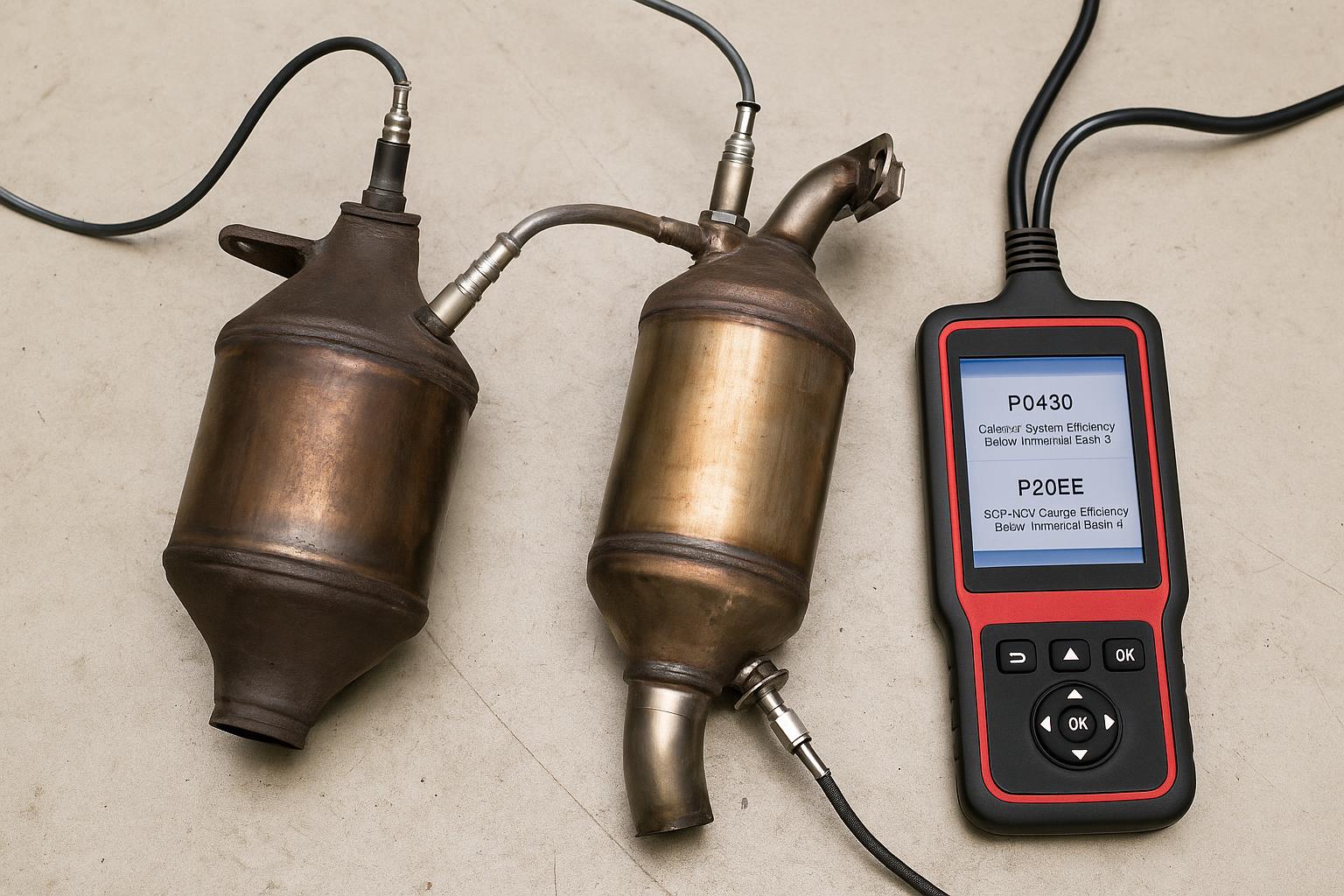
To fix P0430 and P20EE, confirm the sensor readings, rule out exhaust leaks, and test what feeds the catalyst before you replace one. P0430 is a gasoline catalytic converter code. P20EE is a diesel SCR code. They appear on different vehicles, but shops that service mixed fleets see both, and the diagnostic logic is similar. Each code sets when the downstream sensor shows the catalyst is not doing enough work.
What P0430 and P20EE Mean
These codes cover different emissions systems, but they share the same idea. The control module compares inlet and outlet readings to judge how well the catalyst works.
P0430 catalyst system efficiency below threshold (bank 2)
The PCM compares the upstream and downstream oxygen sensors on Bank 2. A working converter stores oxygen and keeps the downstream signal fairly steady. When the downstream sensor starts switching like the upstream sensor, the converter has lost capacity and the code sets.
P20EE SCR NOx catalyst efficiency below threshold (bank 1)
Diesel engines with SCR spray DEF into the exhaust ahead of the SCR catalyst. The DEF breaks down into ammonia, which reacts with NOx in the catalyst. The engine control module compares the upstream NOx sensor with the downstream NOx sensor. If NOx does not drop by the expected amount, the code sets.
How to Fix P0430
Most gasoline catalyst codes start upstream of the converter. Check the engine and sensors before you replace the converter.
Check for misfires and fuel trim problems
Look for misfire counts on Bank 2 cylinders and long term fuel trims outside roughly 10 percent. A misfire or rich condition overheats the converter and will destroy a new one.
Look for exhaust leaks
Inspect the Bank 2 manifold, gaskets, and flex joints ahead of the downstream sensor. Outside air entering through a leak makes the downstream sensor read lean and can set the code on a good converter.
Compare the oxygen sensors
Warm the engine and hold 2,500 rpm while graphing both Bank 2 sensors. A lazy downstream sensor can set the code by itself, so test it before blaming the converter.
Test and replace the converter
If the engine and sensors check out, tap the converter for loose substrate and run a backpressure test if you suspect a restriction. Check service bulletins for PCM calibration updates. When replacing, use a converter approved for the vehicle and the state it is registered in.
How to Diagnose P20EE
Most SCR efficiency codes trace back to DEF quality, DEF dosing, a NOx sensor, or a contaminated catalyst. Test in that order, since the cheapest checks come first.
Test DEF quality
Pull a sample from the tank and check it with a DEF refractometer. Good DEF reads close to 32.5 percent urea. Low concentration, water contamination, or old fluid reduces how much NOx the system can remove. If the reading is off, drain the tank, flush it, and refill with fresh DEF.
Run a DEF dosing test
Most scan tools can run a dosing quantity test. Collect the fluid from the doser in a graduated container and compare the amount to specification. Low output points to a clogged or crystallized doser, a weak DEF pump, or a restricted line. Check the doser tip for white crystal buildup.
Compare the NOx sensors
With the engine warm and before dosing begins, the upstream and downstream NOx readings should be close to each other. A large difference at that point suggests a faulty sensor. Also check for exhaust leaks between the sensors, which dilute the downstream reading.
Check the SCR catalyst and upstream components
Oil or fuel contamination from a failing turbo seal, a leaking injector, or frequent regeneration can coat the SCR catalyst. Check the diesel oxidation catalyst and diesel particulate filter for problems that affect exhaust temperature. Low exhaust temperature from constant idling also reduces SCR efficiency. Look up service bulletins, since several manufacturers have released software updates for SCR efficiency codes.
Why Order Matters on Both Codes
Catalysts are expensive, and both codes can set on a catalyst that still works. Replacing a converter or SCR catalyst without fixing the upstream cause leads to a quick repeat failure.
On diesels, an SCR fault that stays active can trigger a speed or power derate. Communicate that urgency clearly to fleet customers so the truck gets scheduled before it limps into the lot.
What This Means for Your Shop
Shops that work on both gasoline cars and diesel trucks benefit from a single process for catalyst codes. Confirm the sensors, check for leaks, test what feeds the catalyst, and only then test the catalyst. Train every technician to follow that order and record the readings on the repair order. Clear records protect the shop if the customer questions the bill, and they make the next visit faster when the same vehicle returns.
Find the Proven Fix First
P0430 and P20EE both have a long list of possible causes, and each engine family has its own common failures. Identifix Direct-Hit shows confirmed fixes for both codes by make, model, and engine, so your technicians can see whether that vehicle usually needs a sensor, a doser, a software update, or a catalyst. Check Direct-Hit before you order parts and start with the repair that has fixed the same code most often.