




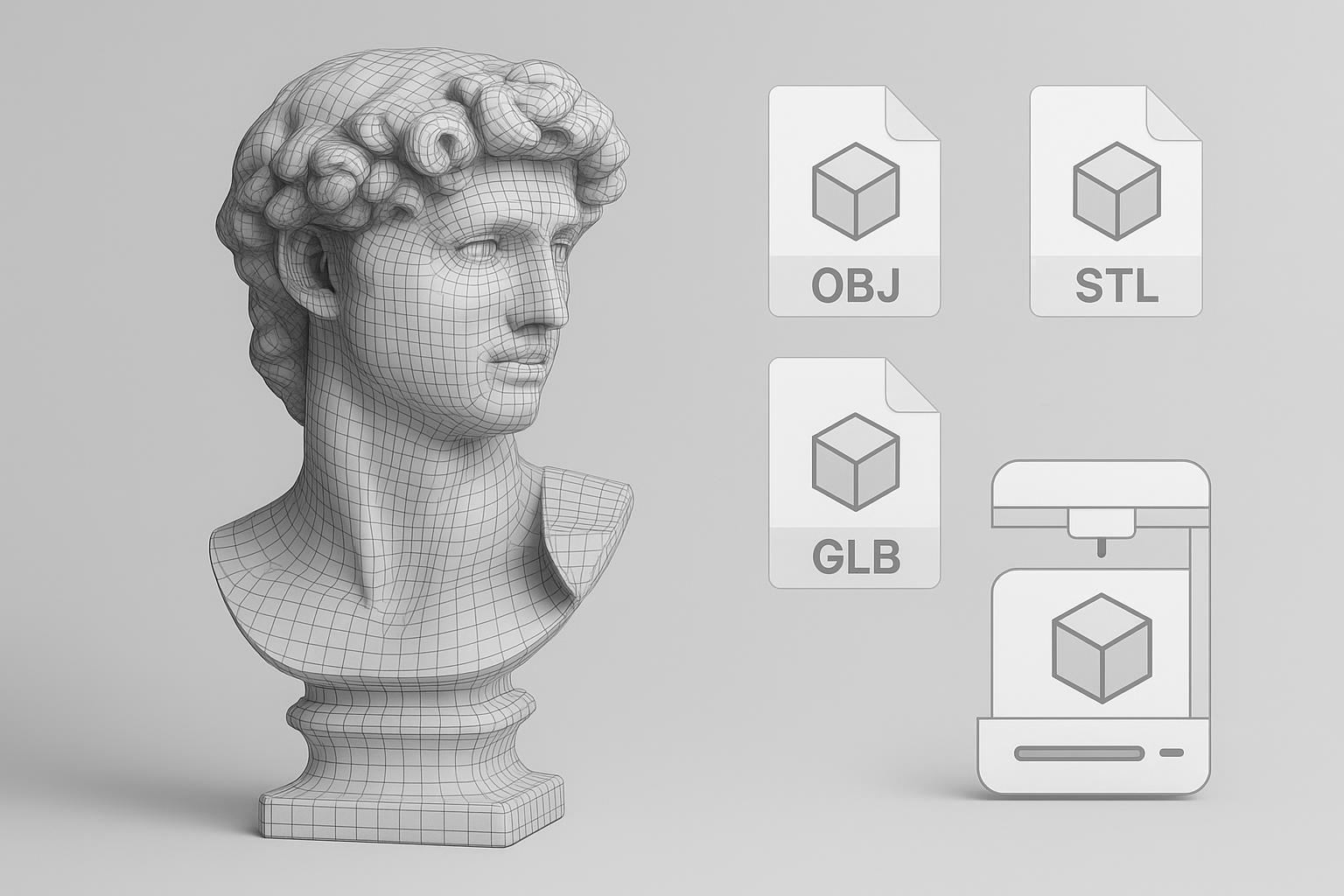
The world of 3D modeling has undergone a dramatic shift in recent years. What once required years of training in complex software like Blender, Maya, or ZBrush can now be accomplished in minutes using artificial intelligence. For makers, designers, and 3D printing enthusiasts, this transformation is nothing short of revolutionary.
The Old Way vs. The New Way
Traditional 3D modeling demanded a steep learning curve. Artists had to master polygon modeling, UV unwrapping, rigging, and texturing — skills that took years to develop. Even experienced designers spent hours crafting a single model from scratch. The barrier to entry was high, and the time investment was significant.
Today, AI-powered tools are dismantling those barriers. By leveraging deep learning and neural networks trained on millions of 3D assets, modern platforms can generate detailed, print-ready 3D models from simple inputs — including photographs and 2D images.
How AI 3D Modeling Works
At the core of AI-driven 3D generation is a process called neural reconstruction. The AI analyzes visual data — depth cues, shadows, edges, and surface textures — and uses this information to infer the three-dimensional structure of an object. Some systems use photogrammetry principles, while others rely on diffusion models similar to those powering image generation tools.
The result is a mesh that can be exported in standard formats like OBJ, STL, or GLB — ready for 3D printing, game engines, or further refinement in traditional software.
What This Means for the Maker Community
For the maker community, AI 3D modeling opens up entirely new creative possibilities. Imagine photographing a vintage toy, a handmade ceramic piece, or a custom part — and having a printable 3D model ready within seconds. This capability is transforming how makers prototype, customize, and share designs.
Hobbyists who previously relied on pre-made files can now generate their own unique models without any design experience. This democratization of 3D creation is expanding the community and enabling a new wave of personalized, one-of-a-kind prints.
Applications Across Industries
Beyond hobbyist making, AI 3D modeling is finding applications across a wide range of industries:
- Product design: Rapid prototyping from reference photos
- Architecture: Converting building photographs into 3D site models
- E-commerce: Creating product visualizations from catalog images
- Gaming: Generating game-ready assets from concept art
- Medical: Building anatomical models from scan imagery
The speed and accessibility of these tools are compressing timelines that once took weeks into hours — or even minutes.
Choosing the Right AI 3D Modeling Tool
Not all AI 3D tools are created equal. Key factors to consider include output quality, supported file formats, ease of use, and the ability to handle complex textures and geometries. For makers specifically, print-readiness is critical — a model that looks great on screen but has non-manifold geometry or excessive polygon counts will fail on the print bed.
One platform that has gained significant attention in this space is 3d model ai from 3D AI Studio. It allows users to upload any image and receive a fully formed 3D model in seconds, with outputs optimized for both 3D printing and digital use. The platform handles the technical complexity behind the scenes, making it accessible to beginners while still delivering the quality that professionals demand.
The Future of AI-Assisted Making
We are still in the early stages of what AI will do for 3D creation. As models become more accurate, outputs more refined, and processing times shorter, the line between designing and generating will continue to blur. For the maker community, this is an exciting frontier — one where creativity is the only real limit.
Whether you are a seasoned designer looking to accelerate your workflow or a newcomer eager to bring your first idea to life, AI 3D modeling tools represent a genuine leap forward. The future of making is here, and it is more accessible than ever before.