




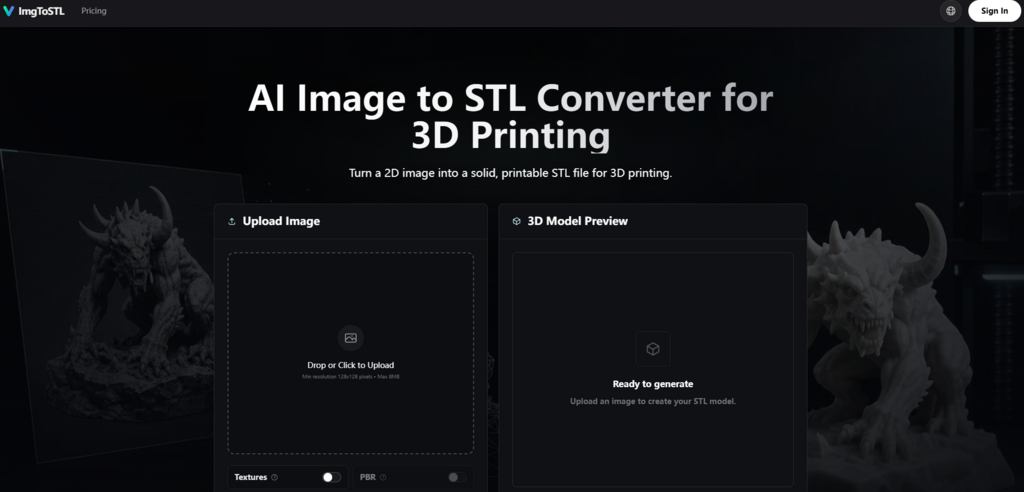
The 3D printing community has long dreamed of turning ordinary photos into printable models with a single click. Over the past year, that dream has become increasingly attainable thanks to a wave of AI-powered platforms that convert 2D images into 3D geometry. But not all tools are created equal—some generate visually impressive renders that fail the manifold check in your slicer, while others prioritize structural integrity from the start. After testing the leading options, I have compared five platforms to help you decide which one best fits your workflow, your skill level, and your printing goals. Let us start with the tool that takes printability most seriously: image to stl conversion redefined.
ImgToSTL: The Print-Ready Specialist
ImgToSTL distinguishes itself by focusing exclusively on generating geometry that is structurally sound for additive manufacturing. Unlike many AI tools that optimize for visual presentation and animation, this platform builds meshes designed to pass the manifold check in slicing software.
How the Workflow Works
The process is refreshingly straightforward. You upload an image in JPG, PNG, JPEG, or WebP format (minimum resolution 128×128 pixels, max file size 8MB). The AI then analyzes the subject’s shape, silhouette, contrast, and depth cues to reconstruct a three-dimensional form—not a simple heightmap extrusion, but a genuine interpretation of the object. A preview lets you rotate and inspect the geometry before you commit. Finally, you export in STL, with GLB, OBJ, and FBX also available.
What Makes It Different
The platform is honest about its limitations. It provides clear guidance on which images work best (centered subjects, strong lighting, simple backgrounds) and warns against tricky inputs like transparent objects or busy scenes. It also encourages you to inspect the mesh in your slicer and use tools like Blender or Meshmixer for cleanup. This transparency builds trust. For users who need a reliable starting point for functional parts, replacement components, or concept prototypes, imgtostl delivers a focused, no-nonsense experience.
Meshy AI: The All-Rounder for Versatile Creation
Meshy AI has become a popular choice for creators who want both printable models and assets for gaming or animation. It supports text-to-3D and image-to-3D generation, giving you flexibility in how you create.
Capabilities and Pricing
Meshy’s image-to-3D feature produces clean geometry, and its automatic remeshing and topology cleanup tools help prepare models for printing. A standout feature is direct integration with Bambu Studio, allowing you to send STL files straight to your slicer. Export options include 3MF, OBJ, FBX, GLB, and BLEND in addition to STL. The free tier offers 100 credits per month, with Pro plans starting around $14.50/month. Meshy is ideal if you need a single tool for multiple 3D use cases beyond printing.
Tripo AI: The Speed Demon With Structural Integrity
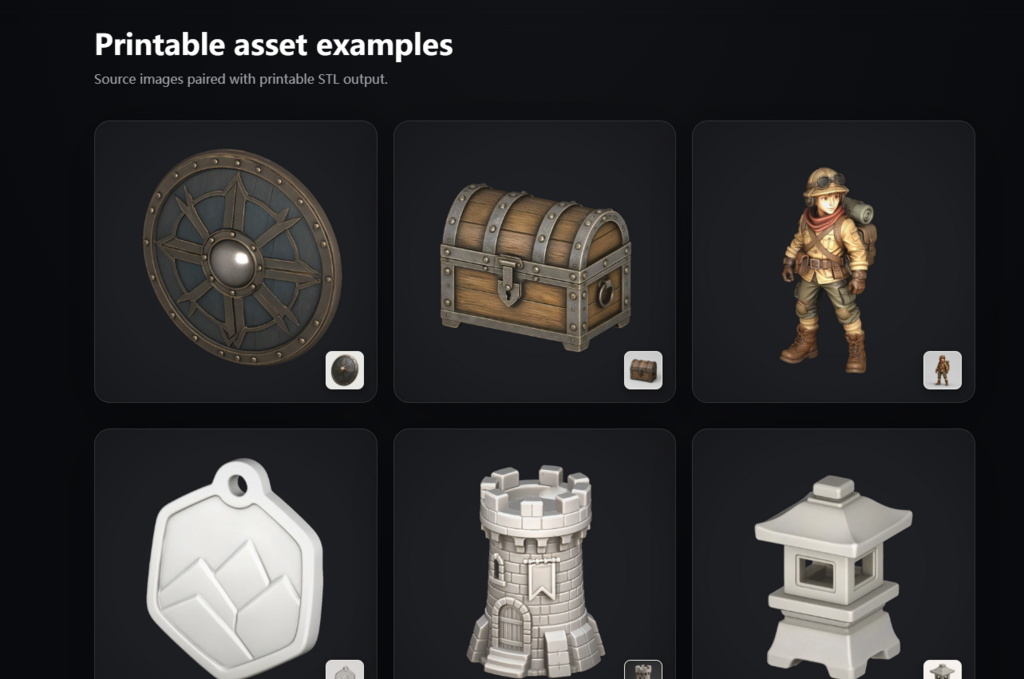
Tripo AI markets itself as a high-speed solution backed by a massive algorithmic engine with over 200 billion parameters. It generates watertight, manifold meshes in seconds, making it a strong contender for rapid prototyping.
Technical Advantages
The platform’s built-in smart retopology feature automatically refines the generated mesh, optimizing it for slicing without manual intervention. This saves significant time for engineers and designers who need production-ready assets quickly. Tripo AI offers a Free plan with 300 credits per month and a Pro plan at $19.90/month with 3,000 credits. Its speed and topology focus make it particularly suitable for iterative design workflows where multiple revisions are common.
Rodin: The Detail Master for Collectibles and Prototypes
Rodin, developed by Hyper3D, excels at creating high-resolution, intricate models from text and image prompts. It is a favorite among designers crafting characters, statues, and detailed product concepts.
High-Resolution Output
Rodin can generate geometry with fine details such as fabric wrinkles, facial features, and complex ornamentation. It also offers texture tweaking, UV generation, and retopology controls, with export in STL and OBJ. The free trial gives you 5 credits, with education and business plans available. While the output is visually stunning, some users still recommend cleaning the model in Blender before printing. Rodin is best suited for artistic projects where detail matters more than speed.
Sloyd: The Stylized Figurine Maker
Sloyd takes a unique approach by using a technique called G-splatting to transform photos into stylized, charming 3D figurines. It detects the subject and creates a model with proper depth, sharp edges, and preserved colors.
Fast and Fun
The conversion takes just seconds, and you can adjust size and thickness for better printability. Export options include STL, GLB, and FBX. Sloyd is particularly useful for indie developers, concept artists, and hobbyists who want to create personalized figurines from vacation photos, pet pictures, or character sketches without getting bogged down in complex modeling. Its stylized output may not suit every functional part, but for gifts and decorative prints, it is hard to beat for speed and simplicity.
Comparison Table and How to Choose
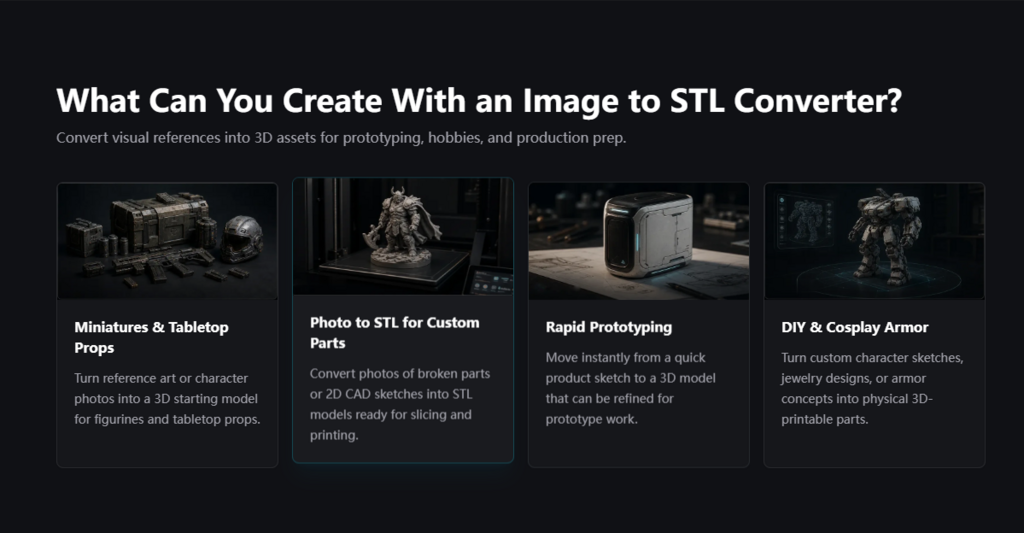
To help you decide at a glance, here is a side-by-side comparison of the five platforms across key criteria.
Feature Comparison
| Platform | Best For | Key Strength | Export Formats | Learning Curve |
|---|---|---|---|---|
| ImgToSTL | Print-ready STL from photos/sketches | Printable geometry focus, preview before export | STL, GLB, OBJ, FBX | Minimal |
| Meshy AI | Overall STL creation | Text + image input, slicer plugins, auto-repair | STL, OBJ, FBX, GLB, 3MF, BLEND | Low |
| Tripo AI | Fast STL generation | Speed, clean topology, 200B+ parameter engine | STL, OBJ, FBX | Low |
| Rodin | High-detail models | High-resolution geometry, PBR textures, UV mapping | STL, OBJ | Moderate |
| Sloyd | Stylized figurines from photos | G-splatting technique, stylized output, fast conversion | STL, GLB, FBX | Minimal |
Which Platform Should You Choose?
Your choice ultimately depends on your primary goal. If you need a dependable, print-first mesh from a product photo, sketch, or part reference, ImgToSTL provides the most honest and focused workflow. If you want a versatile tool that handles both printing and visualization, Meshy AI offers the broadest feature set. For rapid iteration with minimal manual retopology, Tripo AI’s speed and automatic cleanup are compelling. Rodin is the go-to for high-detail artistic prints, while Sloyd excels at quick, stylized figurines. No single platform is perfect for every scenario, but each serves a distinct niche. By matching your needs to the strengths outlined above, you can save time, filament, and frustration on your next 3D printing project.