




For marketing managers at large organizations, sending high-volume email campaigns isn’t just about hitting “send” at scale—it’s about maintaining high deliverability, managing infrastructure, ensuring compliance, and optimizing performance across millions of contacts.
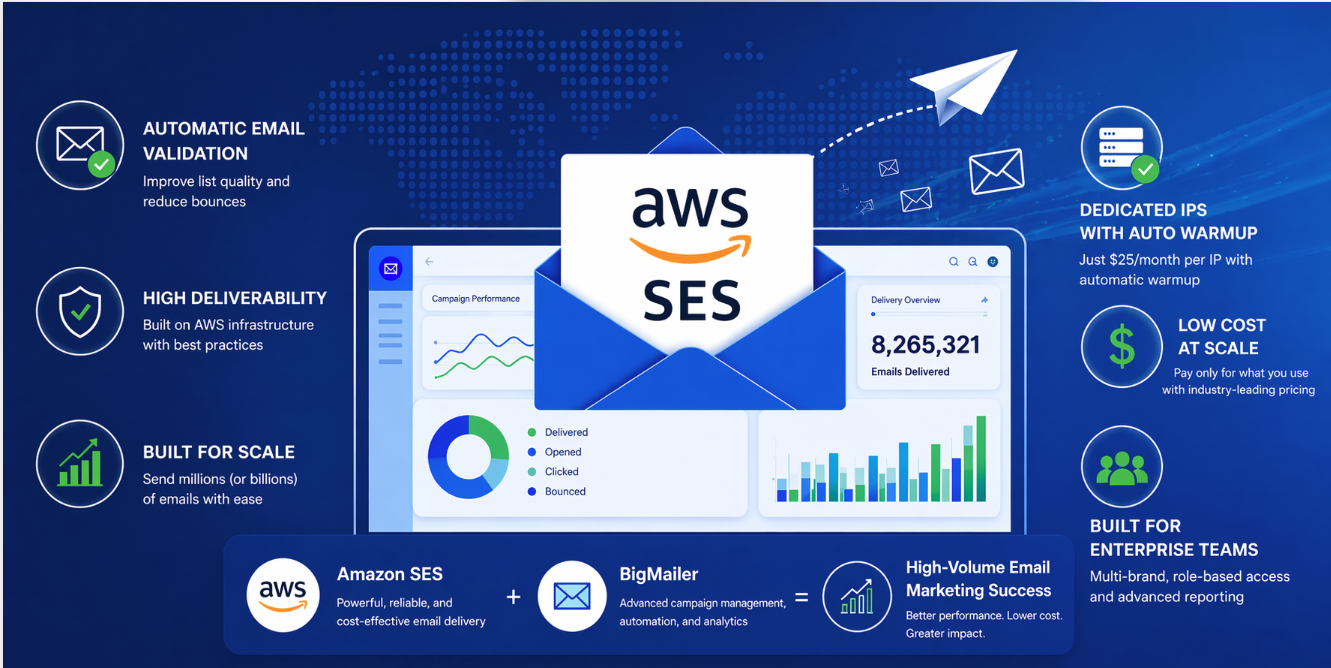
Amazon Simple Email Service (SES) has long been favored by developers for sending transactional email, but use of Amazon SES for email marketing has been emerging as a smart choice for large-scale email programs. On its own, SES is not a marketing platform—it’s an infrastructure layer. The real power emerges when SES is combined with another platform, which transforms that infrastructure into a fully operational high-volume marketing engine. Platforms like BigMailer allow you to manage multiple SES account connections and sender domains, while allowing you to manage campaigns and store templates, images, and detailed engagement analytics.
Here’s how that combination works in practice.
1. Amazon SES as the Sending Engine for Massive Campaigns
At its core, SES is designed for scale. It allows companies to send millions of emails without the pricing constraints of traditional email platforms.
For high-volume campaigns, SES provides:
- Virtually unlimited sending capacity (with quota increases)
- High throughput and low latency delivery
- Global infrastructure via AWS
This makes it ideal for:
- Large promotional bulk campaigns
- Multi-million subscriber newsletters
- Seasonal or event-driven spikes (e.g., Black Friday campaigns)
However, SES alone doesn’t provide campaign creation, segmentation, or automation tools. That’s where platforms like BigMailer become essential.
2. A Marketing Layer SES Lacks
While SES handles sending, BigMailer can provide everything a marketing team needs to actually run campaigns:
- Manage multiple clients, brands, or locations via sub-accounts.
- Create and manage a variety of campaign types – bulk, automations, transactional, and RSS-to-email.
- Segment audiences using advanced rules
- Design emails using HTML or drag-n-drop template builders.
- Track and analyze performance with detailed engagement reporting.
Since BigMailer allows connecting to your own SES, it offers lower cost pricing plans compared to traditional email marketing service providers.
This combination gives enterprises the best of both worlds:
- SES for cost-efficient, scalable delivery
- BigMailer for campaign execution and management
3. Managing List Quality with Built-In Email Validation
Amazon SES has recently introduced native email validation capabilities, allowing marketers to automatically validate addresses before sending. Because this validation can run automatically, it becomes a highly cost-effective, low-maintenance safeguard for large databases.
BigMailer complements this with their own built-in email validation that can identify and remove typos and spam traps.
4. Dedicated IPs and Automatic Warmup
For high-volume senders, dedicated IP addresses are often necessary to maintain consistent deliverability.
SES makes this accessible by offering:
- Dedicated IPs at $25/month per IP, far cheaper than any other ESP
- Automatic IP warmup, gradually increasing sending volume to build reputation
Large agencies and enterprises with multiple brands can also build their own IP pools inside SES.
5. Supporting Multiple Campaign Types in One System
Large enterprises typically operate multiple email streams within their email program:
- Promotional campaigns
- Lifecycle and drip campaigns
- Transactional emails
BigMailer allows managing all of these emails within a single platform, with fully unified customer data and a single price point.
This approach allows for centralized reporting, holistic list management, and simplified cost structure.
By consolidating email operations, teams reduce fragmentation and improve overall efficiency.
6. Cost Advantages Become Significant at High Volume
At smaller scales, pricing differences between platforms may seem marginal. At enterprise scale, they become substantial.
SES’s pay-as-you-go model ensures that:
- Costs scale linearly with usage
- There are no expensive per-contact fees
- Infrastructure costs remain predictable
Adding to this:
- Dedicated IPs remain low-cost (~$25/month)
- Enterprise agreements may include ~10% account-level incentives
BigMailer enhances this value by providing a marketing layer without the high markup typically associated with traditional ESPs.
For organizations sending millions of emails per month, the savings can be dramatic.
7. Multi-Brand and Multi-Team Campaign Management
High-volume email programs in large organizations often involve multiple teams, brands, or regions.
BigMailer is designed to support this complexity by enabling:
- Multi-brand account structures
- Role-based access control
- Separate SES connections for sub-accounts
When paired with SES, this allows each team to:
- Operate independently
- Maintain separate sending reputations if needed
- Scale campaigns without impacting other units
This structure is critical for enterprises managing diverse marketing operations.
Conclusion
Amazon SES is not a traditional email marketing platform, but it offers a capable infrastructure, scalability, and cost efficiency that large-scale email campaigns demand.
BigMailer turns that infrastructure into a complete marketing solution.
Together, they enable enterprise marketing teams to:
- Execute high-volume campaigns
- Maintain strong deliverability through email validation and IP management
- Scale without operational bottlenecks
- Significantly reduce email program costs
For marketing managers responsible for tens of millions of emails per month, this combination offers a compelling alternative to traditional email platforms—one that prioritizes performance, flexibility, and long-term efficiency.