




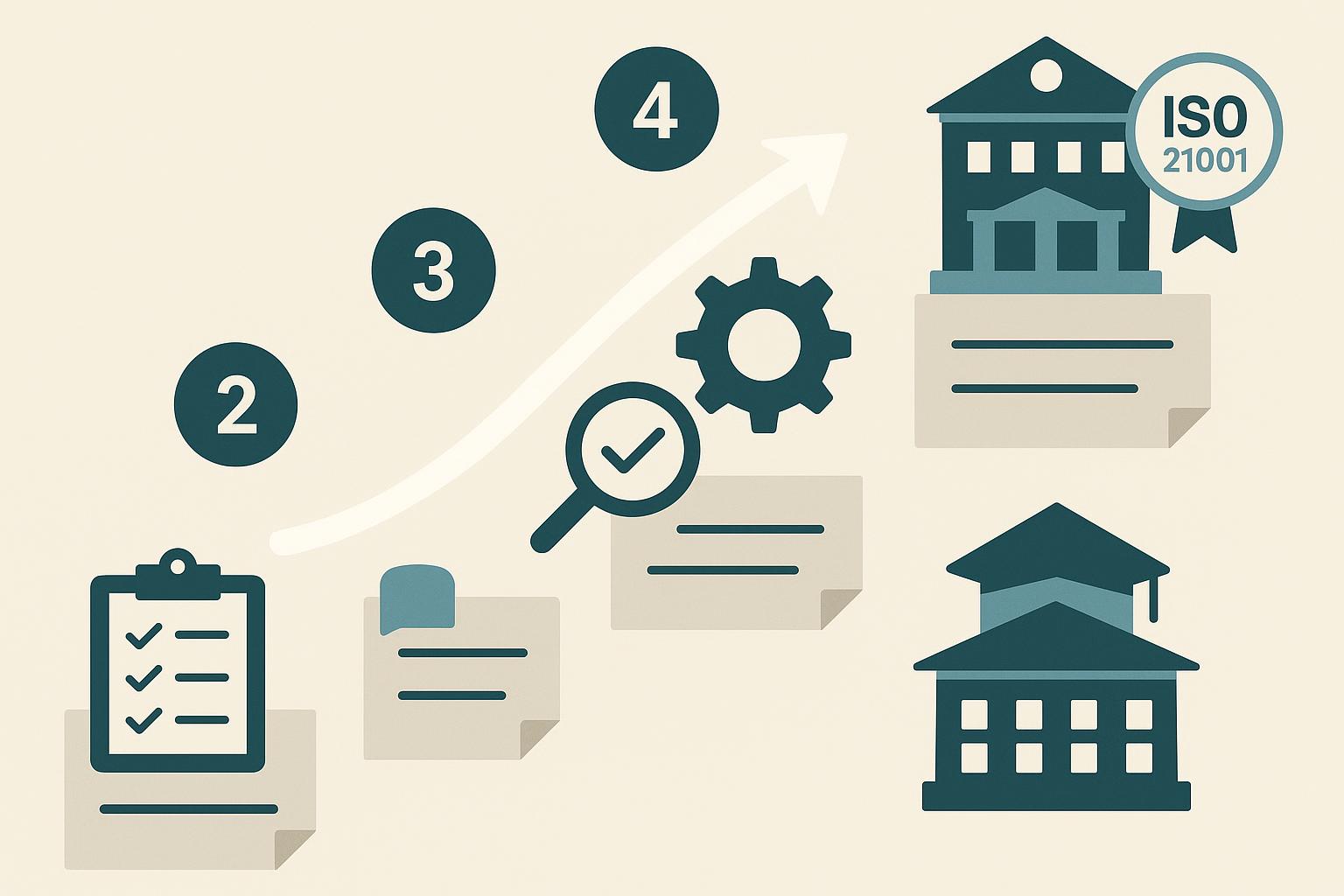
ISO 21001:2018 — the Educational Organizations Management System (EOMS) standard — provides a rigorous, internationally recognized framework for institutions committed to delivering measurable quality to learners and stakeholders. For universities, vocational training centers, corporate learning departments, and schools of every size, achieving ISO 21001 certification signals a genuine commitment to continuous improvement and institutional accountability.
The certification journey, while structured, is entirely achievable with the right preparation. Below is a clear, step-by-step roadmap to guide your educational organization from initial assessment to certified status.
Step 1: Conduct a Comprehensive Gap Analysis
The first step toward ISO 21001 certification is understanding where your organization currently stands relative to the standard’s requirements. A gap analysis compares your existing management systems, processes, and documentation against the clauses of ISO 21001:2018, identifying areas of conformance and — critically — areas that require development or improvement.
This analysis should be conducted systematically, covering all core operational areas: leadership and governance, learner-focused processes, resource management, performance evaluation, and continual improvement mechanisms. The output is a prioritized action plan that forms the foundation of your implementation project. Organizations that invest time in a thorough gap analysis consistently report smoother certification audits and fewer non-conformities.
Step 2: Develop and Document Your Management System
ISO 21001 requires educational organizations to establish, implement, and maintain a documented management system that meets the standard’s requirements. This means creating or updating a suite of policies, procedures, and records that demonstrate how your institution manages its educational processes, addresses learner needs, and drives continuous improvement.
Key documentation typically includes a quality policy, an organizational context statement, risk and opportunity registers, process maps, and records of management review. While the standard does not prescribe a rigid documentation format, clarity and consistency are essential. Every document should be version-controlled, accessible to relevant staff, and reviewed on a defined schedule.
Step 3: Implement the Management System Across the Organization
Documentation alone does not achieve certification — the management system must be actively implemented and embedded into daily operations. This step involves training staff at all levels, communicating the purpose and requirements of the EOMS, and integrating new processes into existing workflows.
Change management is a critical success factor at this stage. Leadership must visibly champion the implementation, and department heads must take ownership of their respective process areas. Internal communication plans, training programs, and regular progress reviews help ensure that the management system becomes a living part of the institution’s culture rather than a compliance exercise.
Step 4: Conduct Internal Audits and Management Reviews
Before inviting an external certification body to audit your organization, ISO 21001 requires you to conduct internal audits and formal management reviews. Internal audits assess whether your management system is being implemented as documented and whether it is effectively achieving its intended outcomes. They also provide an opportunity to identify and correct non-conformities before the external audit.
Management reviews bring together senior leadership to evaluate the overall performance of the EOMS, review audit findings, assess risks and opportunities, and make decisions about resource allocation and improvement priorities. Both internal audits and management reviews must be documented, with records of findings, decisions, and follow-up actions retained as evidence of system maturity.
Step 5: Engage an Accredited Certification Body and Complete the External Audit
The final step is the formal certification audit, conducted by an accredited third-party certification body. This typically takes place in two stages: a Stage 1 audit (document review and readiness assessment) followed by a Stage 2 audit (on-site verification of implementation). Successful completion of both stages results in the award of ISO 21001 certification, valid for three years subject to annual surveillance audits.
Selecting the right certification partner is as important as the audit itself. Working with a trusted specialist in ISO certification consulting ensures your organization is thoroughly prepared for each audit stage, with expert guidance on evidence presentation, auditor interactions, and corrective action management.
The Path Forward
Achieving ISO 21001 certification is a structured process, but it is one that delivers lasting value — improved learner outcomes, stronger stakeholder confidence, and a culture of continuous improvement that sustains institutional excellence long after the certificate is awarded. With a clear roadmap and the right expertise, your educational organization can navigate the certification journey with confidence.