





The European Accessibility Act quickly became a new norm in the digital industry, and EAA compliance is now a board-level topic rather than an afterthought. It’s something much more important than another bureaucratic act. It’s a complete reshaping of the way online products will work across the continent.
In essence, the EAA marks a turning point for accessibility in Europe. What once sat on the “nice to have” list—making websites, devices, and apps usable for everyone — has now become a legal requirement. Businesses of every size and from every corner of the world will soon have to prove that they take accessibility seriously, not as a side project, but as a core part of how they operate.
And here’s the part that often surprises companies: the EAA doesn’t apply only to businesses based in the EU. If you sell or operate within the European market, you’re on the hook for accessibility compliance, regardless of where you’re headquartered. Whether your headquarters sit in Madrid, London, or San Francisco, accessibility has officially become everyone’s business.
The challenge? There isn’t just one EAA rulebook; European Accessibility Act compliance depends on national transposition and local enforcement. While the directive was written at the EU level, each country enacts its own version — what’s called transposition — and that’s where things get complicated. Fines, penalties, enforcement bodies, even timelines can vary dramatically from one member state to another.
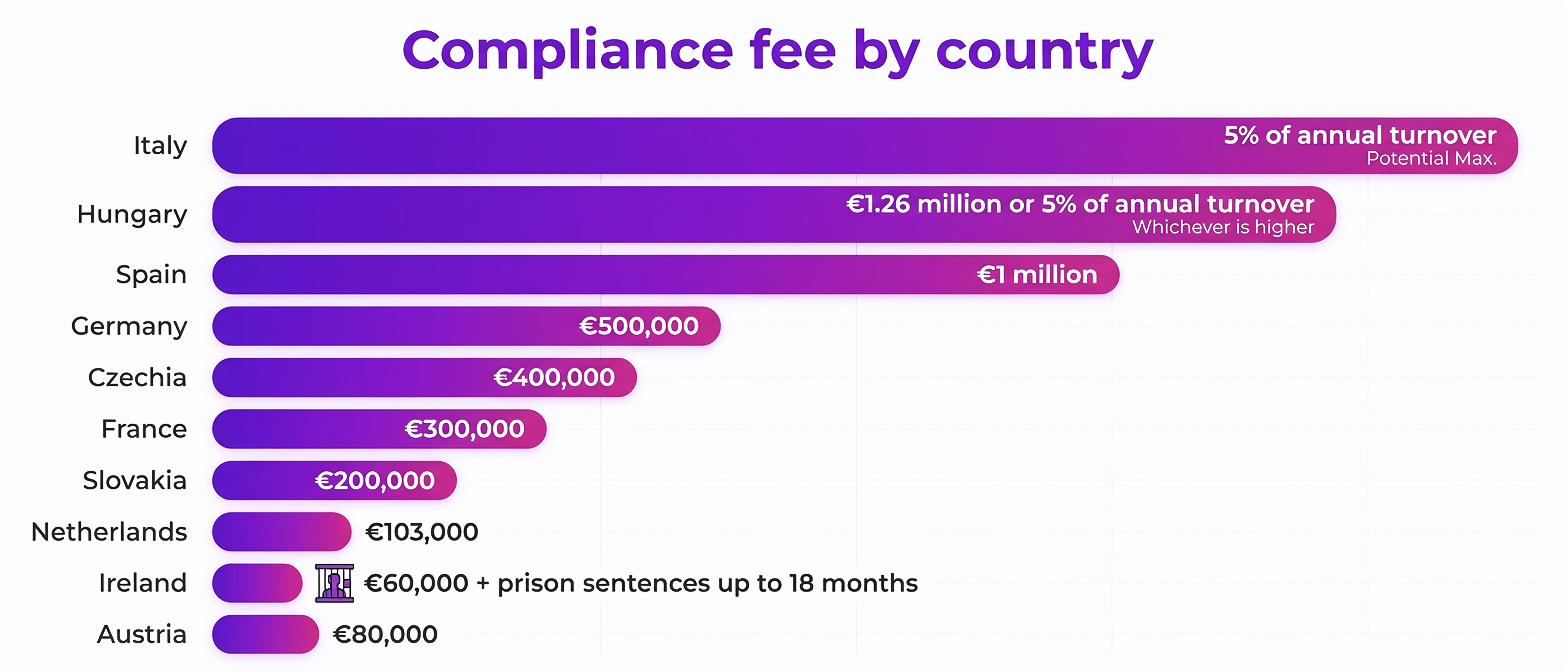
According to data compiled by Deque Systems in collaboration with legal experts from Taylor Wessing, those differences are already taking shape. Some countries, like Germany and Spain, have rolled out heavy financial penalties for European Accessibility Act compliance failures. Others, like Ireland, have added the possibility of imprisonment for severe noncompliance. In short, the cost of getting this wrong could be monumental.
What the European Accessibility Act Really Means
What is the story behind the EAA? It was adopted by the EU in 2019. Its goal is to make the digital space accessible to everyone, including people with disabilities.
It covers a broad range of products and services — from banking apps and e-readers to ticket machines, ATMs, and ecommerce sites. Anything that facilitates everyday life should, by law, be usable regardless of a person’s abilities or the tools they use to access it.
The EAA also aligns closely with WCAG 2.1 AA. If your teams already work toward WCAG, you’re halfway to accessibility compliance; this web accessibility overview can help you calibrate standards. So in practice, a business that’s compliant with WCAG is already well on its way to meeting EAA requirements, but that’s only half the story.
Because it’s a directive, not a regulation, every EU member state must translate the EAA — one big reason EAA compliance varies by country. The process, known as transposition, means that Europe will end up with 27 slightly different accessibility systems all aiming toward the same goal.
That’s why EAA compliance is so complex. To reach full compliance, organizations must research the requirements and penalties for each country to evade mistakes tied to local law enforcement.
Why Compliance Differs from Country to Country
While Brussels sets the broad principles, every national government decides for itself how to apply them. So, let’s look at some EU countries and how they implement these rules.
Take Germany, for example. The Barrierefreiheitsstärkungsgesetz — literally “Accessibility Strengthening Act” — sets a tough standard, backed by fines up to €500,000. By contrast, Ireland’s implementation caps fines at €60,000 but includes the possibility of 18 months in jail for willful violations.
In Spain, EAA compliance violations can trigger fines as high as €1 million and even market exclusion. Meanwhile, Austria enforces its Accessibility Act (BaFG) with a comparatively modest ceiling of €80,000.
These disparities matter. A multinational company operating across several EU markets could theoretically face separate penalties in each country. Failing once could mean paying five or fifteen times.
And beyond the numbers, each country has its own market surveillance authorities, which function as watchdogs. These bodies don’t just issue fines — they conduct audits, demand corrective measures, and in some cases, remove noncompliant products from the marketplace altogether.
The Hidden Costs of Noncompliance
The obvious threat of EAA violations is financial, but the hidden damage goes deeper. Accessibility is heavily tied to brand prestige and customer trust. If consumers or regulators notice that a company fails to meet inclusion standards, the company will suffer reputational damage.
Ignoring accessibility can spark a chain reaction:
- A fine or legal notice leads to public exposure.
- News spreads quickly, especially in industries tied to social impact or consumer trust.
- That publicity translates to lost customers, damaged reputation, and potential bans from government contracts.
And these aren’t hypothetical risks. Europe’s accessibility laws draw from the same philosophy as GDPR, where the enforcement style is strict, public, and meant to set examples.
The takeaway? Accessibility compliance isn’t just about avoiding penalties — it’s about protecting your company’s reputation and long-term license to operate in Europe.
EAA in Practice: How Each Country Enforces the Rules
Let’s explore how the EAA plays out across Europe’s major markets. The data comes from Deque’s comprehensive breakdown of country-level transpositions — an invaluable resource for anyone trying to make sense of this new regulatory map.
Austria
Austria’s approach blends practicality with social responsibility. Its Accessibility Act (BaFG) and Social Ministry Service Act govern both digital and physical accessibility. Enforcement lies with the Federal Office for Social Affairs and Disability, which has the authority to issue corrective orders or impose fines of up to €80,000.
For Austrian businesses, accessibility is treated as both a compliance duty and a moral norm. That cultural alignment has helped many organizations adapt early, using accessibility as part of their corporate identity rather than a last-minute scramble.
Czechia
Czechia’s law — Zákon o požadavcích na přístupnost některých výrobků a služeb — has an almost bureaucratic poetry to its name, but its implications are serious.
Enforcement is spread across several authorities, including the Czech Trade Inspection Authority and Czech Telecommunication Office, which handle cases depending on the industry. The maximum penalty? €400,000.
That decentralization creates complexity for companies. A financial services provider, for example, might be inspected by a different agency than a telecom firm. For multinational operations, keeping track of which body handles what becomes part of the compliance puzzle.
France
France’s model intertwines accessibility with its long-standing consumer protection framework. Laws like the Act for a Digital Republic and the Consumer Code place equal emphasis on usability and user transparency.
Fines can reach €300,000, but France also uses another form of enforcement — public accountability. Many organizations must publish annual accessibility declarations, detailing where they comply and where they don’t.
That openness can be uncomfortable, but it drives real progress. French regulators like ARCEP and DGCCRF see transparency as a compliance tool in itself: if users can see your accessibility gaps, you’re more likely to fix them.
Germany
Germany’s system, anchored by the Barrierefreiheitsstärkungsgesetz, is one of the most mature and unforgiving. Fines top out at €500,000, and enforcement is managed by both national and regional media authorities.
Germany’s philosophy is clear: European Accessibility Act compliance isn’t optional — design inclusively from the start, don’t bolt it on later.
It’s no coincidence that German firms were among the first to build dedicated accessibility teams. For many, the EAA is just an extension of what they already considered best practice.
Hungary
Hungary’s enforcement scale dwarfs most of Europe. Under Act XVII of 2022, noncompliance can cost up to €1.26 million or 5% of annual turnover, whichever is greater.
Authorities like NMHH and the national consumer protection agency actively monitor compliance across digital and physical channels. This aggressive approach reflects Hungary’s stance that accessibility isn’t just moral, it’s economic. Companies that exclude users, the thinking goes, are undermining their own markets.
Ireland
Ireland’s S.I. No. 636/2023 regulation reflects a blend of pragmatism and enforcement muscle. The fines — up to €60,000 — are modest compared to Hungary or Spain, but the inclusion of prison sentences up to 18 months adds a sharper edge.
The Competition and Consumer Protection Commission and Central Bank of Ireland handle oversight, ensuring accessibility expectations extend across industries.
Ireland’s emphasis is on fairness—making sure that accessibility isn’t a competitive disadvantage for businesses that do things right.
Italy
Italy has built on its historic Stanca Law from 2004, one of the earliest digital accessibility acts in Europe, by layering new obligations under Legislative Decree No. 82 (2022).
Private companies face fines of up to 5% of annual turnover for serious violations. The Ministry of Enterprises and Made in Italy (MIMIT) oversees enforcement.
Italy’s approach merges tradition and modernization — it doesn’t just demand accessibility, it connects it to the country’s broader digital transformation agenda.
Netherlands
The Netherlands brings characteristic Dutch precision to accessibility law. Its regulations include a number of acts, like the Warenwet (Product Law), the Equal Treatment on the Grounds of Disability or Chronic Illness Act.
The average fine here is €103,000, with heavy reliance on documentation provided by businesses involved. Companies must demonstrate that accessibility is monitored continuously and improvements are logged.
Slovakia
Slovakia’s Act No. 351/2022 and related decrees bring accessibility into the digital age. Fines of up to €200,000 can be imposed by the Slovak Trade Inspection or the Council for Media Services.
Slovakia has been particularly proactive about telecom and multimodal communication accessibility, signaling that its enforcement won’t stop at websites — it will extend into apps, platforms, and content systems.
Spain
Spain’s web of accessibility laws — spanning Law 11/2023, Law 33/2023, and several royal decrees — forms the continent’s strictest framework. Fines can soar to €1 million, and enforcement happens across national and regional levels.
Spain’s system stands out because it includes preventive audits, not just punitive action. Regulators can compel businesses to fix issues before imposing penalties. But once fines are applied, they can be severe enough to push noncompliant companies out of the market altogether.
Patterns Emerging Across Europe
From all this complexity, a few clear trends emerge:
- The North enforces consistency. Countries like Germany and the Netherlands emphasize structure, documentation, and engineering discipline.
- The South focuses on impact. Spain and Italy lean toward social inclusion, prioritizing the rights of users over the convenience of companies.
- Fines correlate with maturity. Economies with stronger digital ecosystems tend to enforce higher penalties.
- Transparency is a theme. France and the Netherlands see public reporting as part of compliance itself.
The net result is a Europe moving toward accessibility by design — not as charity, but as modern governance.
Preparing for EAA Compliance: A Practical Roadmap
Getting ready for EAA enforcement isn’t about ticking boxes—it’s about weaving accessibility into your organization’s DNA.
Here’s how leading companies are approaching it:
- Start with a full accessibility audit.
Map out how accessible your website, app, or product really is — don’t assume compliance. If you need a structured place to begin, check out Attico’s accessibility checklist — it outlines the key elements every organization should review before testing or remediation. - Focus on high-risk markets first.
If you operate across Europe, prioritize Germany, Spain, and Hungary, where penalties and oversight are toughest. - Build a documentation trail.
Keep track of accessibility tests, bug fixes, and design decisions. In many countries, showing proof of intent can reduce exposure. - Involve everyone.
Accessibility isn’t just the developer’s job — it touches marketing, design, legal, and leadership. - Stay updated.
Because each country’s EAA rules evolve, monitor resources like Deque’s EAA compliance tracker. - Work with accessibility partners.
Legal and technical experts can bridge the gap between WCAG standards and national law.
The companies that succeed treat compliance as culture, not a crisis.
Common Pitfalls of Accessibility Compliance
Even with the best intentions, many organizations stumble when implementing accessibility at scale. The most common mistakes tend to repeat themselves — and they often boil down to treating compliance as a project instead of an ongoing commitment.
The first pitfall is the “one-and-done” mentality. Companies run an accessibility audit once, fix a few items, and consider the job complete. But accessibility is a moving target. Every website update, every new product release, and every CMS plugin can reintroduce issues. Without continuous testing, even well-meaning teams regress fast.
Another frequent misstep is overreliance on automation. Tools like Axe or Lighthouse are valuable, but they only catch about 30% of real accessibility problems. The rest require human insight — someone to navigate your site using a screen reader or test keyboard-only flows. Automation can flag errors, but people experience them.
A third trap is outsourcing compliance completely. Some businesses hand everything off to third-party agencies, expecting to “buy” compliance. The reality is that accessibility can’t be fully outsourced. Internal teams still need awareness, ownership, and training. Otherwise, accessibility breaks the moment your agency’s contract ends.
And finally, many companies forget to maintain accessibility after redesigns. A shiny new site launch often undoes months of previous work. Without proper QA and regression testing, even compliant sites can fall out of alignment overnight.
Accessibility as Strategy, Not Obligation
The truth is, accessibility compliance isn’t just regulation—it’s market reach and better UX for everyone. Nearly a quarter (23.9%) of people aged 16 years or over in the EU had a disability (activity limitation) in 2024. Making digital products accessible isn’t just the law—it’s smart business.
Accessible design often improves usability for everyone: faster navigation, clearer interfaces, smoother experiences. Companies that embrace accessibility early often discover that it sharpens their products and strengthens customer loyalty.
So while the European Accessibility Act may arrive with the force of regulation, its real impact is cultural. It’s pushing Europe—and by extension, global digital business—toward a web that works for everyone.
Final Thoughts: The Future of Compliance in Europe
The lesson is clear: accessibility is no longer something optional. It’s not only about compliance now, it’s about competition.
In the coming years, the companies remembered for their innovation won’t just be those that built the most advanced technologies, but those that built technologies everyone could use.
Accessibility isn’t just the future of compliance. It’s the future of digital civilization. For a structured starting point, review Attico’s accessibility services.