




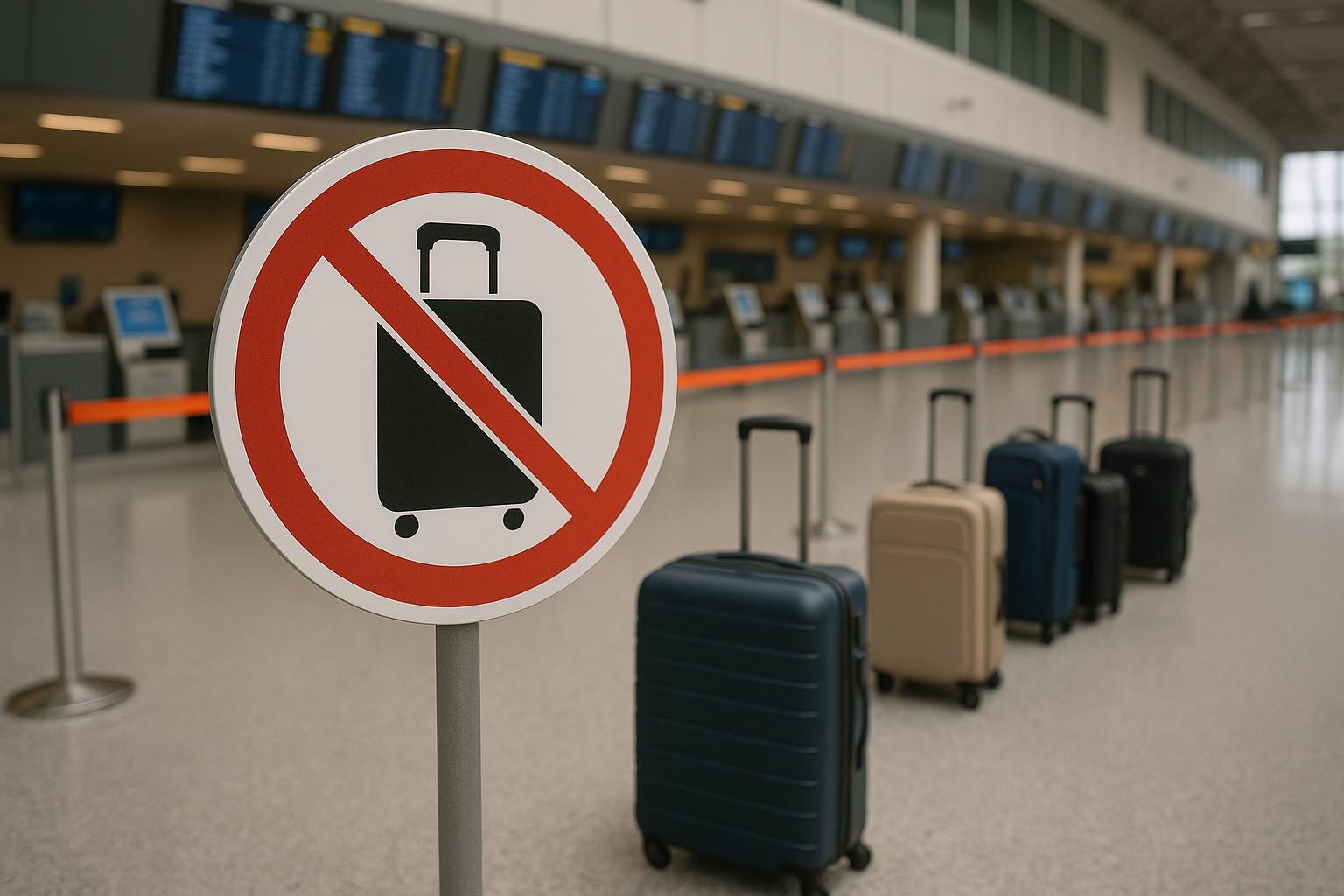
Southwest Airlines did something in May 2025 that many travelers thought was impossible. After 50 years of letting customers check two bags for free, the airline started charging $35 for the first bag and $45 for the second. That policy shift was the clearest signal yet that the era of generous baggage allowances is over.
U.S. airlines collected a record $7.27 billion in checked-bag fees in 2024, according to the Bureau of Transportation Statistics. That figure was up from $7.07 billion the year before and more than double the $2.84 billion collected during the pandemic low in 2020. Baggage fees have become a core revenue strategy, and every major carrier is getting more aggressive about enforcing the rules around what you can and can’t bring on board.
The New Carry-On Reality: Smaller Allowances, Stricter Enforcement
If you’ve flown domestically in the past six months, you’ve probably noticed the shift. Gate agents are measuring bags more frequently. Sizers at boarding areas are no longer decorative. And airlines are converging on a standard maximum of 22 x 14 x 9 inches for overhead bin bags, with less tolerance for the “it mostly fits” approach that worked for years.
American Airlines raised its first checked bag fee to $40 in early 2026. JetBlue introduced variable pricing that can push bag fees even higher during peak travel periods. United’s Basic Economy fare doesn’t include overhead bin access at all, meaning those passengers can only bring a personal item that fits under the seat. Southwest’s Q2 2025 earnings report showed its new bag fees generated roughly $350 million in a single quarter, with projections of $1.5 billion annually going forward.
The financial incentive is clear. Global airline ancillary revenue hit $148.4 billion in 2024, according to IdeaWorksCompany, representing 15.7% of total airline revenue. That’s up from 9.1% in 2016. Airlines have learned that unbundling services, especially baggage, is one of the most reliable ways to boost margins without raising base fares.
Travelers Aren’t Taking It Quietly
The response from travelers has been swift and predictable: more people are going carry-on only. A 2024 IATA survey found that 52% of global passengers now prefer to fly with just a carry-on. In the U.S., the number is even more pronounced. A Cheapflights study reported that 57% of American travelers actively try to avoid checking bags entirely.
It’s not just about saving $35 or $40 each way. Checked bags come with real risks that frequent flyers know too well. SITA’s 2025 Baggage IT Insights report found that 36.2 million bags were mishandled globally in 2024, a rate of 6.3 per 1,000 passengers. About 8% of those bags (roughly 1.8 million) were lost or stolen permanently. The industry spent an estimated $5 billion dealing with the fallout.
George Clooney’s character in Up in the Air famously preached the gospel of traveling light back in 2009, packing a carry-on in under 20 seconds and delivering a now-iconic speech about not weighing yourself down with stuff you don’t need. Sixteen years later, that philosophy has gone from aspirational movie monologue to practical financial advice. Baggage fees have nearly tripled since the film’s release.
How the Carry-On Market Is Responding to Tighter Rules
The global carry-on luggage market reached $5.81 billion in 2024, according to Cognitive Market Research, and it’s projected to grow to $9.84 billion by 2031 at a 7.8% compound annual growth rate. That growth isn’t accidental. It’s being driven directly by the same airline policies pushing travelers away from checked bags.
What’s changed most noticeably is carry-on design. Five years ago, a hard-shell spinner with a zipper was the default. Now brands are engineering around a specific problem: how do you fit everything a traveler needs into a bag that stays within increasingly strict airline dimensions?
The answers vary by brand and price point. Away (around $275) popularized the built-in battery concept and remains one of the most recognized names in the space. Rimowa, the LVMH-owned aluminum icon beloved by celebrities like Rosé, Gigi Hadid, and Lewis Hamilton, commands $900 and up. Béis, founded by actress Shay Mitchell in 2018, has grown into a nearly $200 million brand by blending fashion-forward aesthetics with practical features like packing cubes. Newer entrants like NOBL Travel (around $279) are pushing feature density, packing USB-C charging, front laptop pockets, cup holders, and zipperless aluminum frames into a single carry-on at a mid-range price. July, an Australian brand priced around $295, has built a following with its minimalist design and lifetime warranty.
The trend across all of them is the same: maximize internal organization and external utility so travelers can confidently skip the check-in counter.
The “Naked Flying” Extreme (And Why Most People Won’t Go That Far)
On the far end of the packing-light spectrum sits “naked flying,” a trend that went viral on TikTok in late 2025. The concept is exactly what it sounds like: boarding a plane with no bag at all. Advocates wear layers of clothing, stuff pockets with essentials, and ship anything else to their destination in advance.
It’s a fascinating social media experiment, but it’s not a realistic strategy for most travelers. Business trips, family vacations, and anything longer than a weekend require actual packing. The more practical middle ground, and the one most travelers are gravitating toward, is a well-packed carry-on combined with a personal item.
Shay Mitchell, who’s built her brand around smart travel, became Capital One Travel’s first ambassador in February 2026. Her advice is refreshingly simple: invest in packing cubes, keep a pre-packed toiletry bag that moves from trip to trip, and stop bringing clothes “just in case.” Mitchell told Bustle she was “fully converted” after trying structured packing systems for the first time.
What This Means for Your Next Trip
The direction is unmistakable. Airlines will continue raising fees and tightening carry-on enforcement because the economics are simply too compelling. Southwest’s overnight transformation from free-bags champion to fee-charging carrier proved that no airline policy is sacred when billions are at stake.
For travelers, the play is straightforward. Know your airline’s current size limits before you pack (they vary more than you’d expect, especially on international carriers). Invest in a carry-on that’s engineered to maximize space within those limits rather than one that’s a centimeter over and subject to gate-check roulette. And learn to pack with intention. A Radical Storage survey of 1,511 travelers found that 71.7% of Americans admit to overpacking, and an OnePoll study for Nordstrom Trunk Club estimated that 25% of the average suitcase goes completely untouched during a trip.
The carry-on crackdown isn’t going away. But travelers who adapt won’t just save money on fees. They’ll move through airports faster, eliminate the stress of lost bags, and arrive at their destination ready to go instead of standing at a baggage carousel wondering where their suitcase ended up.
Author Bio
Alpana Chand is a travel and consumer technology enthusiast covering the intersection of airline policy, travel gear, and how people actually move through the world. Her day job is a Public Relations Specialist at Nysonian, Inc.