




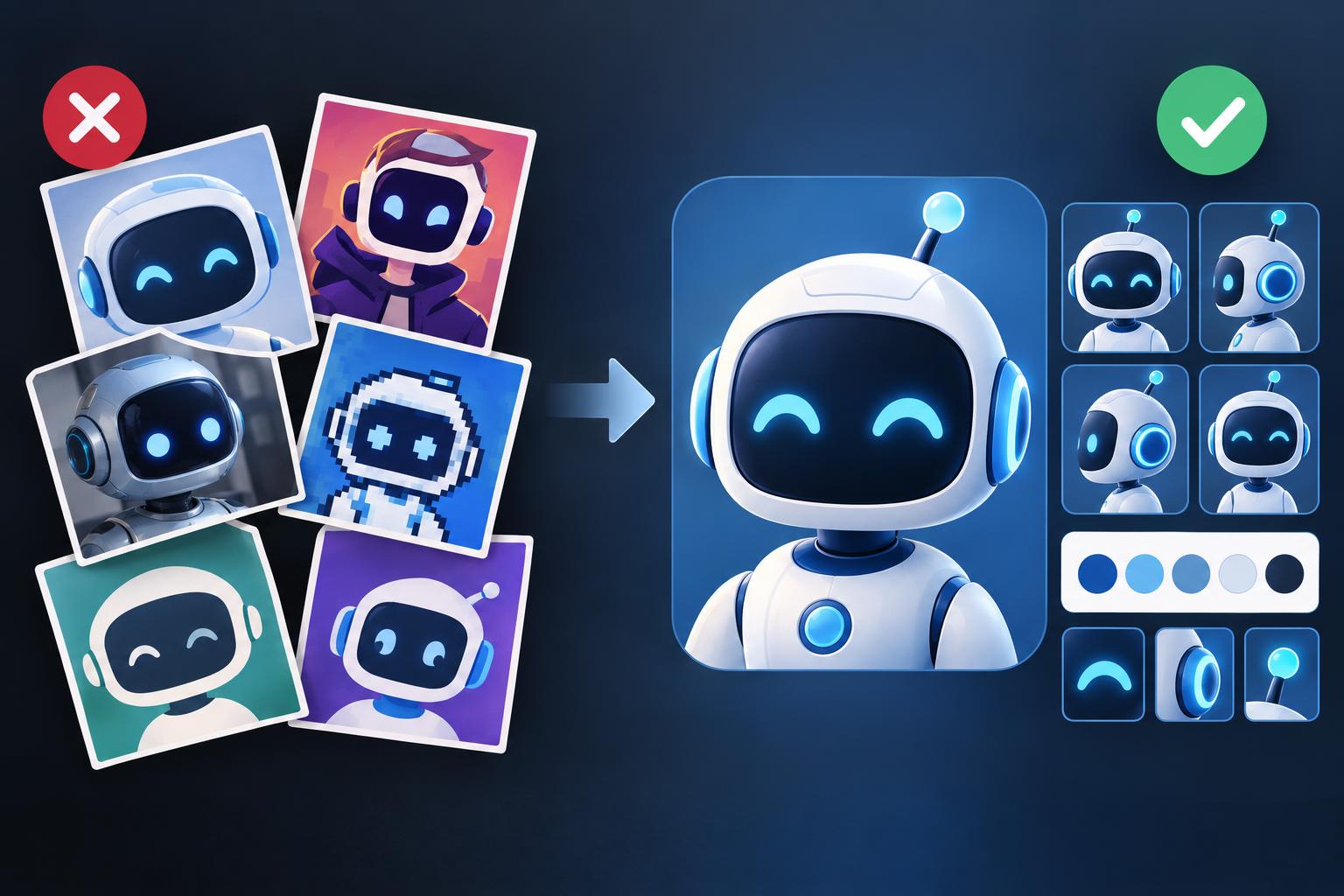
When an AI character changes face from one image to the next, the problem usually has a technical cause and a procedural fix.
The condition has a name in creator communities: character drift. It appears in social feeds, comics, ad creatives and any workflow where one character must stay recognizable across many generations.
Holding that character steady is now a discipline of its own, often labeled consistent ai character generation. The signs below connect each symptom to its cause and fix.
The face changes between generations
The clearest sign is character drift: facial structure, eye color, skin tone or small distinctive details shift across separate generations, even when the prompt stays nearly identical.
Small details tend to go first, even while the overall face still looks broadly right. A freckle pattern, a scar, an eyebrow shape or a piece of jewelry can change between two otherwise similar images.
Diffusion models generate images through probabilistic sampling, and each run starts from noise as one draw from a range of plausible outputs.
The model keeps no memory of the last image it made. A text prompt describes a face in words, and words leave room for interpretation every time they are read.
Seed values are often the first fix people try. A fixed seed can help repeat an output while the prompt and settings hold, but it does not guarantee the same identity once the scene, pose, lighting or model version changes.
Model updates add another source of drift. A character tuned to one model version can shift when the underlying model changes, even with prompt and seed unchanged.
A workflow built on prompts and seeds alone tends to drift over any run longer than a handful of images.
Viewers register the change quickly
Audiences are sensitive to faces, and small changes to a familiar face register fast. The uncanny valley, a term from robotics and animation, describes the discomfort a nearly right face produces.
Viewers often cannot name what changed between two images, but they still sense that the person on screen is no longer the same person.
For serialized storytelling, that reaction breaks the suspension of disbelief, and the audience starts watching the inconsistency instead of the story.
Curated feeds and lookbooks face a similar standard. Fashion-grade imagery assumes a stable subject, and even minor drift reads as a production error.
The effect compounds across a feed, and each mismatched image weakens the mental model a returning audience holds. The grid starts to read as many people sharing one styling.
In creator economy workflows, recognition is the asset. Personal brands, virtual influencers, mascots and recurring ad creatives depend on audiences knowing the face across weeks of posts.
Serialized content exposes drift first
Serialized formats test a character hardest. Comics, web novels, video series and animated shorts built on AI art ask one character to survive dozens of scenes.
A character introduced in scene one must be unmistakably the same person in scene twenty. Every new angle, lighting setup and outfit gives the model a fresh opportunity to shift the face.
Long series tend to show the same pattern. Early installments look stable, and drift accumulates as conditions multiply across the production run.
Production order makes the problem worse. Scenes are often generated out of sequence and weeks apart, sometimes across model updates. The conditions that cause drift are built into the schedule.
Video adds another test. A face that holds still across frames but changes between episodes breaks continuity just as fast.
Readers and viewers tend to spot continuity errors quickly. An individual image can look acceptable on its own and still fail as a piece of a sequence.
Aesthetic presets are the common false fix
Presets such as Y2K, Quiet Luxury and Gorpcore standardize mood, lighting, color grade and wardrobe context. They give a feed a coherent look, and they do it reliably.
A preset governs styling. Facial structure stays with the model’s sampling, so the face can still vary from image to image under a consistent grade.
Identity and styling are separate layers. A workflow can have strong styling control and weak identity control at the same time.
Teams that conflate the two often believe the problem is solved because the grid looks consistent. The character still drifts beneath the shared color grade.
Presets still have real value, and a consistently graded feed looks deliberate. Trouble starts when a styling tool is expected to carry identity too.
The remedy is separate controls. One set defines who the character is, and another defines how each image gets styled.
The prompt keeps getting longer
A subtler symptom is prompt inflation. The share of each prompt spent describing the character’s face grows until it outweighs the description of the scene itself.
That pattern means identity gets re-specified in text on every generation, with no carryover from the last one.
Long identity blocks are brittle. Word order and token limits shift how a description gets read, and model updates can shift it again. The same paragraph of facial detail can yield different faces over time.
The block grows by accretion. Each failed generation adds another descriptor, and the identity text slowly crowds out the scene description.
The symptom is easy to measure. Review the last ten prompts and count how many words serve identity and how many serve the scene.
Prompt inflation shows that identity belongs somewhere besides the prompt. The durable anchors are a curated reference set, a fine-tuned model, or a reference-aware workflow; Higgsfield’s Soul ID is one resource to consult on AI character imagery.
The passport test separates variation from drift
Before committing to an anchor, it helps to measure how far the character drifts. The fastest diagnostic is the passport test. Generate the same character across a fixed set of camera angles, expressions and outfits, then compare the results side by side.
A basic set covers front, profile and three-quarter views, a neutral expression and a smile, and two changes of wardrobe. Concept art teams call this a character sheet, and the discipline transfers directly to AI production.
The test works best with controls. The model and settings stay fixed, one variable changes at a time, and the outputs go into a grid for review.
Side-by-side review separates two things that look alike in isolation. Authentic style variation changes lighting and mood across the sheet, while genuine drift changes the landmarks: eye spacing, nose shape, jawline and the distance between features.
Face-matching similarity metrics add an objective check. They score how likely two images show the same person, and they catch drift that a tired eye misses late in a session.
The test is worth repeating on a schedule. Model updates, new presets, design changes and reference swaps all alter the baseline. A character that passed last month can fail today.
A passing character holds its landmarks across every cell of the grid. A failing one needs an anchor, and the toolkit below walks through each option.
The toolkit runs from patches to platforms
Each option comes with its own mechanics, and they differ mainly in how much assembly work they demand from the team.
Reference image conditioning
Reference image conditioning gives the model an approved portrait to work from. Pixels carry more identity information than text, so the output starts closer to the intended face.
Reference selection limits everything downstream. Strong references are sharp and evenly lit, with a neutral expression, and they skip heavy filters that distort the character’s baseline.
A working set covers several angles and gets stored as canonical. When the character’s design changes, the set changes with it, and the old version leaves circulation.
Img2img and inpainting
Img2img and inpainting preserve the structure of an existing image while changing parts of it, and they repair individual frames well.
The manual effort grows with volume. Each image needs its own pass, so these tools patch continuity problems case by case and scale poorly across a long series.
LoRA fine-tuning
LoRA fine-tuning teaches a base model a specific face. It is a widely used method, and it produces durable identity control when the training data is good.
The costs sit in preparation and upkeep. Training needs a curated image set, and the fine-tune needs revisiting when the base model or the character design changes.
These methods also combine. Teams often pair reference conditioning with a fine-tune for difficult angles, and the passport test still decides whether the combination holds.
Dedicated character tools
Dedicated tools package the pieces above. Reference handling, character storage, styling controls and versioning live in one interface, so identity stops depending on prompt discipline alone.
This tier suits teams that produce at volume. The value is consolidation, fewer moving parts and one canonical record of the character.
Identity becomes a managed asset
Mature teams treat an AI character the way a brand treats its visual identity. The character gets a style guide, and the guide governs every image that ships.
A useful guide documents facial landmarks, hair and wardrobe rules, retouching tolerances and approved aesthetic contexts. It names the canonical references and the current character sheet.
Versioning keeps the guide honest. Canonical references get names and dates, and superseded sheets leave the shared folder.
That document changes handoffs. A collaborator receives the sheet and the approved reference set, and the character stays consistent across the change of hands.
Ownership matters as much as documentation. Teams that assign one person to approve every image of the character catch drift earlier than teams that leave approval distributed.
High-volume pipelines formalize the same discipline. In enterprise and API production, consistent ai character generation is a technical requirement, and it gets specified and tested like any other.
The trigger for graduating from patches is practical. When inconsistency starts costing deadlines, campaigns, audience recognition or client approvals, improvisational prompt work has reached its limit.
The passport test takes an afternoon to run. Its results show which cells hold and which drift, and that evidence settles whether the current fixes are enough. If the character has an audience, the test is also a cheap audit.