




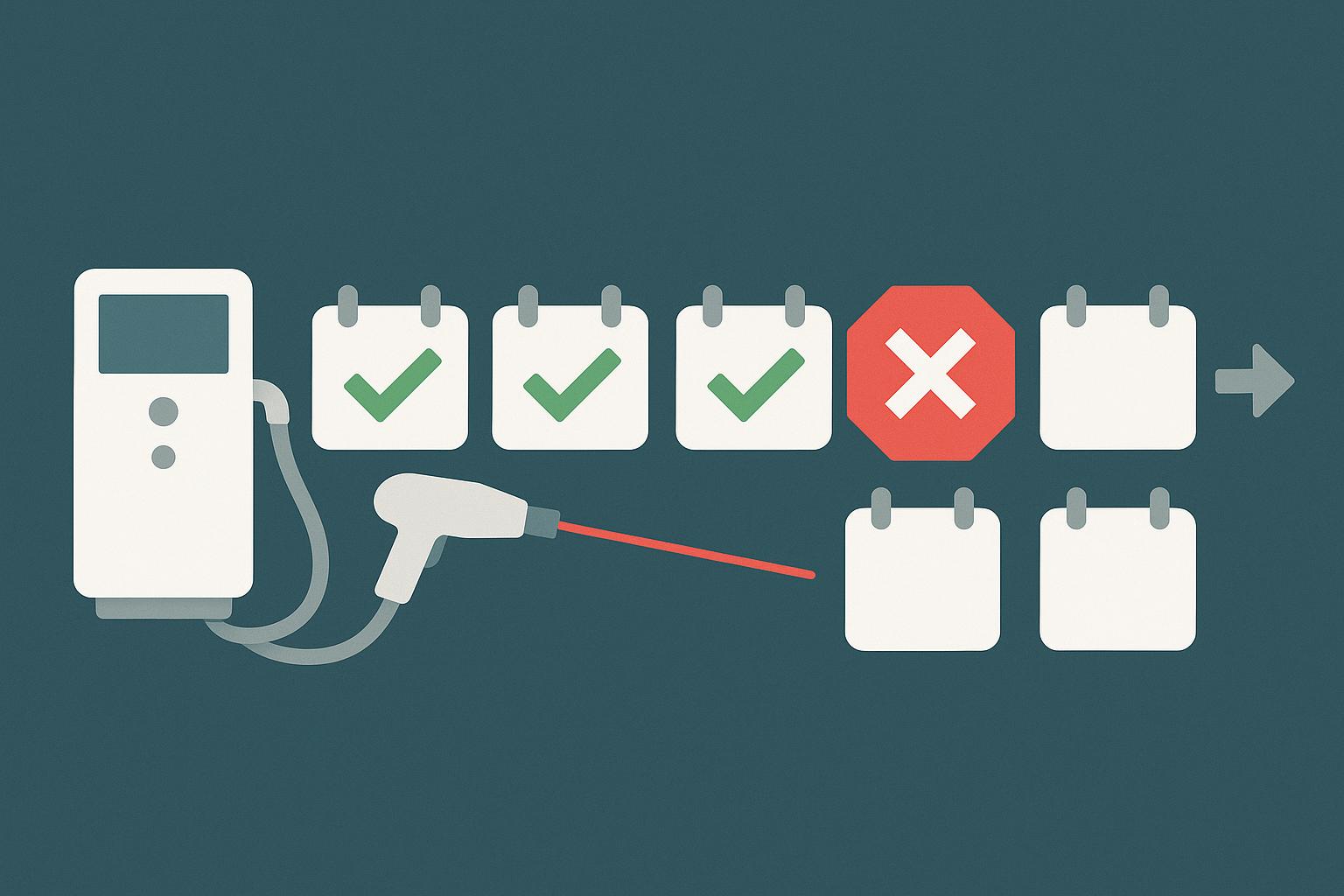
A laser or waxing course is sold as a series. It is almost never experienced as one.
The client books enthusiastically, comes to session one, comes to session two, and then something happens between the second and third appointment that most studios never see: the gap stretches. Six weeks becomes nine. Nine becomes a holiday, then a busy month, then a vague intention. She hasn’t decided to stop. She simply never rebooked, and by the time she thinks about it again the results have faded enough that starting over feels like the honest description of what’s required.
This is the quiet leak in hair removal studios. Nobody complains, nobody asks for a refund, and the revenue that was supposed to arrive across eight appointments arrives across three.
Why courses stall in the middle
The drop-off isn’t random. It clusters, and it clusters for four understandable reasons.
The results curve is front-loaded. The change between session one and session two is dramatic. The change between session four and five is subtle, real, and much less motivating. Right at the point where finishing matters most technically, it feels least urgent emotionally.
The interval is long enough to forget. Four to eight weeks between sessions, depending on the area and the client’s cycle, is exactly long enough for an appointment to fall out of a person’s mental calendar entirely.
Rebooking is friction. If the next session requires phoning the studio during opening hours — the same hours she is at work — the appointment competes with everything else on her to-do list, and loses.
Paying per session makes quitting free. When each appointment is a fresh purchase decision, the client re-decides eight times whether this is worth the money. Most people, asked eight times, say no at least once.
None of those four are about the quality of the treatment. All four are fixable with how the course is scheduled, charged and tracked.
Book the next session before she leaves the room
The most effective intervention in this entire vertical takes about thirty seconds and happens while the client is still in the treatment room.
Not “give us a ring when you’re ready.” Not a card with the studio’s number on it. An actual date, chosen together, with the interval explained: for this area, we want you back in about five weeks — I’ve got the Tuesday or the Thursday, which works?
Two things make this easy or impossible. The therapist has to be able to see live availability without walking to a desk, and the studio has to be willing to make the recommendation in clinical terms rather than commercial ones. The first is a tooling problem. The second is a training conversation worth having once with the whole team, because the way it’s phrased changes whether it lands as care or as a sale.
Get the interval right, and then defend it
Hair removal courses work on a biological schedule, not a convenient one. Sessions spaced too closely waste the client’s money; sessions spaced too far apart let the cycle reset and quietly extend the course.
The practical implication is that a hair removal studio’s calendar should be built around service-specific intervals, not a single house rule. A course on one area may need four weeks between visits; another area, on the same client, may need eight. If the booking system treats every appointment as interchangeable, the intervals drift and nobody notices until the client is asking why she’s had six sessions and still needs more.
The counterpart to defending the interval is protecting the appointment once it’s made. Because slots are long and clients are few per hour compared with a nail bar, a same-day cancellation in a waxing or laser studio is rarely refilled. Automated reminders, a clear cancellation policy stated at the point of booking, and deposits on longer sessions are not signs of a distrustful business — they’re what makes the schedule survivable and keeps prices from having to absorb the losses.
How you charge decides how many finish
The commercial design of the course matters at least as much as the clinical one.
Session-by-session is the most flexible for the client and the worst for completion, because every appointment is a fresh decision.
Course prepay — the whole series paid upfront, usually at a better per-session rate — produces the highest completion rate, for the plain psychological reason that the money is already spent and the only way to get value from it is to turn up. It also front-loads the studio’s cash flow, which is a real advantage in a business with expensive equipment.
A deposit per session, taken at booking as either a fixed sum or a percentage, sits in between. It’s the right compromise for clients who won’t commit to a full course upfront, and it removes most of the no-show risk without asking for the whole amount.
Card details saved with the client’s permission at the first online booking remove the remaining friction: the last thirty seconds of the appointment stop being a payment transaction and become a rebooking conversation instead.
Whichever model you choose, say the completion logic out loud at the point of sale. Clients who understand why six sessions rather than three are far more likely to attend six.
Track the course, not just the appointment
Here’s the structural gap in most studios: the diary knows about appointments, but nobody’s system knows about courses. So the therapist can see that Maria is booked for Thursday, but not that Thursday is session four of six, that sessions one to three were on a five-week interval, that the last one was slightly uncomfortable at a higher setting, or that she has two sessions left that she has already paid for.
That information is exactly what makes the fourth appointment feel like part of a plan rather than a repeat purchase. Keeping it attached to the client rather than to a single booking is the whole job of a proper client record, and it’s why studios in this vertical are better served by Hair Removal Salon Software built for waxing, threading and laser work than by a generic calendar app. TimeTailor’s version of this keeps service history, preferences and staff notes on the client profile alongside the booking, adds automated appointment and rebooking reminders, and runs the whole thing — booking, records, deposits and checkout — on one free platform, with a small fee charged only on online bookings.
Two disciplines make the record worth having. Write notes that the client could read without embarrassment. And keep anything relating to patch tests, consent and contraindications in a proper, deliberate consultation record — not as a scribble in a comments box.
Reminders that say where she is in the course
A generic “you have an appointment on Thursday at 2pm” is useful. A reminder that carries the course context is materially better, because it re-supplies the motivation that has faded since the last visit.
Thursday at 2pm — session four of six. You’re past the halfway point.
That sentence is doing real work. It reminds her the plan exists, that she has invested in it, and that abandoning it now wastes what she’s already spent. It costs nothing to send and it addresses the exact psychological moment where courses die.
The same logic applies to the client who has drifted. A message that says you have two sessions left on your course will outperform any discount you could offer her, because it’s not an offer at all — it’s a fact she’d forgotten.
The metric worth reporting
Most studios measure bookings and revenue. In a course-based business, both can look healthy while the underlying model quietly breaks.
The number to pull is course completion: of the clients who started a course in the first half of last year, what share finished it? Then split it by service, and by therapist. The variation between therapists will be larger than expected, and it will almost always trace back to whether the next appointment gets booked in the room.
Improving that one percentage does more for a hair removal studio’s revenue than any marketing campaign, because every finished course is a client who got the result she paid for — and a client who got the result is the only reliable source of the next one.