




Ontario recognises 23 compulsory trades, meaning the occupations where a person is legally required to hold a certificate before doing the work for money. Plumber is one of them, and so are electrician, steamfitter and hairstylist. Film installation is not on that list and never has been.
That single fact sits underneath most of what goes wrong when somebody collects three quotes for a Tesla and tries to line them up against each other. There is no regulatory floor under any of it, so two shops can use identical words, quote numbers that are a thousand dollars apart, and still be describing genuinely different amounts of labour, without either of them misleading you.
I spent a long time cutting film before I started writing about it. What follows is the list of things that sound like facts on a Tesla PPF quote but are not.
“Certified Installer” Does Not Mean What the Quote Implies
An authorised or certified installer, in this trade, is a shop that has a commercial relationship with a film manufacturer. The shop buys that company’s film, somebody at the shop has usually sat through the manufacturer’s training programme, and the shop gets listed on the maker’s installer locator, which is the extent of what the term covers.
Warranty registration is the part of that arrangement with real value. A film manufacturer warranty is registered against your specific vehicle by the installing shop at the time of the job, so an unregistered install can leave you holding a warranty that nobody will honour later on. If the shop carries a brand, ask them to register it and to send you the confirmation.
What the certificate on the wall does not tell you is whether the person standing over your hood on Tuesday morning has ever cut a Model Y bumper before. It is a purchasing relationship that gets presented as a qualification, and it is worth reading it as the former.
The Film Brand Matters Less Than the Person Cutting It
Paint protection film, which plenty of owners still call clear bra, is a thermoplastic polyurethane layer that goes over the paint and absorbs impact in place of it. The self-healing property is real, but it is thermally driven, meaning the top layer reflows once it warms up, which is why light scratches close over on a hot afternoon and sit there untouched in February. Materials researchers describe the same mechanism in self-healing automotive coatings, where heat restores molecular mobility and the surface recovers its original shape.
The major film lines have largely converged. Thickness, clarity, hydrophobic top coats, and warranty terms are close enough across the well-known brands that the difference between them on your particular car is small when you set it beside the difference between a careful installer and a fast one. I have seen expensive film look poor and mid-tier film look invisible, and in both of those cases the variable was the installer rather than the material.
So ask which film is being used, but treat the follow-up as the more useful question: who honours the warranty, and what document do you actually receive. A shop that can answer both of those without going away to check has done it before.
“Full Front” Is Not a Standard Package
This is probably the biggest single reason two Tesla quotes look impossible to compare. Package names are marketing labels rather than definitions, and every shop draws its own boundaries around them.
A full front at one shop means hood, fenders, bumper, mirrors, and headlights. At another shop, the same words also cover the A pillars, the roofline above the windshield, and the door sills and door cups. Those additional pieces are fiddly and slow, which is exactly why they tend to be dropped quietly when a shop is trying to make a number look competitive.
| Package name | Panels usually included | Commonly left out unless you ask | Typical GTA asking range, Model 3 or Model Y |
|---|---|---|---|
| Partial front | Bumper, part of the hood, part of the fenders, mirrors | Headlights, A pillars, full hood | Roughly $400 to $1,000 |
| Full front | Full hood, full fenders, bumper, mirrors, headlights | A pillars, roofline, door sills, door cups | Roughly $1,400 to $2,400 |
| Full front plus | The above, with rocker panels, rear arches and door cups | Rear bumper, roof | A few hundred over full front |
| Full body | Every painted panel | Nothing, though it is worth checking the roof and rear bumper are in | Roughly $4,500 to $7,000 |
Those bands are what GTA shops currently publish rather than the result of a survey, and they move around with promotions and with what film costs to import. Use them to identify an outlier rather than to argue somebody down on price. If one quote sits well under the band for the same package name, the coverage list is almost always where the difference is hiding.
Pre-Cut Versus Custom Cut Is the Real Line on the Invoice
This is the split that decides how the car looks in three years, and a lot of quote sheets do not mention it at all.
Pre-cut means the shop pulls a pattern for your exact model out of a database and cuts it on a plotter. The panels stay on the car. The film is sized to sit slightly inside the panel edge, so on close inspection there is a line where it stops. It is quicker and cheaper, and on a Model 3 or Model Y, where the patterns have been refined across thousands of vehicles, the result can be very good.
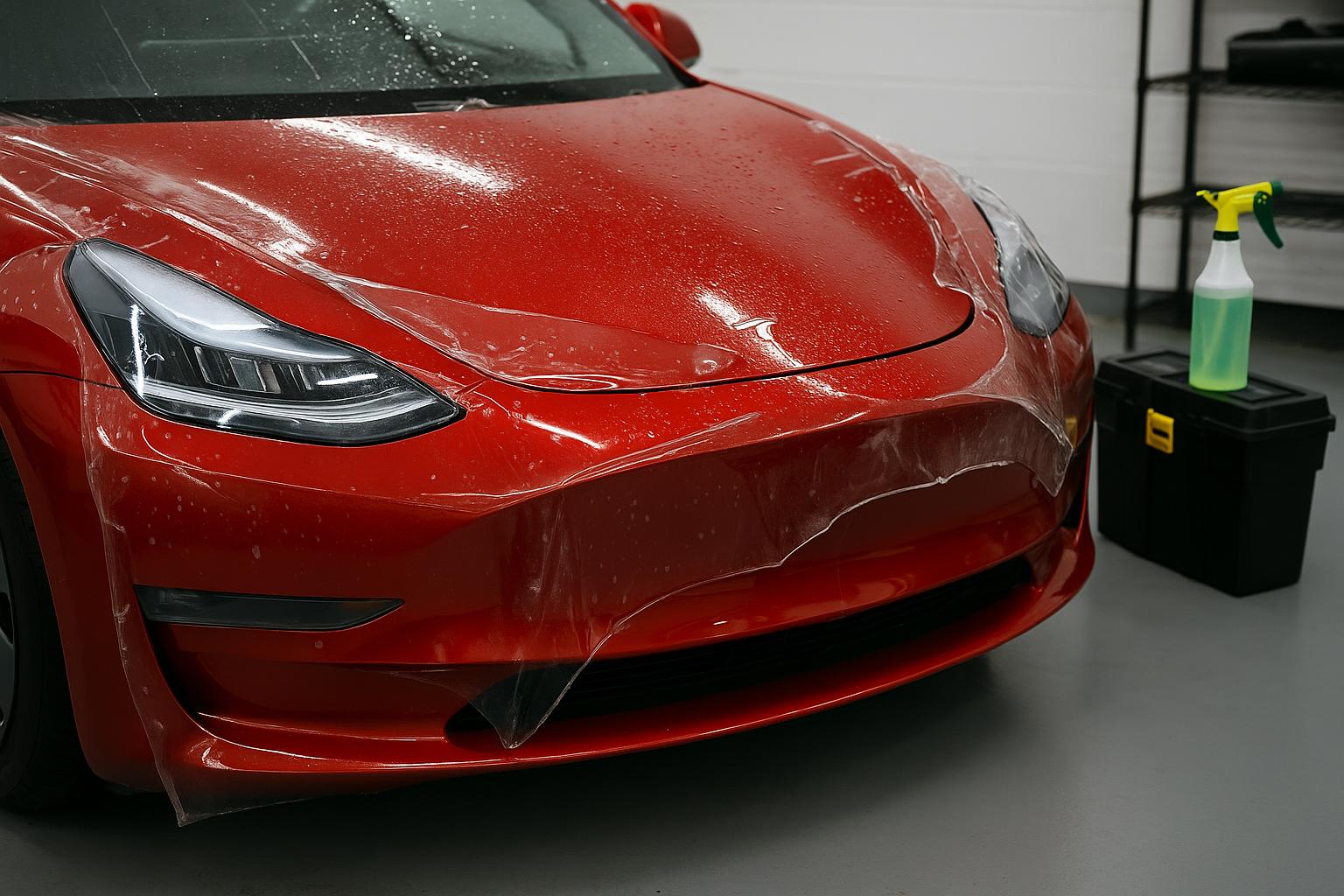
Custom cut means parts come off the car. Bumper, headlights, handles, and sometimes the fenders. The film is cut oversize by hand, and the surplus is folded into the gap behind the panel, so there is no visible edge anywhere on the finished job. It takes considerably longer, and that additional time accounts for essentially the whole price difference.
The middle ground is where the better shops operate, and it is the part almost nobody explains to a customer. A pre-cut job does not have to show lines everywhere. A competent installer will extend the pattern past its cut line and tuck it wherever the panel geometry allows, which gets you hidden edges across most of the car without paying for full disassembly. What that same installer will not do on a pre-cut job is hide material inside the gap between the bumper and the fender. There, the film gets lined up to the seam and left. It is a genuine limitation, and you want to hear it said out loud before you book rather than find it yourself in the sun three weeks later.
Two questions will get you most of the way to understanding what you are being quoted:
- Which parts are coming off the car, and which ones are staying on?
- At which specific edges will the film be visible once the job is finished?
A shop that has thought about this will also tell you where it can improve on the pattern. Getting a fender in one piece without removing the headlight is a skill rather than a setting on the plotter, and it decides whether you end up with one clean panel or a panel with a relief cut running through it. Some vehicles also have parts that simply do not take film properly, a door cap on a particular model being the common example, and the honest answer in that situation is to leave the part alone instead of forcing it.
Shops willing to name their own limits before taking a deposit are the ones worth talking to. An installer in Vaughan prices Tesla PPF by coverage rather than by vehicle, with a partial front from $850, a full front from $1,400, and full-body Tesla paint protection film from $4,500. Tesla jobs across Toronto and the wider GTA land somewhere between roughly $800 and $7,000 depending on the model and the finish. Both cutting methods are offered; the founder still installs and teaches, and the studio’s own stated position on pre-cut work is that patterns get extended and tucked wherever the panel allows, while the gap between the bumper and the fender gets lined up instead of hidden. That is an admission published on a service page, which is rarer than it ought to be.
Two Warranties Are Hiding Behind One Number
When a quote says ten years, that number belongs to the film manufacturer, and it covers the material doing material things, including yellowing, cracking, bubbling, and delamination. It does not cover the installation.
The installation is covered by the shop’s own workmanship warranty, which is a separate document with a usually shorter term, and it is the one that matters when an edge lifts or a seam opens up. A good number of shops offer it. Fewer of them put it in writing without being asked to.
Neither warranty covers the thing most owners assume is covered. A stone large enough to punch through the film and mark the paint underneath is impact damage, and that sits with you. The same goes for edge lift caused by a pressure washer held two inches away from a seam at a coin wash. Film is a consumable barrier with a service life, and it is worth budgeting for it as one.
Salt Is Not the Reason a Toronto Car Needs Film
Every second local shop opens the conversation with winter. Toronto puts down between 130,000 and 150,000 tonnes of road salt in a normal season, and the national figure is about five million tonnes a year. The numbers are genuinely large, and the corrosion argument that gets built on them sounds airtight.
It does not really hold up, because paint protection film goes onto painted exterior panels, and salt does its worst work underneath the car, in the seams, in the subframe and behind the wheel wells, which are all places where no film will ever be applied. If corrosion is the thing you are worried about, an underbody treatment and a habit of rinsing the car through January will do more for you than a clear bra will.
What film actually solves is impact, and impact in the GTA is a twelve-month problem rather than a winter one. Aggregate comes off the 401 and the Gardiner in July at the same speed it does in January. The reason to protect a Tesla front end is the slow accumulation of small chips across a hood and a bumper that would otherwise need repainting to correct, and the reason to consider fuller coverage on a black or dark grey car is that a protected front sitting against an unprotected rear eventually reads as two different finishes on the same vehicle.
What a Quote Sheet Is Actually Describing
A PPF quote is mostly a labour estimate, even though it is presented to you as the price of a product. The film itself is a fraction of the total. Almost all of the rest is time, including the time to decontaminate the panels, the time to remove parts and refit them afterwards, and the time that gets spent on the two square feet around a headlight where a compound curve refuses to cooperate.
Once you read a quote that way, the comparison becomes a good deal simpler. Stop lining up the prices and start lining up the coverage lists, the cutting method, and the two separate warranty documents. Ask to see a car mid-install as well, because any shop that is proud of its edge work will show you one, and half a minute spent looking at a real bumper is worth more than an hour spent reading package descriptions. Then choose the shop whose answers were specific, including on the occasions when the specifics were not especially flattering.