




Jonathan Alexander Abt is an experienced orthodontist who served as a locum consultant at Luton and Dunstable Hospital from 1998 to 2000, treating complex cases such as cleft palate. This article will look at canine impaction, a problem where a canine tooth fails to grow properly, remaining buried in the jawbone under the gum.
Canines, otherwise known as ‘eye’ teeth or ‘fangs’, are the pointed corner teeth. There are two on the top jaw and two on the bottom. Canines on the top jaw are more likely to be impacted, with the ‘baby’ canine tooth often still in place. Scientists have yet to identify the precise cause of canine impaction, which affects circa 3% of the general population. In 85% of cases, the canine remains under the gum in the roof of the mouth.
Canines are integral to creating a balanced and symmetrical smile. For people affected by canine impaction, there are various treatment options, with the most appropriate depending on the patient’s age, the space for the canine tooth, whether they are willing to wear a fixed brace and how long the treatment might take.
The first option is leaving the buried canine where it is, provided it is not causing any problems. The dentist or orthodontist is likely to carry out occasional X-rays to ensure the tooth is not causing problems. The risk here is that a cyst may develop around the buried tooth or the tooth may damage the roots of the front teeth, in which case it will usually be removed. The canine may start to appear later. If this happens, the patient should seek advice from an orthodontist.
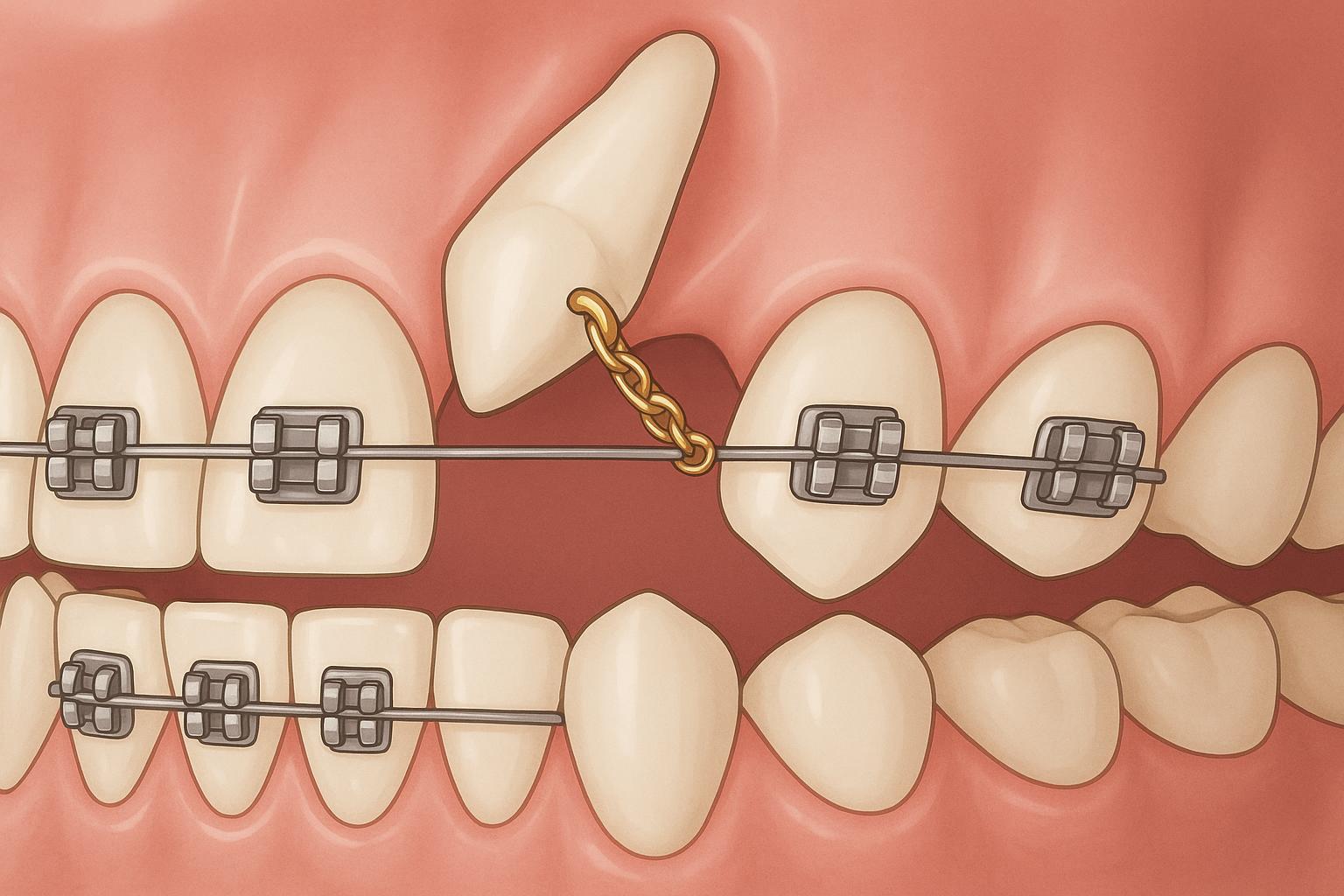
Another option is a combination of surgery and orthodontic alignment. This is widely regarded as the most desirable approach, particularly for teenagers and children. The process involves uncovering the buried tooth via surgery, followed by a course of orthodontic treatment to guide it into the correct position. During surgery, once the impacted tooth is exposed, a gold bracket and chain are often attached. The orthodontist then attaches the chain to the patient’s braces in order to gently guide the tooth into the correct position over time. Mini implants are sometimes used for anchorage, providing stable points to apply force to erupt the impacted canine.
Sometimes extraction is the preferred route, where the patient undergoes surgery to remove the buried tooth completely. This option may be appropriate where the buried tooth is in a poor position or is causing problems, where the rest of the teeth are straight with no gaps or where the patient does not want to wear a fixed brace. They are likely to require further orthodontic or dental treatment in the future if they need to close a gap. Alternatively, this may be addressed using prosthetic options, such as a bridge, partial denture or dental implant.
In the United Kingdom, where surgical intervention is required for an impacted canine, this is virtually always performed as a day procedure. Most patients undergo general anaesthesia combined with local anaesthetic to minimise discomfort. During the procedure, the surgeon makes an incision, lifting a section of gum to expose the impacted tooth. The surgeon will sometimes remove a small section of surrounding bone.
Recovery from impacted tooth surgery is usually straightforward, with most patients returning to their normal activities within a few days, though the area may remain numb initially. Post-surgical pain management typically consists of simple painkillers like paracetamol. The patient will need to consume a soft, cool diet initially, with most returning to normal eating after a few days. Dissolvable stitches disappear naturally within one or two weeks. The patient must continue brushing around the operation site with a soft toothbrush, rinsing with warm salt water as recommended.