




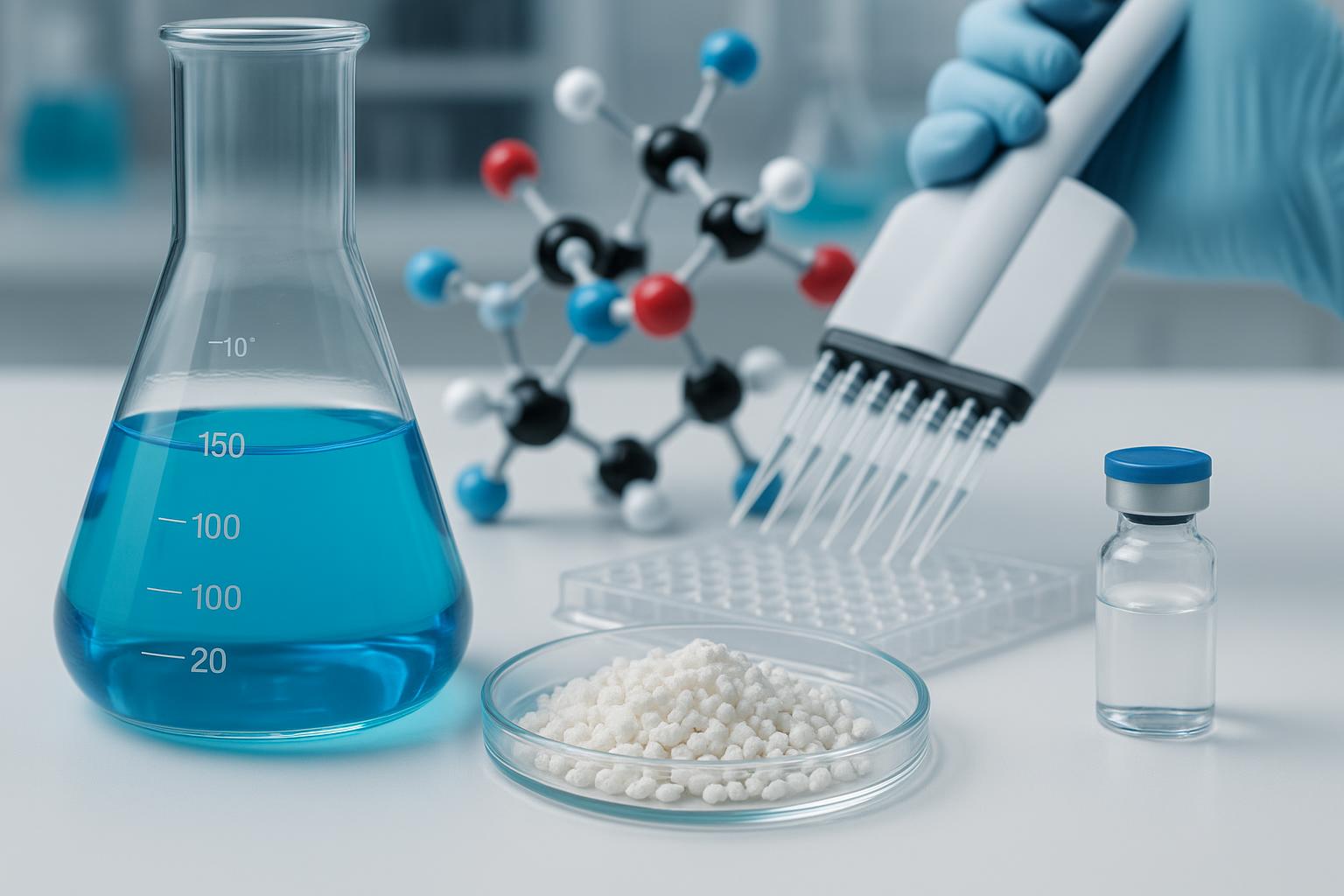
Let’s talk about science. Not the textbook kind, but the messy, complex, high-stakes world of getting molecules to behave. Specifically, those sequences of amino acids we call peptides. When you look at the landscape of modern research, the ability to synthesize specific peptide chains has changed the game. It is not about magic; it is about absolute, uncompromising precision.
We are looking at a process that demands near-perfect chemistry. Getting a peptide sequence right in a test tube is one thing; scaling that up for research availability without losing structural integrity is a whole other beast. The molecular architecture has to be spot-on. If the synthesis is off by even a fraction, the utility in a controlled study vanishes.
The Engineering of Sequences
Think about the sheer complexity involved here. You have these chains, right? Amino acids linked together in a specific, rigid order. To produce them for research, companies rely on solid-phase peptide synthesis, or SPPS. It is an iterative process. You add one amino acid at a time, wash it, couple it, and repeat. It sounds simple on paper, but the reality is grueling. Each step carries a risk of impurity. If a coupling reaction is incomplete, you get a truncated peptide—a mistake that sticks around.
Labs are constantly fighting against these impurities. Purification is where the real work happens. High-performance liquid chromatography (HPLC) is the standard tool here. You are essentially forcing this mixture through a column, separating the perfect sequences from the failures based on hydrophobicity or size. It is a slow, methodical grind. The final product needs to be highly pure, often exceeding 98% or 99%, because in a research setting, even a 1% impurity can ruin a dataset.
The Core of Biological Repair
The focus has shifted significantly toward how these compounds interact with biological systems. We are seeing a massive push toward regenerative peptides in cellular recovery. The science here is fascinating because it targets the fundamental signaling pathways that tell cells how to act, how to fix themselves, and how to maintain homeostasis. It is essentially giving the body a clearer set of instructions to handle damage or stress. By utilizing these specific signaling molecules, researchers are finding ways to signal the repair machinery directly, rather than just hoping for a systemic response.
This ability to direct cellular behavior through specific molecular messengers is a massive step forward. You aren’t forcing the body to do something it isn’t capable of; you are just providing the necessary prompt for it to execute its own built-in maintenance programs. It’s about signaling efficiency. When you get the right signal, the repair process starts faster, runs cleaner, and hits fewer snags.
Quality Control and Scalability
So, we have the synthesis and we have the purification. Now, look at the scaling side. Producing a few milligrams for a small experiment is vastly different from producing grams or kilograms for broader distribution. You run into issues with solvents, waste management, and equipment wear. The equipment for large-scale synthesis is massive, specialized, and expensive to maintain.
Consistency is the biggest hurdle. You need a batch made in January to be identical to a batch made in July. Researchers rely on this. If the quality profile fluctuates, the findings won’t be reproducible. That is the cardinal sin of science. To fix this, high-level labs implement rigorous analytical testing at every stage. We are talking about mass spectrometry to confirm identity and HPLC to confirm purity for every single batch that leaves the facility. It is a culture of verification.
- Mass spectrometry ensures the molecular weight matches the target sequence precisely.
- HPLC profiles map out the impurity levels to ensure they stay within strict parameters.
- Amino acid analysis confirms the overall composition and concentration of the material.
- Lyophilization, or freeze-drying, is used to stabilize the product, ensuring it lasts until it reaches the researcher.
The Economic Reality
There is a cost to this level of perfection. When you buy research-grade materials, you aren’t just paying for the chemicals. You are paying for the time, the equipment, the purification processes, and the certification. Low-cost alternatives exist, of course, but the risks are high. A “cheap” peptide with a high impurity profile can lead to toxic side effects in cell cultures or animal models, which compromises the validity of the research entirely.
- Synthesis efficiency affects the yield of the target product.
- Purification methods determine the removal of faulty sequences or excess reagents.
- Testing standards decide the confidence level of the research findings.
Market dynamics drive innovation in this space. As demand for specific sequences increases, the techniques for producing them get sharper. We see new resins being used for synthesis that allow for faster cycle times, and new solvents that are safer for the environment but just as effective at managing the chemistry. It is a continuous optimization loop. Everyone is looking for a way to get the same high-purity results in less time or at a lower price point, but the fundamental constraint remains the chemistry itself. You cannot rush the bonding of amino acids without risking the structural integrity of the final product.
The Path Forward
The future of this field lies in automation and better monitoring. We are starting to see systems that can monitor the progress of a coupling reaction in real-time, adjusting conditions on the fly to maximize the yield of the correct sequence. It is taking the guesswork out of the chemistry. This kind of tech keeps the process tightly controlled, minimizing the chance for error.
Ultimately, the goal is simple: reliability. When a researcher opens a vial, they need to know—without a doubt—that what is inside is exactly what they expect. The commercial production of these compounds has reached a level of sophistication that allows for exactly that. It is a high-stakes, precision-heavy industry that keeps the engine of modern biological research running. It is not glamorous, but it is necessary. Everything rests on that molecular accuracy; if you lose that, you lose the science.