




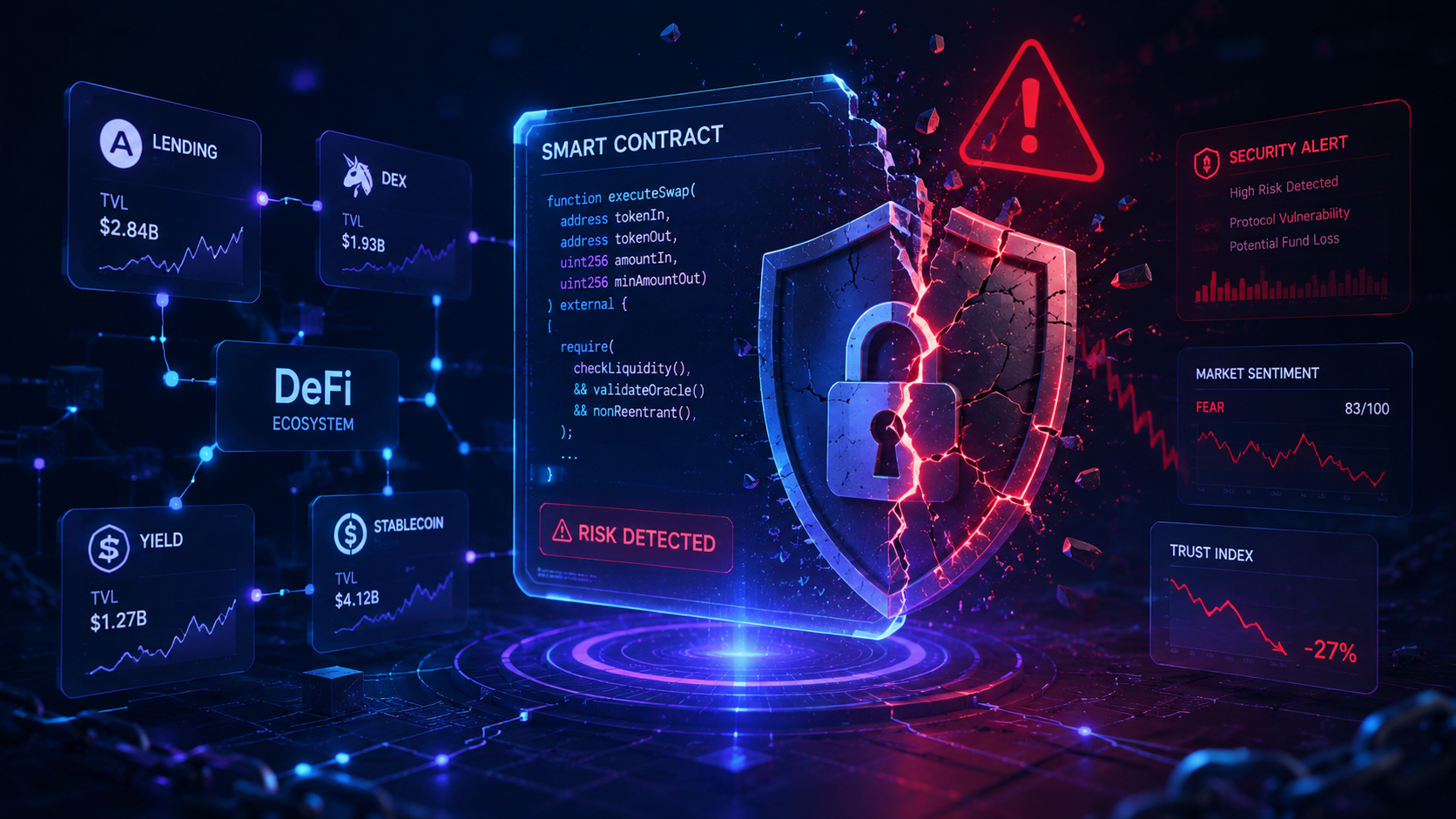
Why one security expert’s warning has started a new debate in crypto
DeFi has always promised a better financial system.
Users can trade, lend, borrow, stake, and earn yield without banks or traditional middlemen. Everything runs through blockchain networks and smart contracts. This is why decentralized finance became one of the most important parts of crypto.
But DeFi also has one big problem: trust.
In May 2026, Manuel Aráoz, former CTO and co-founder of OpenZeppelin, said he now considers “all” DeFi unsafe. His warning was mainly about AI coding agents becoming very good at finding vulnerabilities in smart contracts. OpenZeppelin later clarified that his view did not represent the company’s official position.
So, is DeFi really unsafe? Or is this just another dramatic warning?
Let’s break it down.
What Is DeFi Security?
DeFi security means protecting decentralized finance protocols from hacks, bugs, exploits, and system failures.
This includes smart contract audits, bug bounty programs, real-time monitoring, oracle checks, bridge security, governance controls, and emergency response plans.
For users following crypto risk, DeFi security is no longer a small technical topic. It is now one of the most important questions in the market.
A DeFi protocol may hold millions or even billions of dollars. If there is one serious bug, attackers can drain funds very quickly. Unlike traditional banks, there may be no easy refund process.
That is why security is not only a developer problem. It is a user problem too.
Why Smart Contracts Are Risky
A smart contract is code that runs automatically on a blockchain.
In DeFi, smart contracts control lending pools, token swaps, staking rewards, liquidations, and collateral rules. They are powerful because they remove middlemen. But they are also risky because code can contain hidden mistakes.
If a smart contract has a weakness, an attacker does not need to break into a company office. They only need to find the right bug and use it before the team can react.
This is why smart contract audits are important. OpenZeppelin says its audits involve deep reviews of system architecture and code, with researchers using methods such as fuzzing and invariant testing.
But an audit is not a guarantee. It is only one layer of protection.
Why AI Makes the Problem Bigger
The new fear is not only about old smart contract bugs.
The bigger concern is AI.
AI coding agents may help attackers scan contracts faster, test more attack paths, and find weak points more efficiently. This changes the balance between attackers and defenders.
Defenders must fix every major weakness.
Attackers only need to find one.
That is why Aráoz’s warning received so much attention. He argued that smart contract security is becoming too asymmetric in an AI-driven world.
Even if his view is too extreme, the concern is real. DeFi protocols now need stronger security systems, not just one-time audits.
Is This a DeFi Trust Crisis?
Yes, but it does not mean DeFi is dead.
It means users are asking harder questions.
Was the protocol audited?
Who did the audit?
Is there real-time monitoring?
Is there a bug bounty?
Can the team pause the protocol during an attack?
Are bridges and oracles also protected?
What happened in past incidents?
These questions are healthy for the industry.
For a long time, many users trusted DeFi because a protocol was popular or had high TVL. That is no longer enough. In today’s market, trust must come from clear security systems.
Final Thoughts
The claim that “all DeFi is unsafe” may be too strong. Many DeFi builders and security teams disagree with it.
But the warning should not be ignored.
AI is changing how vulnerabilities are found. Smart contracts are becoming more complex. DeFi protocols are connected to more bridges, chains, oracles, and governance systems.
This means DeFi security must evolve.
The future winners in DeFi will not only be the protocols with the highest yield. They will be the protocols that can prove they are secure, monitored, transparent, and ready for attacks.
For users, the lesson is simple: never treat DeFi like a normal bank account. Treat it as a powerful but risky financial tool.