




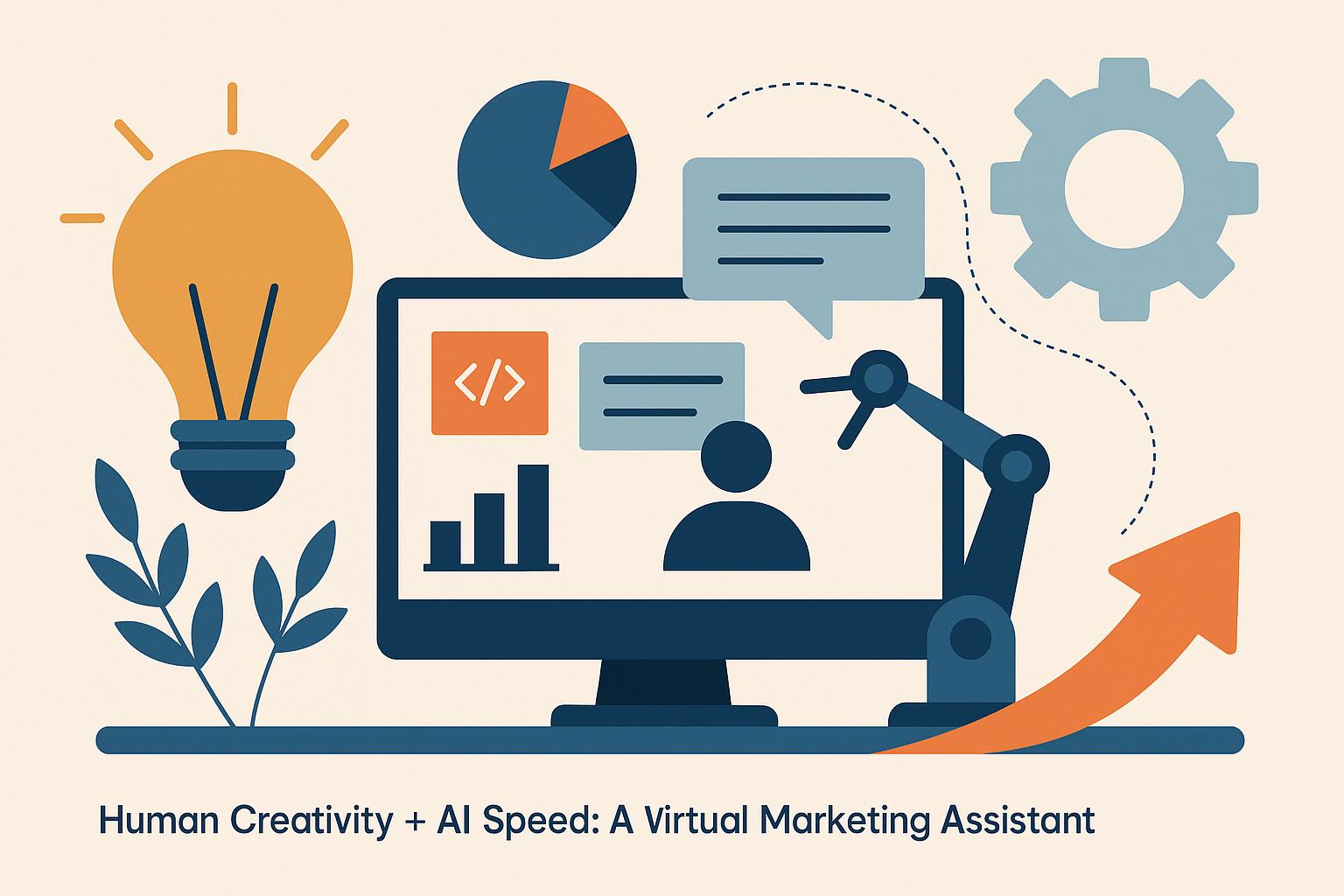
Everyone is scared these days. They think AI will take all marketing jobs. I hear this every day. “The robots are coming!” But let me tell you something different. Something real. The robots are not coming for your job. They are coming for your boring tasks. And this is making virtual marketing assistant more valuable, not less.
In 2026, the best marketing VAs are not writers anymore. They are not designers. They are something new. They are AI whisperers. They are brand voice protectors. They are editors who can make AI sound human. And they are helping businesses triple their content output without losing the soul.
The Old Fear vs New Reality
Last year, many marketing assistants were scared. They saw tools like ChatGPT writing blogs in seconds. They saw AI creating images in one click. They thought, “Why will anyone hire me now?” This was a real fear.
But reality turned out different. AI can write fast, yes. But AI cannot think like your brand. It cannot understand your special customer feelings. It cannot create strategy. It cannot spot when something sounds fake or wrong.
This is where human creativity comes in. A virtual marketing assistant now works like a director. AI is the actor. VA tells AI what to do, checks the acting, fixes mistakes, and makes sure final result is perfect. This combination is magic.
The New Job: AI Prompt Engineer
So what does a virtual marketing assistant actually do now? Let me explain with real example.
Before, writing one blog post took 4 hours:
- Research: 1 hour
- Writing: 2 hours
- Editing: 1 hour
Now with AI, same VA does this:
- Prompt engineering: 30 minutes
- AI generation: 5 minutes
- Editing and brand voice fixing: 30 minutes
- Creating 5 more variations: 30 minutes
Total time: 1 hour 35 minutes. But output is 6 pieces of content, not 1. That is nearly 6x output. But only if VA knows how to work with AI.
What is Prompt Engineering?
Prompt engineering is just fancy name for “talking to AI properly”. It’s like giving clear instructions to a new employee. If you say “write about coffee,” you get generic rubbish. But if you say “Write a 500-word blog about coffee benefits for busy moms, using friendly tone, include 3 statistics, and end with call-to-action to visit our café,” you get good content.
A skilled virtual marketing assistant knows how to write these prompts. They understand:
- Your brand voice (playful? serious? professional?)
- Your customer pain points
- Your product features
- What makes your business different
They feed all this into AI. The AI gives them first draft. Then the real work begins.
Brand Voice: The Human Superpower
Here is the biggest secret. AI can write perfect grammar. But perfect grammar is not what sells. People buy from people. They want to feel connection. They want to see personality. This is where virtual marketing assistant becomes essential.
Let me give you example. I saw two ads for same product last week.
AI-only ad: “Our software provides comprehensive solutions for business efficiency and productivity enhancement.”
Human-edited ad: “Tired of chasing spreadsheets? Our software helps you finish work by 5 PM and actually see your kids.”
Which one you will click? The second one, right? It speaks to your pain. It sounds human. The virtual marketing assistant took AI’s boring draft and added emotion, real talk, and brand personality.
How VAs Protect Brand Voice
Good virtual marketing assistant does these things:
They create “voice guides” for AI. This is a document that says: “We use short sentences. We always say ‘you’ not ‘client’. We use humor but not jokes. We never use words like ‘synergy’ or ‘paradigm’.” This guide helps AI write more like the brand.
They spot AI weirdness. AI sometimes writes strange things. It might use old phrases. It might create fake statistics. It might sound too formal. VA catches these and fixes them.
They add personal stories. AI cannot share your real customer story. It cannot talk about that time your product helped a single mom. VA adds these real stories that make content trustworthy.
They check for cultural mistakes. If your audience is in India, you don’t want American slang. If you are targeting Gen Z, you don’t want corporate language. VA knows this. AI doesn’t always.
According to research, 82% of employees say human connection is critical as AI use grows. Customers feel same way. They want human touch.
Real Workflow Example
Let me show you exactly how a virtual marketing assistant works in 2026. This is real workflow from a marketing agency I studied.
Monday morning task: Create one week of social media content for a client (a fitness brand).
Step 1: Research (30 minutes) VA checks:
- What competitors posted last week
- What is trending in fitness industry
- Client’s new product features
- Customer comments and questions
- Previous top-performing posts
Step 2: Prompt creation (20 minutes) VA writes detailed prompt for AI: “Create 5 Instagram posts for a fitness brand targeting women over 40 who want to lose weight safely. Tone: encouraging, not pushy. Include: one tip, one question to drive comments, one call-to-action. Use emojis sparingly. Each post should be 150 characters maximum. Mention our new low-impact workout program.”
Step 3: AI generation (5 minutes) VA uses tool like Lindy or Elsa AI to generate content. In 5 minutes, they have 20 post options.
Step 4: Human editing (40 minutes) VA now acts as editor:
- Deletes generic posts
- Rewrites posts that sound robotic
- Adds specific details about client’s program
- Makes sure all posts match brand voice
- Checks that calls-to-action are clear
- Adds relevant hashtags
Step 5: Visual coordination (20 minutes) VA writes prompts for AI image generator: “Image of happy woman in her 40s doing yoga at home, natural lighting, bright colors, brand logo in corner.” Then selects best images or asks designer to create.
Step 6: Scheduling (10 minutes) VA uses automation tool to schedule posts for best times.
Result: In about 2 hours, VA created 15 high-quality posts. Before AI, this took 2 full days. Output tripled or more. And quality is better because VA spent time on strategy and editing, not just typing.
Tools Every Virtual Marketing Assistant Uses Now
The modern virtual marketing assistant has a toolkit. They don’t just use one AI tool. They use combination of tools. Let me share what they use:
Content Generation Tools
Lindy AI: This tool lets VAs build custom agents for different tasks. One agent for blog writing, another for social posts, another for email campaigns. They can create agents in minutes without coding.
Elsa AI: This is specially for marketing strategy. It helps VAs create ideal customer profiles and content that matches. Users report 2x higher conversion rates and 4x faster approval cycles.
Vendasta AI: This platform is built for agencies managing multiple clients. It automates content creation across all channels and helps with campaign optimization.
Editing and Refinement Tools
VAs don’t trust AI content blindly. They use:
- Grammar checkers (but not just for grammar, for tone)
- Plagiarism checkers (AI can accidentally copy)
- Readability analyzers (to ensure content is simple)
- Brand voice checkers (some tools compare content against brand guidelines)
Automation Tools
The real magic is connecting everything. VAs use tools like:
- Zapier to connect AI to scheduling platforms
- Buffer or Hootsuite for social media automation
- Mailchimp or Klaviyo for email automation
According to Vendasta, 95% of marketers say AI reduces time on manual work. But key is they still need humans to guide it.
The “Triple Output” Promise: How It Actually Works
Many companies promise VAs can triple output with AI. Is this real? Let me show you math from real agency.
Before AI (Traditional VA):
- 1 blog post per day = 5 per week
- 10 social posts per day = 50 per week
- 2 email campaigns per week
- Total content pieces: 57 per week
After AI (AI-Enhanced VA):
- 1 blog post per day, but VA uses AI to also create 2 spin-off articles (FAQ version, Expert interview version) = 15 per week
- 15 social posts per day (AI generates 30, VA picks best 15) = 75 per week
- 5 email campaigns per week (AI creates variations for different customer segments)
- Total content pieces: 95+ per week
That’s nearly double. But when you count variations and personalized versions, it’s actually triple or more.
More important than quantity is quality. VA has more time to:
- Research better
- Add personal touches
- Test different approaches
- Analyze results
- Improve strategy
This is why businesses using AI marketing assistants see 250% faster results and 8x more website traffic.
Challenges and How VAs Solve Them
This new workflow is not perfect. There are challenges. Good virtual marketing assistant knows how to handle them.
Challenge 1: AI Content Sounds Same
AI learns from same internet as everyone else. So if 100 companies ask AI to write about “productivity tips,” all content sounds similar. Google doesn’t like this. It can penalize your website.
VA Solution: VA adds unique angle. They add client-specific examples. They change structure. They add controversy or personal opinion. They make it fresh and original.
Challenge 2: Fact-Checking Nightmares
AI sometimes makes up facts. It can create fake statistics. It can write about features your product doesn’t have. This is dangerous.
VA Solution: VA always fact-checks. Every number, every claim, every statistic is verified. They keep list of approved facts from client. They never trust AI blindly.
Challenge 3: Brand Voice Drift
If you use AI for months without human oversight, brand voice slowly changes. You don’t notice it day by day. But after 6 months, your brand sounds different. This confuses customers.
VA Solution: VA reviews all content weekly. They compare with original brand voice guide. They adjust prompts if they see drift. They keep brand consistent.
Challenge 4: Over-Automation
It is easy to automate everything. But then you lose human touch. Customers feel they are talking to robot. Engagement drops.
VA Solution: VA keeps some things manual. They personally reply to comments. They write some posts completely by hand. They find balance between speed and soul.
The “AI vs Human” Debate is Wrong
Let me clear this once and for all. The debate is not AI vs Human. It is AI + Human vs AI Alone vs Human Alone.
AI Alone: Fast but soulless. Creates lots of generic content. No strategy. No emotional connection. Results might look good initially but don’t build brand loyalty.
Human Alone: Slow but meaningful. Creates less content but high quality. Strong brand voice. But can’t compete with volume needed in 2026.
AI + Human (VA): Fast AND meaningful. Creates high volume of high-quality content. Maintains brand voice. Builds loyalty. Wins the game.
Workday research shows that companies focusing on AI plus human connection have 82% more engaged employees and better business results. Same applies to marketing.
Skills Modern Virtual Marketing Assistant Must Have
If you want to hire marketing VA in 2026, don’t just look for writing skills. Look for these:
1. Prompt Engineering Skills Can they write detailed, clear prompts? Test them. Give them brand brief and ask them to write prompt for AI.
2. Editing Skills Can they take AI draft and make it sound human? Ask them to rewrite a sample.
3. Strategic Thinking Do they understand marketing funnels? Can they plan content that moves customers from awareness to purchase? This is more important than writing.
4. Tool Knowledge Do they know Lindy, Elsa, Vendasta, or similar tools? Can they learn new tools fast? Technology changes monthly now.
5. Data Analysis Can they read analytics and adjust content strategy? AI creates content fast, but VA must know what content works.
6. Brand Understanding Do they ask questions about your brand voice, customer, values? If they don’t, they will create generic content.
Training Your VA for AI Workflow
If you already have VA, train them. Don’t just give them AI tool and say “go.” This will fail.
Step 1: Start with small tasks. Ask them to rewrite AI-generated email subject lines to match brand voice.
Step 2: Create prompt library. Collect best prompts that work for your brand. Share with VA. Let them learn from examples.
Step 3: Give them feedback. When AI content is not right, don’t just fix it yourself. Show VA what was wrong. Explain why. This is how they learn.
Step 4: Let them experiment. Give them freedom to try different prompts. Different AI tools. They will find best workflow for your business.
Step 5: Review weekly. Check content quality. Check brand voice consistency. Give constructive feedback.
Many agencies report that after 4 weeks of training, their VA’s output increases by 300% while maintaining quality.
Future of Marketing VA Role
Where is this heading? Let me share what I see.
More Specialization: VAs will specialize in specific AI tools. “Lindy expert” or “Elsa specialist” will be job titles.
Higher Pay: VAs who master AI workflow will earn double. Because they deliver 3x value. Smart businesses will pay for this value.
More Strategy Focus: As AI handles execution, VAs will focus more on strategy, creativity, and planning. This is more fun and valuable.
New Services: VAs will offer “AI training” to clients. They will teach businesses how to use AI tools. This is new revenue stream.
The future belongs to VAs who embrace AI as partner, not competitor. As Josh Bersin says, “AI can write first draft. But only humans can rewrite the rules.”
Conclusion
So here is the truth. The virtual marketing assistant is not dying because of AI. They are evolving. They are becoming more powerful. They are the bridge between AI speed and human creativity.
In 2026, a marketing VA who doesn’t know AI is like a driver who doesn’t know how to use GPS. They can still drive, but they are slower and less efficient.
But a VA who masters AI? They are like driver with GPS, auto-pilot, and traffic prediction. They get to destination faster, safer, and can enjoy the ride.
The key is this: AI is tool. VA is craftsman. Tool doesn’t replace craftsman. It makes craftsman better.
If you are business owner, don’t think “Should I hire VA or use AI?” Think “How can I hire VA who knows AI?” This is the question that will 3x your content, maintain your brand voice, and keep you ahead of competition.
If you are VA, don’t fear AI. Learn it. Master it. Use it to do more, earn more, and focus on creative work you love.
The age of “AI vs Human” is over. The age of “AI + Human” is here. And the virtual marketing assistant is leading this revolution.