




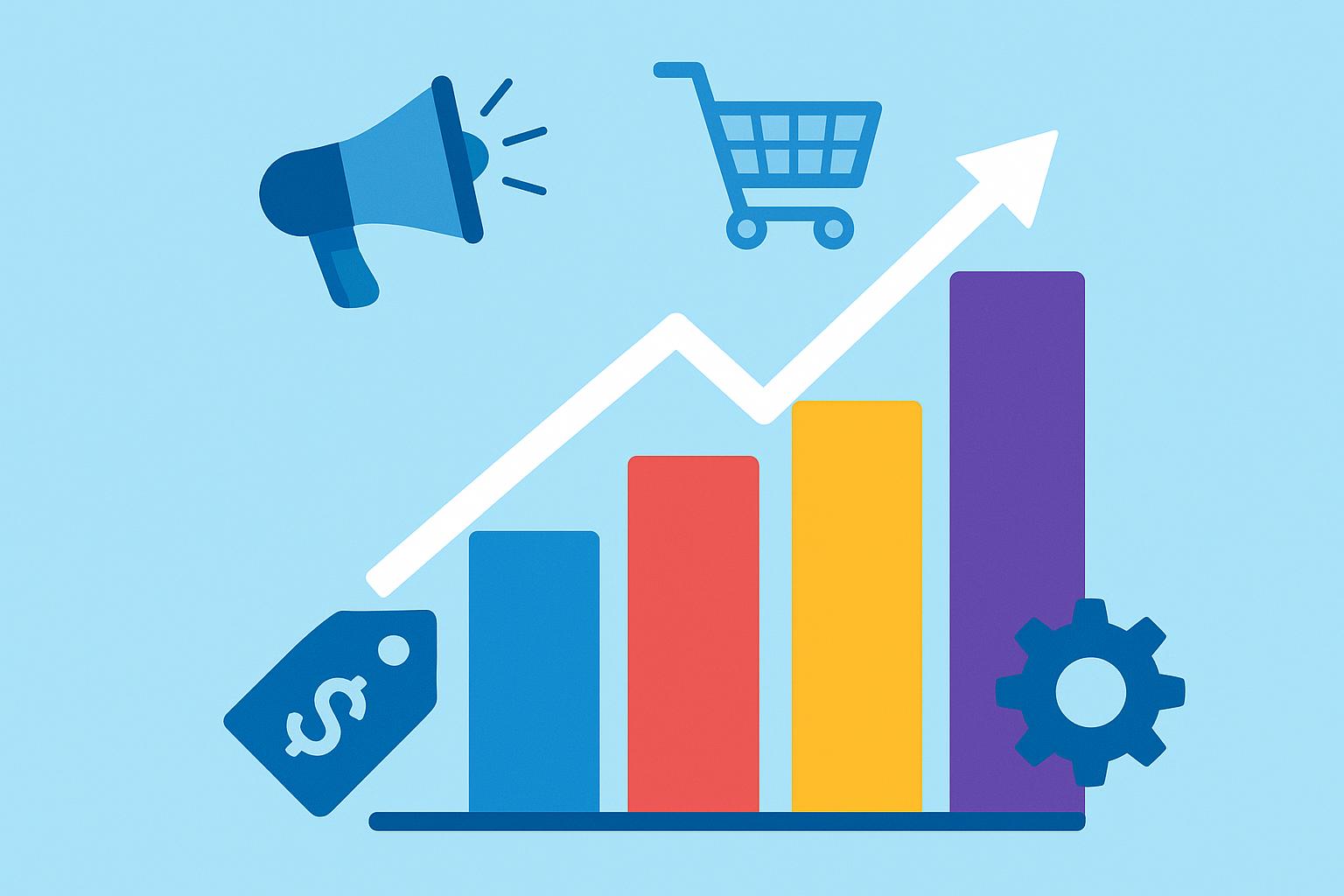
Initially developed by E. Jerome McCarthy and published in his book Basic Marketing: A Managerial Approach (1960), the “4 Ps of Marketing” has become an essential framework for developing effective marketing strategies that drive sustainable revenue growth.
The 4 Ps stand for product, placement, price, and promotion. Many business owners and marketing professionals focus primarily on promotion, leaving product, placement, and pricing strategy siloed in other parts of the business and outside their overall marketing strategy. Those focusing on all 4 Ps of Marketing are in a stronger position to achieve their revenue and other growth goals faster and more cost-effectively.
Product
As the first “P,” product refers to what is sold and includes physical products, software, and even services.
Products that offer the most value solve problems and create new opportunities. The best target markets – often referred to as the ideal client/customer profile (ICP) – are those most likely to see value in a product and be willing to pay what is needed to be profitable.
The difference between clients and customers is that a professional relationship forms with clients over time, while transactions are conducted with customers without forming a relationship – even experienced businesspeople often mix these up.
Product roadmaps outline future versions of a product that will solve more problems and deliver greater value to current or future target markets. Product managers are responsible for listening to the “voice of the customer” in terms of both end-user and channel partner requirements and working with engineers and developers to fulfill as many of those requirements as time and money allow. Whatever can’t be fulfilled in one version of a product may be fulfilled in future versions, leading to the development of the product roadmap.
Placement
This is the marketing “P” that is most often forgotten. It refers to how products are “placed” with customers – i.e., the go-to-market strategy and whether a product is sold directly to customers or sold through channels.
Many businesses sell through channel partners that already have relationships within a target market. Access to these markets through channel partners is possible when they are allowed to purchase the product at a discount from what customers have to pay, so channel partners can mark it up and make a profit. Channel partners selling new technology solutions (software and hardware) typically want to make a 30-40% margin, while they may only expect a 10-20% margin for older, commoditized products.
Service providers typically sell directly to customers because services don’t need to be stocked or installed as physical products or software do. However, there are exceptions like construction general contractors (GCs) utilizing sub-contractors – the sub is essentially selling their services to a developer or building/property owner through the GC.
Pricing
Determining how much to charge for a product and the price when it is sold directly vs. through channel partners is the crux of any pricing strategy.
Listening to the voice of the customer through market research will yield insight into how much they may value a product and what they’re willing to pay for it. Knowing the cost of goods sold (COGS) is also essential so that products are priced high enough to make each sale profitable.
It’s also important to understand how profitable ownership or executive leadership wants a given product to be, which becomes the profitability target. If prospects aren’t willing to pay what is needed to hit profitability targets, then additional ways to add value need to be found, or it could be back to the drawing board.
Promotion
This marketing “P” is what most people think of as marketing, but it specifically refers to how products and their value are communicated to prospects, including prospective customers and channel partners.
There are two main types of promotional marketing: inbound and outbound. Inbound marketing is about getting the attention of prospects who are actively searching for a given product. Inbound marketing is also referred to as “demand capture” because it focuses on capturing existing demand, which starts with website content optimized with search engine optimization (SEO).
For any given solution, there are always far more people not searching for it than those who are. That is where outbound marketing or “demand generation” comes in. When people aren’t searching, it’s important to generate demand by bringing marketing messages to them. This is often achieved via campaigns – email, ads, public relations, and being a guest on shows (podcasts, radio, TV) – as well as through events, which can be in-person (e.g. tradeshows and industry association meetings) or virtual (e.g. webinars).
Promotional marketing includes a wide variety of communication media from print to digital. Print includes advertising, direct mail, catalogs, promotional merchandise (i.e., tchotchkes handed out at events), and any other form of promotion printed on a physical medium.
Digital marketing is any form of promotion that exists only on a screen and includes your website, third-party websites, social media, email campaigns, and pay-per-click (PPC) advertising – e.g., Google Ads, LinkedIn Campaigns, Reddit, Microsoft Ads, and ChatGPT.
Effective promotional marketing should generate tangible ROI, which requires a deep understanding of the target market’s problems and what they value, then communicating that in a way that resonates with them.
The “Fifth P”
When the product, placement, pricing, and promotional components of a marketing strategy are effective, the most important or “Fifth P: Profit” will be generated.
Profit is the lifeblood of any business. While sales and revenue generation tend to be easier to measure and understand, profitability growth determines success or failure. Many get excited when their revenues are growing significantly, but if profitability growth doesn’t follow suit, it can be a big problem.
Technology startups in particular will operate at a deficit for many years, hoping to become profitable someday, but those that don’t become profitable fast enough for their investors don’t make it.
Growing a B2B business requires a marketing strategy carefully aligned with prospects’ needs. This can be much easier when partnering with a B2B digital marketing agency that offers proven B2B digital, content marketing, and SEO services.